
Tarrant County higher education leaders talk innovation, economy and strategies
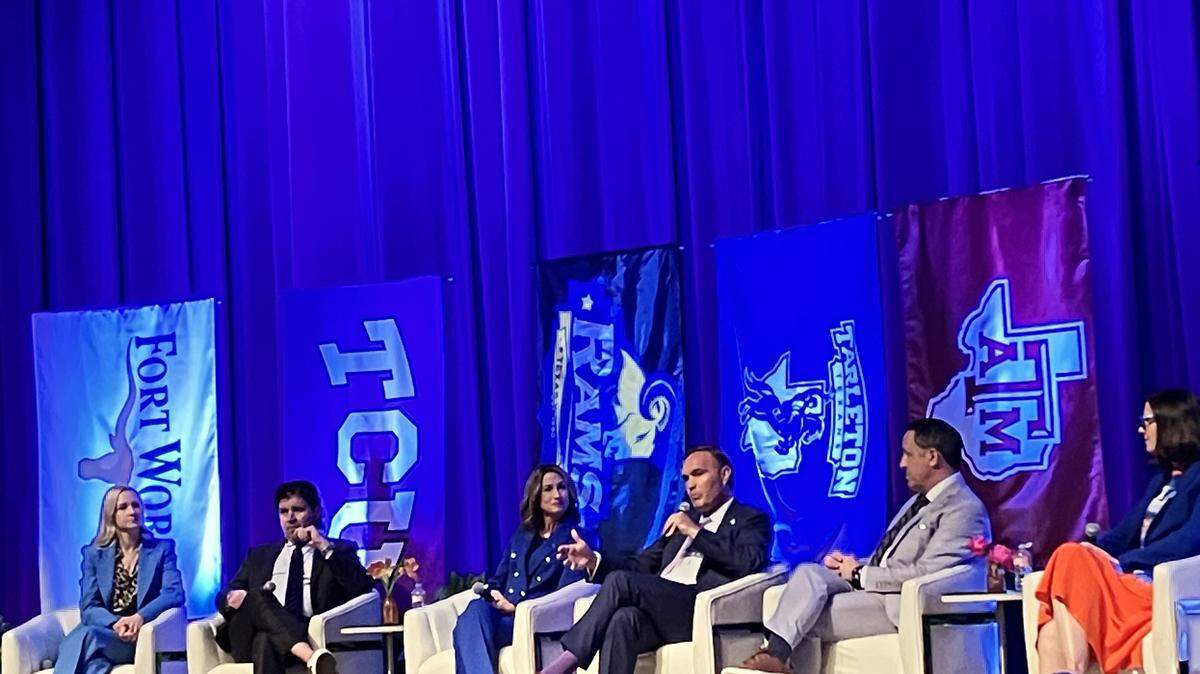
Against the backdrop of a population boom and an ever-evolving economic environment, leaders from Tarrant County’s higher education institutions said Monday they are unified in preparing a growing number of students to excel in tomorrow’s workplace.
Fort Worth Mayor Mattie Parker joined presidents and chancellors from six local universities and Tarrant County College in a Nov. 3 panel discussion at Fort Worth’s Bass Performance Hall centered around fueling innovation and economic vitality in the area.
The consensus was that it’s incumbent upon post-secondary institutions to develop the innovative thinkers Tarrant County companies are looking for, especially as the competition for the best and brightest young minds ramps up.
The panel was organized by TCU and Daniel Pullin, the university’s chancellor, said he looks to the local business community to help ensure the school’s academics align with what will most benefit student job seekers and the marketplace at-large.
Pullin went on to say that higher education leaders need to help students think creatively and dream bigger about what’s possible.
“If you think about what research is, it’s being able to ask questions that haven’t been (asked) but need to be,” said Pullin.
Pullin emphasized the importance of innovation at TCU. The university is working toward reaching “R1” status, a designation held by the top research institutions in the country.
Kirk Calhoun, president of the University of North Texas Health Science Center in Fort Worth, said being innovative also extends to how schools provide their curricula. For example, Calhoun questioned the age-old path to becoming a medical doctor and the time it takes to do so.
“Does it take eight years to produce a physician?” asked Calhoun. “I don’t think so.”
To that point, Tarleton State University President James Hurley said things have changed dramatically in recent years in terms of how students learn. He pointed to Tarleton’s hybrid course offerings, which combine online and in-person instruction. The reason for that shift was to meet students where they are, in terms of how they learn best, said Hurley.
Like Pullin, Hurley talked about pushing students to take thoughtful risks. That’s especially needed, he said, with lower income students, who often lean more toward the secure paths.
How higher education benefits the Tarrant County economy
Texas boasts the world’s eighth-largest economy, said Glenn Hegar, Texas A&M University system chancellor, and educational institutions play a big role in supporting that economy.
Parker said she regularly enlists higher education leaders to help pitch the city of Fort Worth to companies looking to establish a presence here, alluding to the value our local schools provide businesses in terms of innovation and human capital.
She also pointed out that roughly a quarter of Texas college students are enrolled in Dallas-Fort Worth area schools, which puts our region in a unique position to harness all of that brainpower. The state’s economic and technological growth, Parker argued, should start here. But it’s a challenge to keep that talent local when employers from other states and other parts of Texas are recruiting those students.
Texas Wesleyan University President Emily Messer said she’s focused on connecting students with Tarrant County business leaders to help them create a professional network that anchors them to this area. More than half the university’s students are first generation, meaning many come in lacking the kind of network that you often need to secure that first job out of college.
Messer also said Texas Wesleyan is adopting a new strategic plan that emphasizes career development in all courses, beginning with undergraduate courses.
University of Texas at Arlington President Jennier Cowley echoed that, saying her university is encouraging students to immerse themselves in the community.
Pullin said keeping students also comes down to making Tarrant County a place where students can thrive, something he said educational leaders have an obligation to do.
Tarrant County College Chancellor Elva LeBlanc talked about the wide array of programs offered on her campuses to meet the diverse needs of TCC students, the vast majority of whom work and care for families in addition to going to school.
Many of TCC’s programs focus on entrepreneurship, LeBlanc said, to develop more local business owners. There’s also been a recent push to train more TCC students in film and television production given the growing need for production crew members in and around Fort Worth.
As the panel discussion wound down, the participants talked about ways to minimize and eliminate the hurdles students face when deciding whether to attend college.
Calhoun identified cost as a big hurdle for many students, and he said the UNT Health Science Center is constantly evaluating its tuition and fees.
Cowley talked about the UTA’s decision to offer free tuition to Texas students whose families earn less than $100,000 a year. Likewise, Pullin pointed to TCU’s recent move to cover tuition for in-state students whose families earn less than $70,000.
Hegar talked about providing multiple pathways for students to make higher education more attainable. He said the sole focus shouldn’t be on steering high school graduates to four-year institutions, but that students should understand that community colleges and trade programs are similarly valuable vehicles for getting them where they want to go.
The big takeaway was that it’s critical that schools get more students in post-secondary classrooms, for the benefit of the students, the broader community and the local economy.