North Texas is second-worst area in U.S. for allergies. So, what’s causing us to sneeze?
Dallas–Fort Worth–Arlington ranked as the second worst metropolitan statistical area in the U.S. for allergies, according to the 2023 Allergy Capitals report.
DFW received an allergy score of 87.26, higher than the average of 71.49. Rankings for tree, grass and weed pollen as well as over-the-counter medication use were worse than average, and the number of allergy specialists was average.
In 2022, DFW had the highest sum of high (90-1,499 grains per cubic meter) and very high (1,500+ grains per cubic meter) days for tree pollen. Tree pollen was detected as early as December and peaked in March and April. DFW ranked second for tree pollen, fourth for grass pollen and 26th for weed pollen.
Houston-The Woodlands-Sugar Land ranked twelfth, according to the 2023 Allergy Capitals report, which used data at the metropolitan statistical area level, as defined by the U.S. Census Bureau. Houston scored a 78.33, slightly higher than the average. Tree, grass and weed pollen ranked worse than average. Medicine use and number of allergy specialists were ranked average.
Houston ranked 10th for grass pollen and McAllen-Edinburg-Mission ranked 11th. Houston was also listed as the twelfth worst MSA for tree pollen and McAllen as 29th. Houston ranked 59th for weed pollen and McAllen at 80th.
McAllen was the third worst Texas MSA at number 25 and a score of 75.64. The pollen score was worse than average, medicine use better than average and number of specialists average.
In the list of the top 100 allergy capitals in the U.S.:
- No. 37 — San Antonio-New Braunfels
- No. 39 — El Paso
- No. 97 — Austin-Round Rock
San Antonio ranked 17th for grass pollen, 21st for tree pollen and 96th for weed pollen, while El Paso was 27th for weed pollen, 42nd for grass pollen and 54th for tree pollen. Austin was 71st in the national grass pollen ranking and 99th for tree and weed pollen.
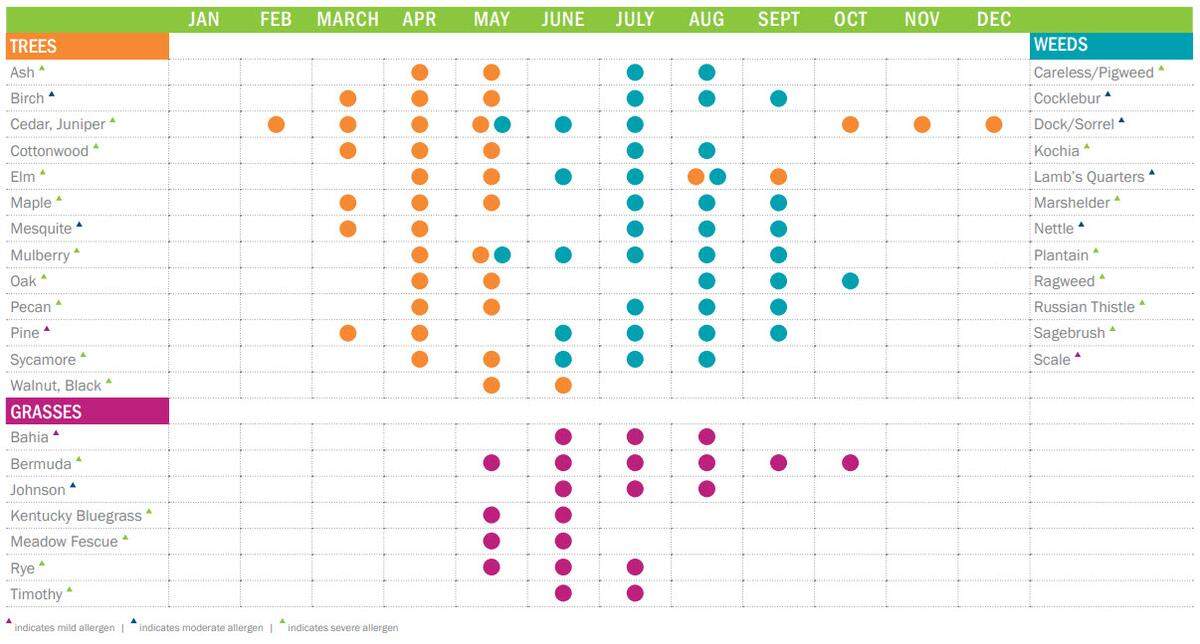
What allergens affect Texans?
Tree pollen from ash, elm, pine, oak, pecan, hickory, poplar and walnut trees is responsible for many spring allergies, peaking from February to June, according to Children’s Health. Grass pollen peaks in the summer between March and September. Mold allergies are worst in the late summer during July and August. Ragweed season lasts for four months in Texas, from August to November. Cedar fever peaks from December to February.
Tips to minimize allergy symptoms
During allergy season, use these tips from Children’s Health to help:
- Stay inside when it’s dry and windy.
- Avoid yard work if allergies are flared up.
- Wash clothes and bathe after being outside.
- Keep doors and windows closed.
- Use a HEPA filter.
- Vacuum often.
- Flush sinuses with nasal rinse.
This story was originally published April 11, 2023 at 12:38 PM.