Arlington council OKs new natural gas drilling near daycare. ‘This may not be over’
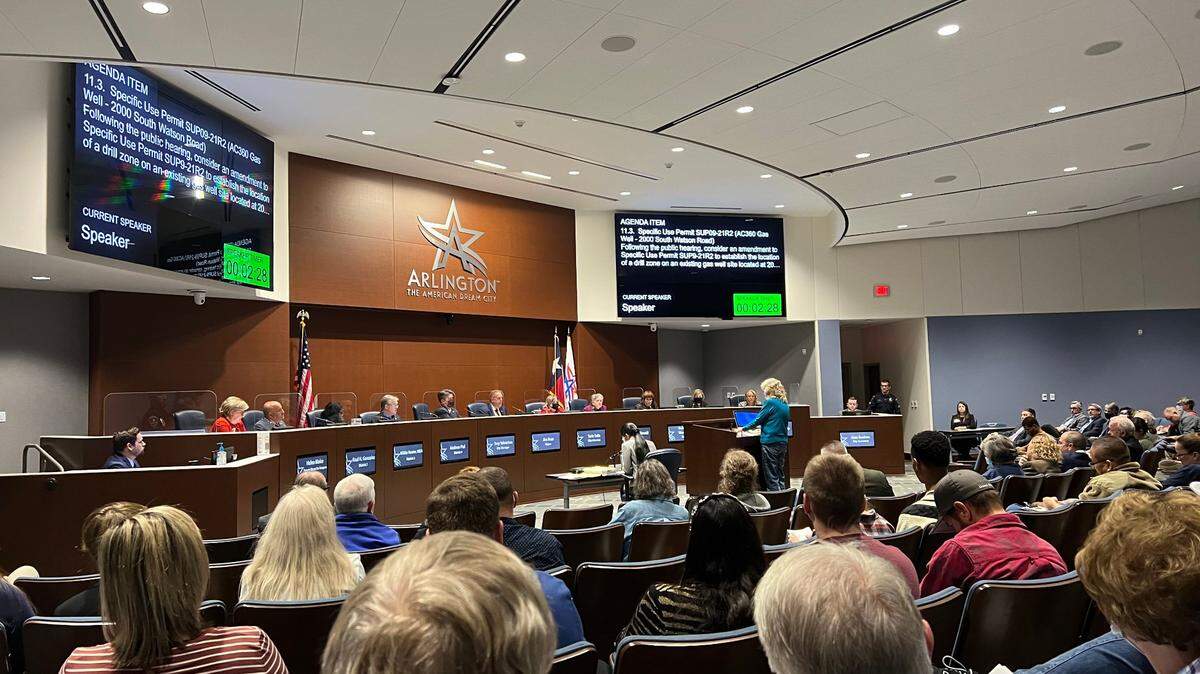
Three months of contentious debate over public health risks tied to natural gas drilling in Arlington came to a head on Tuesday night, when City Council members narrowly approved a permit to add three new gas wells at a drill site just over 600 feet from a daycare center and homes.
Council approved the Total Energies application 5-4, with members Ruby Faye Woolridge, Victoria Farrar-Myers, Nikkie Hunter and Raul Gonzalez opposing the measure. A final vote will take place before the final permit is issued to TEP Barnett, the Fort Worth branch of the French energy giant.
Speakers against Total’s application, which earned national media attention in the days leading up to the public hearing, spent more than an hour urging council members to honor a June 2020 council vote denying a request to add more wells at the AC360 drill site.
Ranjana Bhandari, executive director of environmental advocacy group Liveable Arlington, cited census data showing that 25% of families in the neighborhood live below the poverty line. About two-thirds of gas wells are located in east Arlington, which is a majority-minority part of the city, she said.
“Last year, we talked about why this was such a poor idea,” Bhandari said. “Among the no votes were two of the most ardent supporters of fracking the City Council has ever seen …It was the first time in the entire history of their votes that they voted no. I think that’s your roadmap for what needs to be done today.”
Since that vote was held, four new members have joined the council alongside Mayor Jim Ross, who was elected in June. Three of the council’s newest faces opposed the measure on Tuesday.
Council members who supported Total’s permit said they feared facing an expensive, unwinnable lawsuit if Arlington rejected an application that met all technical requirements.
“It’s moments like now (that) make me wonder why in the world I decided to run for mayor, because I struggle with this,” said Ross, who voted in favor of Total. “If it came down to ‘it’s just about the kids,’ it’s a no brainer for me. But it’s not about just that.”
The city would stand to lose out on royalties generated by Total’s drilling. Over a four-year period, Arlington earned about $5 million in royalties from TEP Barnett’s 160-plus wells at 32 sites in the city, according to an investigation published by Reveal. About $2.2 million in royalties stemmed from five drill sites close to daycare centers.
In addition, Arlington received almost $3 million in bonus payments from TEP Barnett during that same period, according to public records. Ross and fellow council member Andrew Piel denied their decision to vote for the permit was financially motivated beyond avoiding massive legal fees.
More than 4,000 children go to school within walking distance of the drill site located at 2000 South Watson Road, said Wanda Vincent, who opened Mother’s Heart in 2003 and offers care to a diverse neighborhood of Black and Latino families.
Providing a safe and healthy environment for children is of the utmost importance to the parents and caregivers at her center, Vincent said. But the expansion of drilling in Arlington has placed “a big question mark” on whether or not that goal is achievable, she said.
“Do not allow Total to expose our children to numerous, dangerous, toxic emissions,” Vincent told the council. “No disrespect, but we’re not animals. The tests may have been done on animals, but we’re human beings. We’re people. I’m here to let you know that we do care about our children. We care about our neighborhood, we care about our schools.”
Several residents cited studies finding that fracking near schools and playgrounds can lead to higher rates of childhood asthma, among other health risks.
However, Ross said there is insufficient data to tie any health effects experienced by Arlington children to Total’s drill site. He cited his experience prosecuting environmental exposure cases alongside close friend and famed activist Erin Brockovich.
“I’m going to support the applicant in this because I believe that is the right thing to do in Arlington, not because I don’t care about the kids, and not because I don’t care about the community, and not because I care less about Blacks or Latinos or Asians,” Ross said. “But I care about all of us, the businesses, the corporations, the kids, the community. And there has to be a balance.”
Total commits to more air testing, trees near drill site
Kevin Strawser, a spokesman for Total’s Fort Worth branch TEP Barnett, told the council that the AC360 site has never been cited for code violations., though another site was temporarily shut down last year for violating Arlington’s ordinance. He pointed to steps the company has taken toward reducing emissions and committed to doing more air quality testing after pressure from councilwoman Victoria Farrar-Myers.
Barbara Odom-Wesley, who voted against Total’s request last summer, voted for the second permit Tuesday evening.
She cited changes in drilling operations, including use of electric-powered rigs and willingness to respond to resident concerns, as reasons for her change. Strawser also told council members the company will plant new trees on the property to provide buffers to improve air quality. Both provisions are requirements under city regulations.
“What I’ve seen has changed is Total, at least in this instance, that’s listening to the citizens, listening to the concerns of the citizens and being responsive,” Odom-Wesley said
Arlington’s positioning above the Barnett Shale also makes the city the chief area of interest for drilling, she said.
“The Barnett Shale is a geological formation that we didn’t put in place,” Odom-Wesley said. “We are the ones who built neighborhoods on top of it.”
Total representatives were not the only speakers singing the company’s praises. Carla Smith, an administrator with Cornerstone Academy at 5415 Matlock Road, said their center has had no complaints about its own proximity to gas wells. The daycare is part of Cornerstone Baptist Church, which earns royalties from Total’s nearby drilling.
“They have been great neighbors that have communicated with us frequently and answered questions,” Smith said.
Activists upset over ‘appalling’ vote, future of drilling
Bhandari, the Liveable Arlington activist, spent weeks collecting signatures for petitions opposing the permit and speaking with council members about the dangers of approving the permit near Mother’s Heart.
She was especially frustrated by the council’s decision to decide the permit by a simple majority vote rather than a supermajority vote, which would have required seven ‘yes’ votes to approve Total’s permit.
The company’s initial drill zone included a well that is less than 600 feet from protected buildings, triggering the need for a supermajority vote to obtain a waiver from the council, according to Arlington’s gas well ordinance.
However, Total has agreed to limit future wells to areas over 600 feet away from protected buildings, allowing the city to approve a different drill zone by a simple majority vote, according to City Attorney Galen Gatten. Woolridge said she was not convinced by Gatten’s explanation, but the vote moved forward as planned.
Bhandari called the vote “appalling” and a potential violation of the city’s gas ordinance, which was updated to include the super majority clause in 2019.
“I gave up three months of my life, and all of us work so hard because I was afraid this was coming,” Bhandari said. “The mayor said to me yesterday: ‘You’re asking me to move the goalposts.’ But they moved the goalposts by changing it from a super majority vote to a majority.”
Several council members said they didn’t have the authority to turn down the permit due to House Bill 40, a 2015 law that prohibits cities from banning drilling within city limits and from implementing any regulations that are not “commercially reasonable.”
Typical city regulations include issues like noise control, the number of trees required for buffer zones and distances between drill zones and protected buildings like hospitals and schools.
“Take the facts that you have and begin to fight House Bill 40 because that’s what’s taking away your local control and limiting us,” said District 1 councilwoman Helen Moise. “Put your energies to something that can have a difference statewide, not just one drill site at a time, or something that’s going to put the city at risk of not only paying legal fees, but paying business losses.”
After the council vote, Bhandari and Vincent said this battle “may not be over.” They plan to investigate whether or not the council’s “sleight of hand” involving the majority vote is allowed under city law, Bhandari said.
“The facts are the facts, and we see these drill sites in certain communities. Even though you say it’s not about Black, brown or Asian communities, the proof is in the pudding,” Vincent said. “I’m here for the children, and just because they voted how they voted tonight doesn’t mean that it’s over.”
This story was originally published December 1, 2021 at 1:05 PM.