Aledo ISD could grow to 45K students in 30 years. Here’s how the city is preparing
When Dan Reilley moved to Aledo, he knew the timing was right.
He had a child getting ready to start kindergarten and knew he wanted to be settled. In Aledo, he and his family found a sense of community while still being close enough to the city. But mostly, Reilley said, Aledo felt like home.
Thousands of others think so too.
Those moving into the area come for a variety of reasons. Some want the views of the rolling prairie. Those like Reilley are drawn to the community for its small-town feel and proximity to Fort Worth’s amenities. Others want to send their children to classes in the Aledo school district, which scored 13 points higher than the Fort Worth school district to earn an A rating in the most recent Texas Education Agency accountability score.
The city’s population has grown 98% since 2010, to 5,380. Demographers estimate development of neighborhoods like Walsh, Morningstar, Parks of Aledo, Dean Ranch and Veale Ranch will bring more than 9,500 homes to the area by 2031. The 130-square-mile district stretches to Willow Park, Hudson Oaks and Fort Worth.
The growth is outpacing classroom space, as the district enrollment has nearly doubled since 2011, from 4,669 to 7,809 students this year.
District officials say three of its six elementary schools will exceed capacity in 2023, and five will exceed capacity by the 2024 school year. The middle schools and high school will exceed capacity in 2027.
And Aledo is already planning for what to do next. The district formed the Aledo Growth Committee to navigate the population boom and study the options to accommodate the new students.
The committee has met three times. If it recommends a bond, the the earliest it would go up for a vote is in May 2023.
Then, Aledo’s future will be in the voters’ hands.
Opposition to growth
Some in the once-rural community are dead-set against seeing it become a suburb.
Bonds in Aledo have been difficult to pass, though voters in 2019 approved $150 million for a middle school, elementary school and renovations to three campuses.
That vote came after voters overwhelmingly rejected a $72.9 million proposal in 2017 to build a middle school and convert an intermediate school into an elementary school.
In 2015, they approved $53.2 million for an elementary school and technology, buses and safety and security after rejecting a similar proposal six months earlier.
Aledo athletic director Steve Wood said it took three tries for voters to approve Bearcat Stadium, home of the 10-time state champion football team. That bond eventually passed in 2005.
“There’s a little bit of a feel of, if you don’t build the schools, then the people won’t come,” said Superintendent Susan Bohn. “And I think people are coming to realize that that’s not reality.”
Bohn thinks the community is starting to understand.
“Sometimes people get nervous when they hear we’re planning for growth, because they think our planning is making the growth happen,” Bohn said. “Like they think it’s causal, when it, in my experience, it’s not. The growth is going to happen and we either plan for it or we don’t. And we just believe really strongly that it’s important for us to ask our citizens, what do you want Aledo ISD to look like in the future? What do you want this community to be? And ask them to recommend that path forward to us.”
Why Aledo?
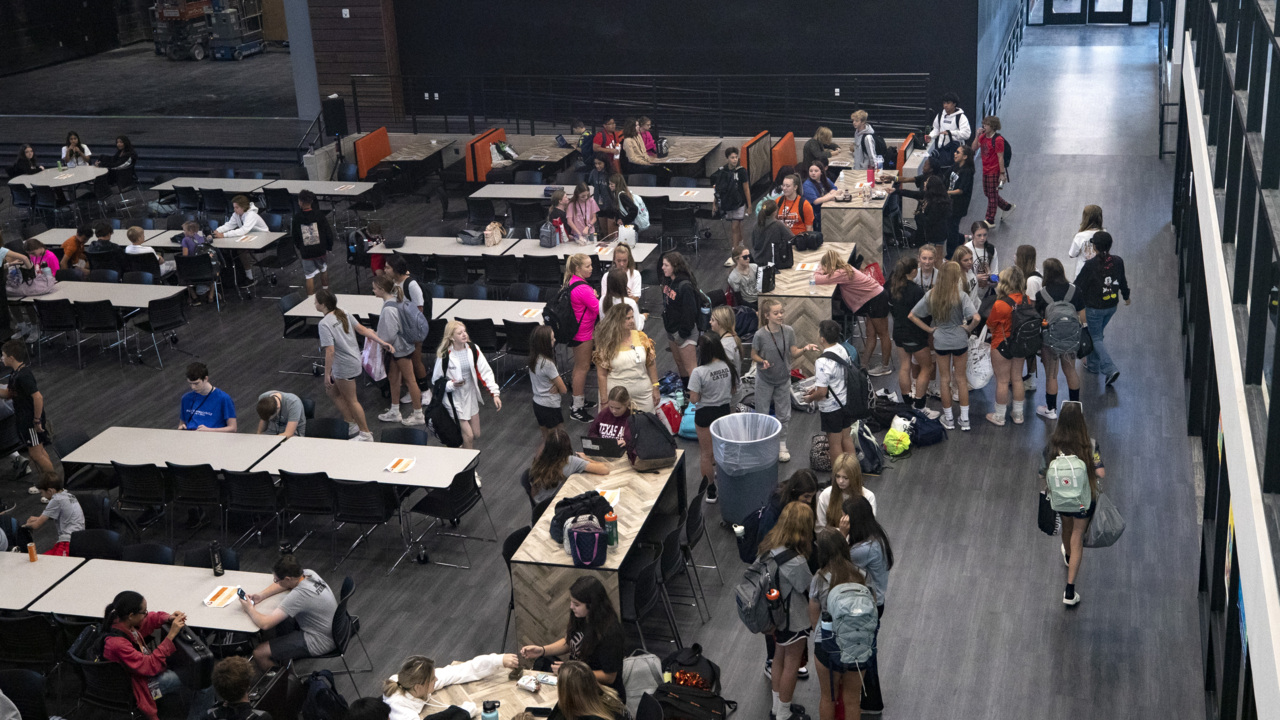
Just before the start of the school year one Saturday morning in August, cars lurched into the Aledo High School parking lot for the annual Bearcat 101, an event for students and residents to meet with school and community groups to get involved in extracurriculars.
Tables inside the cafeteria clung tight next to each other in aisles that pulsed with a sea of bodies. Signs advertised nearly every activity, from the dance team to Boy Scouts to 4-H.
Marcus McWaters, who attended the back-to-school event with his daughter, Eva, said they moved to the area to be close to his job at Lockheed Martin and for the high school.
With the explosive growth, Marcus is worried Eva might be zoned out of the high school if another one has to be built. It’s a fear that might not be too far out of the realm of possibility.
Laura Morrow, who was also at Bearcat 101, has lived in Aledo her whole life and watched it blossom with new families and the traffic that comes with development. She yearns for the Aledo she knew in the 1980s and ’90s.
“I know that it’s a great place to be, so it attracts a lot of people,” Morrow said. “I think the challenge will be to keep it a small-town feel while making sure that the families and students have what they need to be successful.”
From opposition to leading the charge
Reilley moved to Aledo when the 2017 bond package for a new middle school went to voters. Reilley was a part of the 71% who voted against the proposal.
He admits now that part of the reason he voted against the issue was because he didn’t know too much about it. But the numbers didn’t lie — Aledo still needed a new middle school.
That’s when school officials started to ask residents if they wanted to be a part of the Bearcat Growth Committee.
“You hear people talk about the new kids, you know, the new people,” Reilley said. “They’re the problem. Well, if I’m going to be a problem, I’m going to be part of the solution.”
Reilley joined the committee and helped lead a successful push to pass the bond package on the second go-round. Reilley is now one of the co-chairs for the new Aledo Growth Committee.
The way bonds have usually worked in Aledo, Reilley said, is if they don’t pass the first year, they’ll pass the next year once they’re tailored to what the community wants. The growth committee’s goal is to eliminate that back and forth.
One of the biggest tasks for the Aledo Growth Committee will be to determine the landscape of school space.
In the next 30 years, Bohn said, the district could grow to 45,000 students. She thinks future Aledo will be unique, but that the school district could become comparable to Keller or even Frisco in size.
But for some in the community, becoming like the other school districts is something they fear.
Reilley’s goal for the school system is set: They want to be the first Aledo.
“We’re not trying to mimic what others have done,” he said. “We’re trying to create what we want.”
This story was originally published October 14, 2022 at 5:00 AM.