‘It will drive the entire market’: Texas supply chain industries brace for Trump tariffs
As new tariffs loom, Texas’ supply chain industry is bracing for an uncertain trade landscape.
Since his inauguration, President Trump has sent shock waves through the global trade community with announcement of new tariffs
The Trump administration imposed a 10% tariff on all Chinese goods earlier this month. Plans for additional duties have also made headlines.
On Monday, the Trump administration announced a 25% tariff on aluminium and steel imports, which is slated to go into effect on March 12. About half of the aluminium used in the United States is imported, the majority from Canada.
Tariffs on Mexico and Canada, which were delayed for 30 days on Feb. 3, are set to go into effect early next month. The 25% tariffs on almost all imports from Mexico and Canada are expected to raise prices for consumers across the country. Costs for cars, clothing, groceries — even tacos — could go up.
What are tariffs designed to do?
Beverly Mendoza, assistant professor of economics and finance at Stephen F. Austin State University in Nacogdoches, said tariffs are an economic tool used to limit free trade. Free trade typically allows for more competition in the market, making it cheaper to produce goods.
In theory, governments can use tariffs to discourage the import of goods that have negative effects on consumers, like cigarettes, she said.
Trump may be using the threat of new tariffs as a way to open negotiations with other countries. Texas Gov. Greg Abbott, a longtime Trump supporter, told CBS Texas the president is using tariffs as “a tactic to achieve another goal.”
The new duties on almost all imports from specific countries differ from the tariffs Trump enacted during his first term, most of which focused on China and were rolled out in waves.
Texas has the eighth-largest economy in the world. Mexico has been the state’s top trade partner for over 15 years. Trade between Texas and Mexico was worth over $292 billion in 2023; in that same year, Texas imported over $142 billion worth of goods from Mexico.
Mendoza said the state’s oil and gas industry will somewhat insulate the state from higher gas prices that tariffs could cause. The country’s top exporter, Texas exported over $139 billion of oil and gas alone in 2023.
Mendoza said higher costs for raw materials could make manufacturing more expensive. She said product shortages are also possible, depending on how companies decide to import goods once tariffs are in effect.
How could tariffs impact North Texas?
Supply chain support has become a major industry in North Texas over the past six years. Roughly 110 million square feet of new warehouse and distribution space was built in the Metroplex between 2019 and 2023. Some of the world’s largest companies, including Walmart, Amazon, Nestle, Tyson and LG Electronics, have distribution facilities in Fort Worth.
ITS Logistics, a third-party logistics company, opened a 1.1 million-square-foot distribution facility in north Fort Worth in 2023. Paul Brashier, the vice president of global supply chain at ITS, said the threat of tariffs is affecting the behavior of the entire transportation industry.
Brashier said companies are already moving goods in Canada to the U.S., but he expects tariffs to have the biggest impact on pieces of the supply chain in Mexico. He said companies will likely move goods in Mexico to Texas, and imports through the port of Houston could increase.
“That’s going to be a very hard, hard road to manage because adding additional capacity to operate in Mexico is very expensive and it’s very difficult to do quickly,” Brashier said.
ITS Logistics hasn’t seen a spike in inventory but is making contingency plans with clients in case tariffs on Mexico and Canada do go into effect. The company does not anticipate having to raise rates for its services.
Brashier said supply chain disruptions caused by tariffs will be “exponentially different” from those created by the COVID-19 pandemic, when the global logistics industry shut down.
Brashier said tariffs on China haven’t yet had a major effect on the U.S. supply chain, as most goods spend about six to eight weeks in transit between both nations. Though delayed, impacts will likely begin to emerge as China ramps up business activity after the Lunar New Year holiday season.
Negative impacts on shoppers, like higher prices, are also a worry.
“If the consumer is over extended due to additional costs from tariffs, that might limit people purchasing goods, and thus having to move them,” Brashier said.
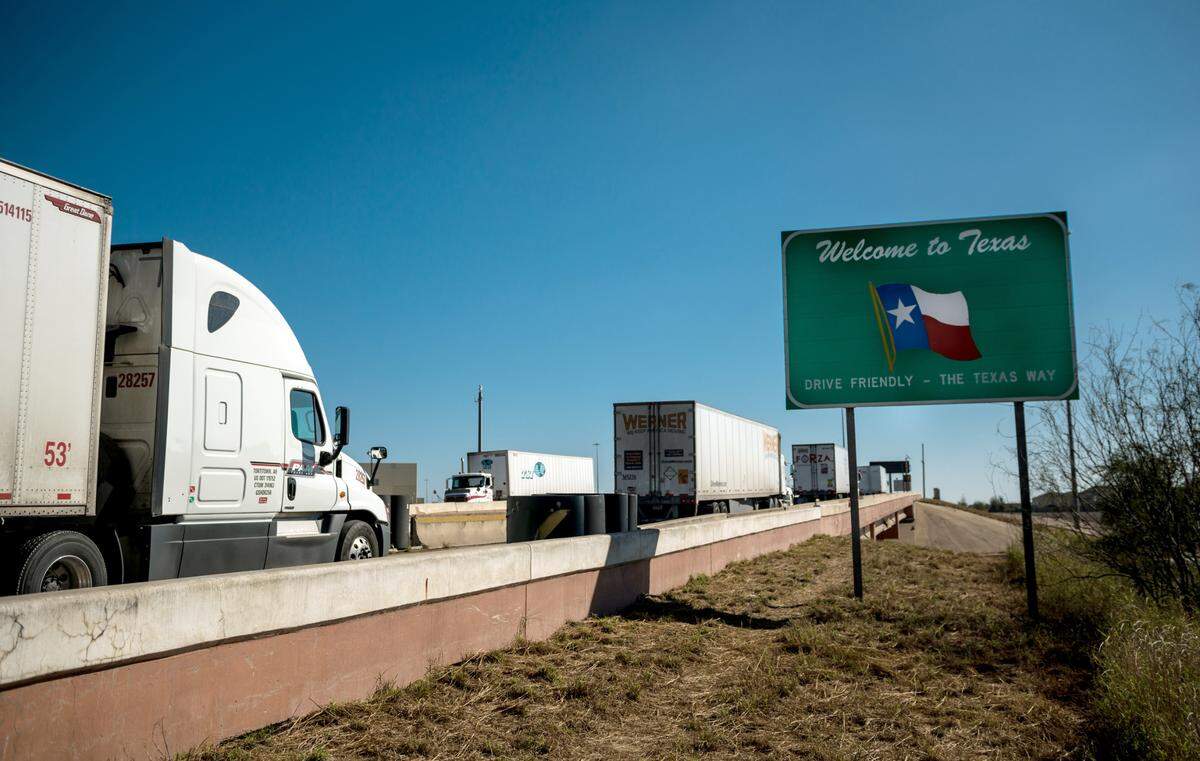
John Esparza, president and CEO of the Texas Trucking Association, expects tariffs to put pressure on the country’s entire logistics industry.
“It will drive the entire market,” Esparza said. “Whatever happens as a result, we’re all in this together.”
Esparza said tariffs could lead to job creation if they prompt companies to reshore their operations. Reshoring could also stabilize prices for some goods, which are expected to rise if tariffs go into effect.
Despite the uncertain tariffs, Esparza said the future of Texas’ trucking industry is bright.
“There’s one thing that we can count on, and that has been the increase in the amount of freight that is moving across the state at any given day and at any given time,” Esparza said.
Over 2.9 million trucks crossed into the U.S. from Mexico at the Laredo border crossing in 2023, an almost 5% increase from 2022. Nearly 40% of the truck volume on the southern border is managed by the port of Laredo, according to the Bureau of Transportation Statistics.