Discovery of abandoned tunnel in Armour building restoration adds to Stockyards lore
For decades, the historic red-brick Armour building at the east end of the Fort Worth Stockyards has stood as a mysterious-looking monument to an era long past.
It turns out that the inside of the old building holds a few mysteries, too.
U.S. Energy Development Corp., the Arlington based firm that bought the property in 2022, has been extensively renovating and preserving the building to turn it into the company’s new headquarters. The three-story building is one of the only surviving structures from what was once a sprawling meatpacking operation, dating back to the early 1900s.
As construction crews worked, they uncovered an abandoned tunnel beneath the floor heading east from the building. It’s unclear exactly where the dark passage led, because workers quickly realized that the tunnel contained asbestos. Abatement of the toxic material was completed and the tunnel was collapsed, but it was just one surprise in store for crews as they bring new life to the familiar Stockyards landmark.
The Star-Telegram recently got an inside look at the building and learned more about U.S. Energy’s plans for it.
The private oil and gas exploration and production company bought the property from multifamily developer Kairoi Residential, which is building over 400 apartments on adjacent land.
U.S. Energy will be moving its headquarters from Arlington’s Skymark Tower once renovations to the Armour property are complete in early 2025. The move is expected to create about 20 jobs with six-figure salaries over the next several years.
One of the company’s owners, Jacqueline Jayson, declined to say how much U.S. Energy has invested in the property. City permits estimated renovation costs around $13.7 million.
U.S. Energy will occupy half of the almost 54,000 square feet of space and lease the remainder. Ryan Matthews, senior managing director at JLL’s Fort Worth office, has been charged with leasing the second half of the building, which can accommodate one to three tenants depending on how much space a company needs.
Matthews said potential tenants, both small and large, have shown “robust” interest in the property over the past quarter. Companies interested in the space include those in the financial sector and Western-oriented brands. Matthews said he has given about one to two tours of the space per week lately.
Matthews said the Stockyards is developing an interesting office submarket, which is expected to grow when the Stockyards’ ownership group completes a major expansion including hotels, multi-family housing and at least 300,000 square feet of commercial space.
The number of offices in the Stockyards is already growing. Professional Bull Riders relocated its headquarters to Mule Alley in August. Simpli.fi, a technology company, moved its operations to Mule Alley in 2020.
“We’re looking to kind of draft off of the interest that those tenants have had, and being in this place to set up an office, get access to (Interstate) 35 in this location, I think there’ll be some demand from people that just want to take advantage of the opportunity that hadn’t really existed up until this was built,” Matthews said.
He said the area works well for offices; once Kairoi’s apartments open in 2026, it will be a place where people can live, work and enjoy the Stockyards.
Space in the Armour building, available for lease around $37 to $42 per square foot, is priced on the lower end for new Class A office in Fort Worth, Matthews said. It is the only Class A office space in the Stockyards available for lease.
A Stockyards icon
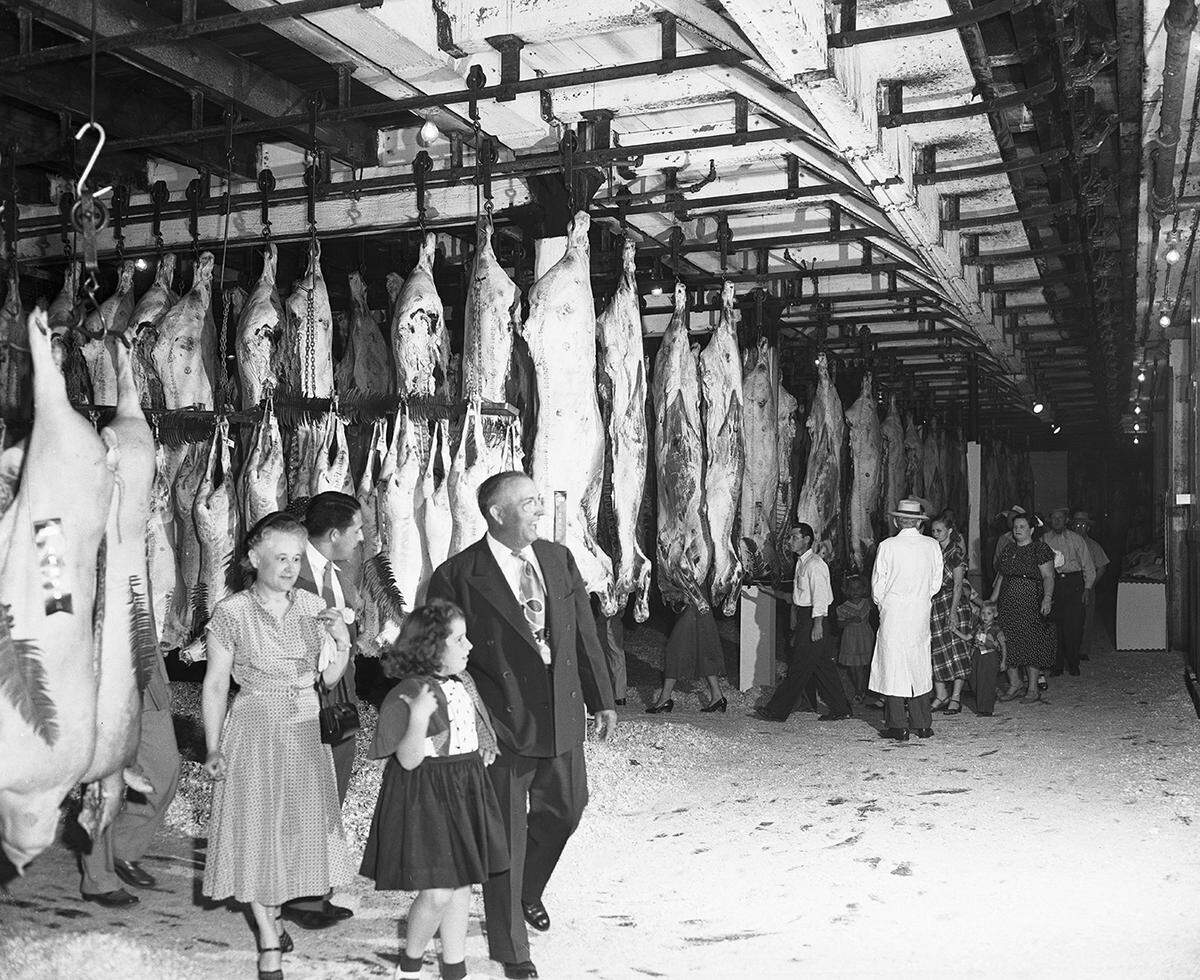
At its height in the early- to mid-1900s, the Fort Worth Stockyards was the third-largest livestock market in the country. Large meatpacking facilities supported the major local industry, which spurred the city’s early growth.
Built in 1943 by meatpacker Armour & Co., the three-story laboratory building is all that remains of the company’s once-huge Stockyards meatpacking operation. In the early 20th century, Armour and rival meatpacker Swift & Co. each received about 22 acres atop the hill at the end of East Exchange Avenue on which to build their facilities.
Tunnels during that era of the Stockyards were not uncommon.
Tunnels dating to 1903 run beneath East Exchange Avenue, once serving as concrete passages for hogs and sheep to move from holding pens to bridges above the rail yard that led to the Armour and Swift processing plants.
Armour closed the Fort Worth plant in 1962, and the neighboring Swift and Co. facility across the street closed in 1970. Fires in the 1970s significantly damaged both plants. Remaining structures were demolished over the years, leaving only the Armour laboratory building and Swift’s former offices intact.
‘A cultural fit’
U.S. Energy’s renovation work on the Armour building began in October 2023. The company expects to move in during the first quarter of 2025, with additional tenants moving in around the third quarter.
Work is well underway inside the building. Clumps of sawdust are scattered across the floor, gathering between piles of paint-splattered buckets and stacks of wood. Newly installed glass doors are encased in protective plastic. On the day of the Star-Telegram’s visit, the first panes of opaque glass were being installed in the front walls of offices on the third floor.
Kerby Smith, founder and president of KRS Realty Advisors, who is leading the property’s renovation, said it’s come a long way from the state it was in when he first toured the property. Before U.S. Energy bought the building, it was being used to house animals for the Stockyards’ petting zoo.
Jayson said U.S. Energy wanted to be respectful of Fort Worth’s culture and for the building to still make sense for the Stockyards after renovations. The company has no plans to put its name on the outside of the building.
“It’s a cultural fit to the company, too,” Jayson said.
Her brother, company CEO Jordan Jayson, lives in Fort Worth.
U.S. Energy is a family business founded by their parents in 1980 in Buffalo, New York. Her parents, Joseph and Judith, both died in 2014. Of the couple’s five children, Jacqueline and her brother Jordan are the only ones involved in the company. Her husband, Matthew Iak, is U.S. Energy’s executive vice president.
Jayson said though U.S. Energy has grown over the years, the family’s dynamic has stayed the same.
“I just think if you have a common passion and interest, it’s easy to work together,” Jayson said. “My parents worked side by side, and we would literally go to work things with them constantly, so it was ingrained in us.”
Much of the renovation work has focused on restoring the building to what it looked like when Armour built it. Metroplex-based firm Bennett Partners designed the restoration.
Brick has been left exposed on walls throughout the building where it is thought Armour left it unplastered. New glass blocks in the gym’s windows echo the originals. Round holes in the ceiling where large canisters used to sit when the building was a laboratory have been converted into lights.
“It’s very much a custom build,” Smith said.
Some modern additions have also been made.
One of the Armour building’s key selling points is its large rooftop deck overlooking the Stockyards. The deck (and its expansive views) will be available for all of the building’s tenants to enjoy. There is a catering kitchen just off of it to support future events hosted at the building.
Thirty new windows, which received approval to be added to the building, bring more light into the space. An open staircase added to U.S. Energy’s office weaves between all three floors, linking shared spaces.
Building a second floor above a former loading dock created an additional 2,200 square feet of usable space. A private deck off the CEO’s office has views of the Kairoi apartments. New outdoor amenities include a fire pit.
Though there’s still a ways to go before U.S. Energy calls the building home, the company made sure to fit in with the Stockyards’ holiday aesthetic. For Christmas, the Armour building was decorated with ornament-laden garlands, wreaths with festive red bows and strings of hundreds of white icicle lights, even on the side of the property only construction workers see. Lit up once again, the Armour building’s decades of sitting idle are finally long gone.
This story was originally published December 30, 2024 at 1:46 PM.