
As leaves fall, gardeners begin to notice strange things in their trees
We’re spending a lot of time beneath and around our shade trees right now, much of it raking or bagging recently fallen leaves. Based on the questions folks are asking in the process, we’re noticing things that skipped past us earlier. See what you think.
Mistletoe. As cedar elms, hackberries and several other species shed their leaves we’re discovering clumps of this parasite that have started to grow on their twigs. Birds carry the sticky seeds as they dine. Annoyed, they wipe their beaks on the twigs, and in doing so they “plant” the seeds.
The first-year clumps are usually softball-sized or smaller, and that’s the time to deal with them. Use a long-handled pole pruner to clip them out of the tree. At that point you’ll be trimming off only twigs and small branches. If you wait another year or two you’ll have to use a saw to remove actual limbs. The mistletoe clumps will be as big as watermelons by then and growth of the plant tissues will be badly distorted. Unfortunately, there still is no consumer spray that eliminate mistletoe without harming the host tree.
Lichens. You might be referring to these as “moss” on the trunks of your trees, but odds are that they’re the symbiotic growth of algae and fungi we know as lichens. They nourish one another, taking nothing from the tree in the process. It’s worthy of noting, however, that lichens will accumulate on dead and dying branches that don’t slough off dead bark. So, while they’re not actually causing the branch to die, lichens can be early warning signals that something is amiss.
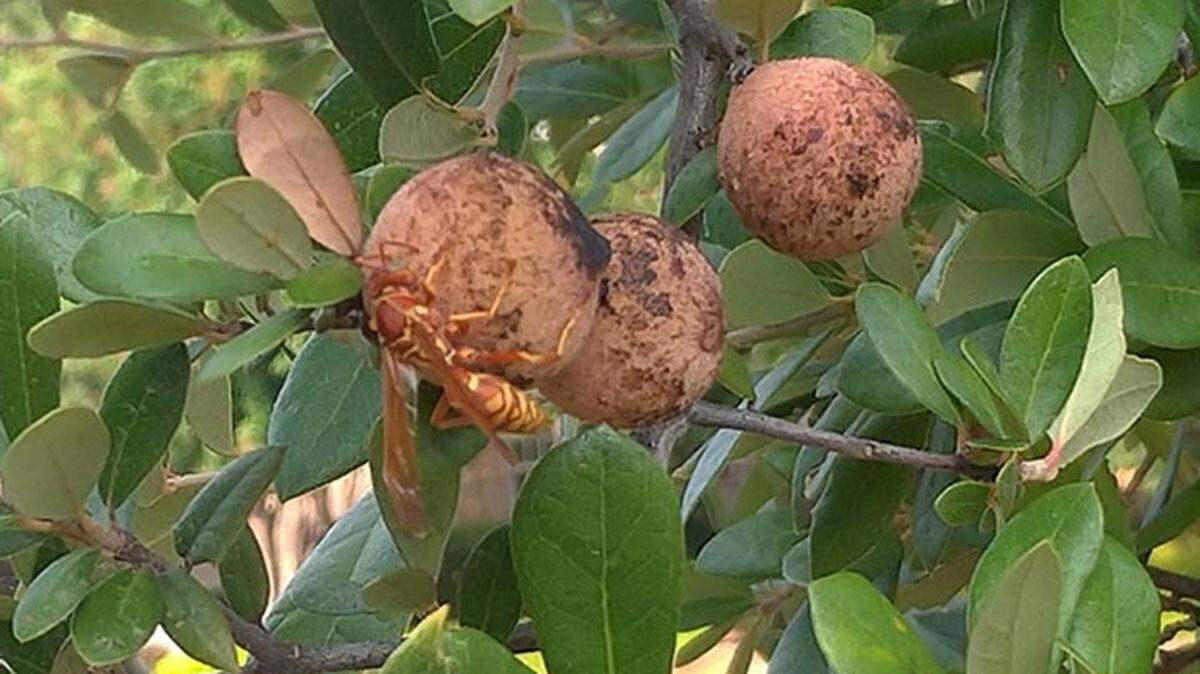
Galls. Most of these have been present all growing season, but for some reason we didn’t see them until now. In many cases that’s because they are attached to leaves that have recently fallen. In other cases, it’s because we just didn’t look closely enough. Woody oak galls look like fuzzy English peas, and they’re firmly attached to the backs of many of the live oaks’ leaves. Woody oak galls resemble large wooden marbles. In both cases the adult insects are only present long enough to lay their eggs. The galls form around the eggs protecting the developing larvae. The galls and insects do no measurable harm. That’s good news since there’s nothing we could do to stop them anyway.
Conks. Most of us have called these “bracket funguses.” They look like something in a rock-climbing wall as they extend out from the trunks of afflicted shade trees. However, unlike some of the other things I’m listing, these are a bad sign of a serious problem. The fungus that causes these will have penetrated the internal tissues of the trunk of the tree completely by the time these often-colorful structures form. The tree has been compromised and could actually fall without warning. When you see these, you need to have a certified arborist inspect your tree as quickly as possible.
Burls. Some people say that these look like tumors, but in reality they’re just parts of the trunk that have grown without standard elongated grain. Woodworkers treasure burls for their wildly beautiful patterns of grains. Burls rarely present any threat to trees or their trunks. Unless you are removing the tree entirely for some other reason, it’s usually best just to leave a burl intact. Their true causes are seldom known, but they don’t present any concern.
Acorns. Last year was a banner year for acorns beneath our oak trees across Texas. Folks wore me out asking how they could prevent acorns from forming. Sadly, I wore them out with my reply that there was nothing that could be done to stop them. I tried to give them hope that oaks, like pecans, were “alternate bearers” – that a heavy year would be followed by one or two really light years. Unfortunately, based on the several oaks around our rural landscape and the places I pass on my regular routes, that’s not the case this year. Acorns are back, and they’re back in big numbers.
My answer, unfortunately, is still the same. All you can do is blow them into a corner and, as best you can, pick them up with a shovel or lawn vac. You don’t want to leave them on top of the ground. They’re uncomfortable to walk on, and too many will germinate. They’re not easily pulled, and that’s the only way to eliminate them when they start sprouting in flowerbeds.
Twig girdlers. You may have noticed these back in the summer. Quarter-inch twigs that look like they’d been cut with a pocket knife were falling to the ground. Pecans are most likely to have them, but other species will, too.
That’s the damage of twig girdlers. The adult beetle deposits her eggs in the far end of a small branch. She then uses her very sharp mouthparts to score the branch so that it will die and eventually fall. The larvae develop within the dead tissue, later emerging as the next generation.
There is no control for this insect. The female isn’t there long enough to spray, nor does she actually feed on the host tree, and the larvae are well protected. Your best bet is to pick up the fallen twigs and discard them. The good news is that they do almost no permanent damage to the trees.
You can hear Neil Sperry on KLIF 570AM on Saturday afternoons 1-3 pm and on WBAP 820AM Sunday mornings 8-10 am. Join him at www.neilsperry.com and follow him on Facebook.