
Protect those trunks as if trees depended on them
If I were writing a column on interior decorating, it certainly would be more fun if it covered beautiful Italian tile or decorative wall coverings.
But sooner or later, we’d have to address toilets and trash cans. They’re parts of everyday life, after all.
Well, it’s that way with tree trunks. They’re not glamorous. They’re usually not very colorful compared to flowers. They certainly don’t taste as good as fruits and vegetables. But they’re essential to the trees we have around us. So, I’m going to dedicate these paragraphs today to trunks and all the things we can do to protect them.
First things first, let me introduce you to the structural parts of a tree’s trunk. You’ve already met the bark. You probably used it the last time you climbed up into a tree. Maybe you use it to identify your favorite trees. But trees use it as well. It serves to protect them. It cushions them against impact. It protects tender and critical tissues that function to sustain life up and down within the tree.
Just inside the bark is a tissue known as the phloem. It is through that cylinder that the tree sends manufactured sugars that it has produced in its leaves down to the root system. Those sugars are critical in keeping the roots alive. Sugars may also be stored in the roots for use at other times.
Just inside the phloem is a tissue called the cambium. This layer of cells divides to the outside to form more phloem and to the inside to form more xylem. The xylem makes up the bulk of the wood of a tree’s trunk. Its cells are no longer living, but they are structurally strong. They are hollow, and it is through them that minerals and water flow from the roots to the leaves where photosynthesis can perform the miracle of manufacturing the sugars we all must have to sustain life on this planet.
So now that you know a little bit about the physiology of a tree’s trunk, let me explain why you must protect the trunk. If the bark is lost all or most of the way around the trunk, the phloem will be severed and the supply of sugars to the roots will be stopped. Obviously that can result in severe damage or death to the tree. There’s even good likelihood that the cambium will be lost when the bark is cut or pulled loose.
Ways we damage trees’ trunks
- By planting a tree too deep initially. If you examine any tree you will notice that its roots flare out almost immediately beneath the soil surface. Arborists refer to that as the “root flare.” You want to see the tree’s trunk broadening as it enters the soil. If it goes into the ground with its sides parallel, like a broomstick stuck into the earth, it probably has been planted too deeply. Tree companies will use an air spade to remove a few inches of topsoil and expose the root flare a few feet out away from the trunk so the tree can develop at a depth at which it had become adjusted originally.
- With line trimmers and mower wheels. This may be the quickest way to ruin a perfectly beautiful tree. If a maintenance person cuts all the bark away from the trunk and plunges deeply into the inner tissues of the wood, the tree is almost assuredly going to be severely damaged or lost. Unfortunately, there is no turning back. All you can do is wait to see how severe the damages will end up being.
- By leaving wires and nylon twine tied in place around a trunk or limb. This happens more commonly when stakes are left in place too long or when nursery tags are not removed at the time of planting. You’ll notice that sugars accumulate above the wires. You simply must remove all of these devices before they begin to “girdle” their way into the tree tissues. Trees will try to grow right around them.
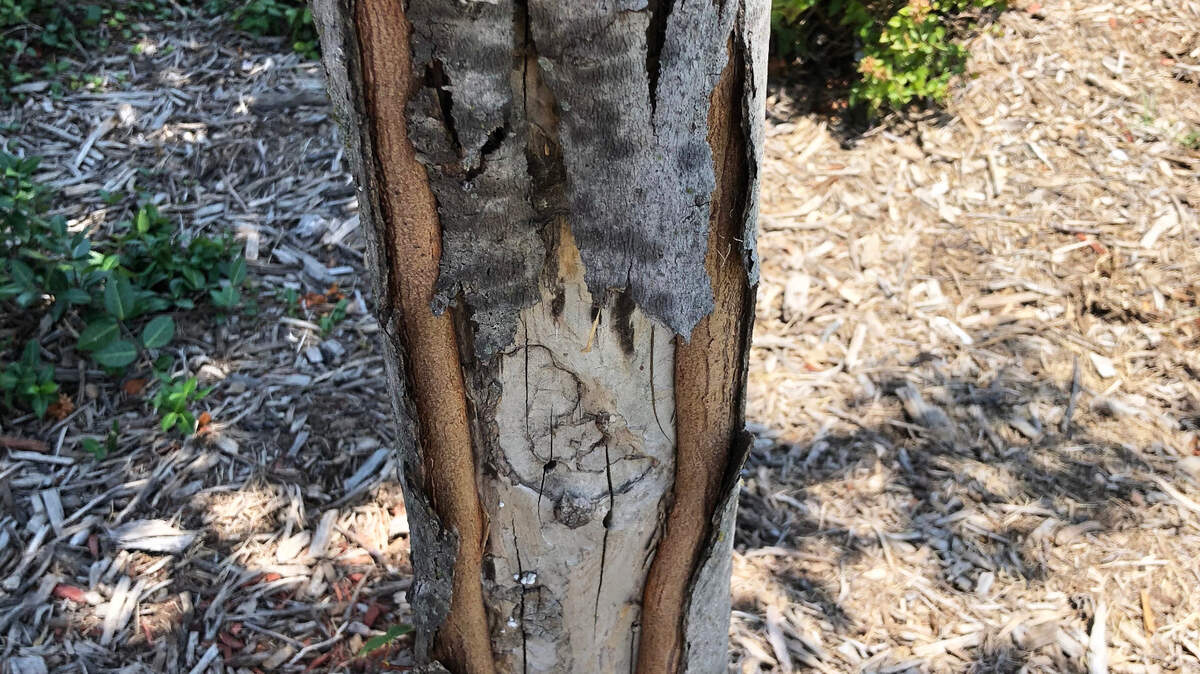
- By leaving new trees’ trunks exposed to the sun’s rays. This is so heartbreaking! People buy beautiful new trees and plant them. They stake them and water them carefully. They fertilize and nurture them. But nobody warned them that they need to wrap the trunks to prevent sunscald. Three or four years later they call my radio program or post a photo on my Facebook page showing the tree’s trunk with vertical splits in the bark and internal tissues showing dramatically. Eventually the bark separates and falls off entirely. By then, the top of the tree is dead. All that would be needed is to have wrapped the trunk of the tree with paper tree wrap from the ground up to the lower limbs for the first couple of years. A $5 or $10 investment could have saved the tree.
- By leaving stubs when limbs break or when we’re pruning our trees. Remember that root flare we talked about? Branches have the same kind of flare. It’s called a branch collar, and when you prune to remove a branch, you want to leave a small portion of that branch collar in place. Research has shown that the tree will heal across the wound much more quickly when you do so compared to making a flush cut against the trunk. Oh, and you need to seal all cuts made on oaks with pruning paint to protect against invasion of oak wilt. Oaks should only be pruned between mid-July and mid-February. That is when the oak wilt fungus is inactive.
You can hear Neil Sperry on KLIF 570AM on Saturday afternoons 1-3 pm and on WBAP 820AM Sunday mornings 8-10 am. Join him at www.neilsperry.com and follow him on Facebook.