
Ideas for flowering trees and shrubs in early summer
When the topic turns to flowering trees and shrubs, people generally think of redbuds, Mexican plums, azaleas and other early spring bloomers.
Fortunately, however, we are also blessed with some fabulous woody plants that bloom in early summer.
Let’s outline a few of the best:
- Vitex, or lilac chaste tree. I grew up with this beautiful shrub all around me in College Station. I referred to it as a shrub, because genetically that’s what it is. Back then, it was allowed to grow clear to the ground 15 or 18 feet wide and 12 to 15 feet tall. We had big city lots back then.
Vitex produces spikes of beautiful (and unusual) blue flowers late each spring and into the early summer, often at a time when few other trees and shrubs are blooming. It should be noted that white and pink forms are also sold, but if you miss the blue one, you’ve bypassed the real joy of the clan.
Over the past 15 to 20 years, vitex has been used as a small tree with its lower limbs removed. To some degree, that’s the same way we treat crape myrtles. However, vitex is a much broader plant in its growth habit. You need to allow more room for it. Don’t be afraid to prune it in winter to maintain a natural, compact growth form.
Note that vitex is sometimes called “Texas lilac,” but that does this plant a terrible disservice. It’s in no way related to lilacs. It doesn’t look like a lilac. It has no fragrance. It’s far better adapted locally than lilacs. If I could wave a wand, that name would be sent out with the trash.
- Althaeas, or roses-of-Sharon. There are many varieties of these lovely close relatives of tropical hibiscus. Unlike most of its cousins, however, althaeas are woody shrubs that grow to heights of 8 to 20 feet. They’re deciduous, but they’re winter-hardy clear into Canada, so Texas cold is of no concern with them.
Flower colors include red, pink, lavender and white, often with two colors on the same flower. Some types produce single flowers (one row of petals), while others bloom with double flowers (multiple petals).
Two things that should be noted: althaeas will abort a noticeable portion of their flower buds without their ever opening. It’s especially common in years when we go from cool, moist weather suddenly to hot, dry conditions. It’s just their way of ensuring they’re able to hold up to the moisture demands of all the buds they produce. Second, althaeas are highly susceptible to the soil-borne fungus cotton root rot, if that’s been a problem in your soils.
- Crape myrtles. No flowering shrub or small tree stands as a better symbol of the Texas summer as do these iconic plants. With upwards of 150 varieties in the nursery industry, there’s a size, color and growth form for almost any gardening need. The time to buy them is when they’re in full bloom, generally June. That said, I’m going to leave more detail on crape myrtles to a full feature on them here in the next couple of weeks. They deserve the spotlight all to themselves.
- Texas sage, or ceniza. Plants in our part of the Metroplex have already bloomed a couple of times. This plant is occasionally called “barometer bush” because it has the unusual ability to bloom just two or three days after a rain. That seems unusual to us here in fairly wet North Central Texas, but if you visit Big Bend National Park and other parts of the arid Southwest, you’ll find that most plants operate that way. One or two days after a rain, almost all of the desert will be in bloom.
Texas sage, in its several improved varieties, is favored, not only for its lavender-pink flowers, but also for its gray-green foliage. People love that stark contrast with the dark greens of many of our other popular shrubs. However, it has a couple of down sides. It’s not reliably winter-hardy to North Central Texas. That’s probably why it’s not native here. And it also struggles with our heavy clay soils when we have prolonged periods of rain. My advice is always to plant one or three of them – not a massed grouping.
- Desert willow, or Chilopsis. People love this small tree’s unusual flowers. It’s not a willow, but it does grow in the desert (or relatively arid areas). But it grows with its feet (roots) in the edges of running streams, so it’s not really a plant for dryland gardening unless you can keep it properly watered. It grows a bit erratically, so don’t plan on training it into a formal landscaping growth form. It’s a first cousin to catalpas. You can see that in its flowers.
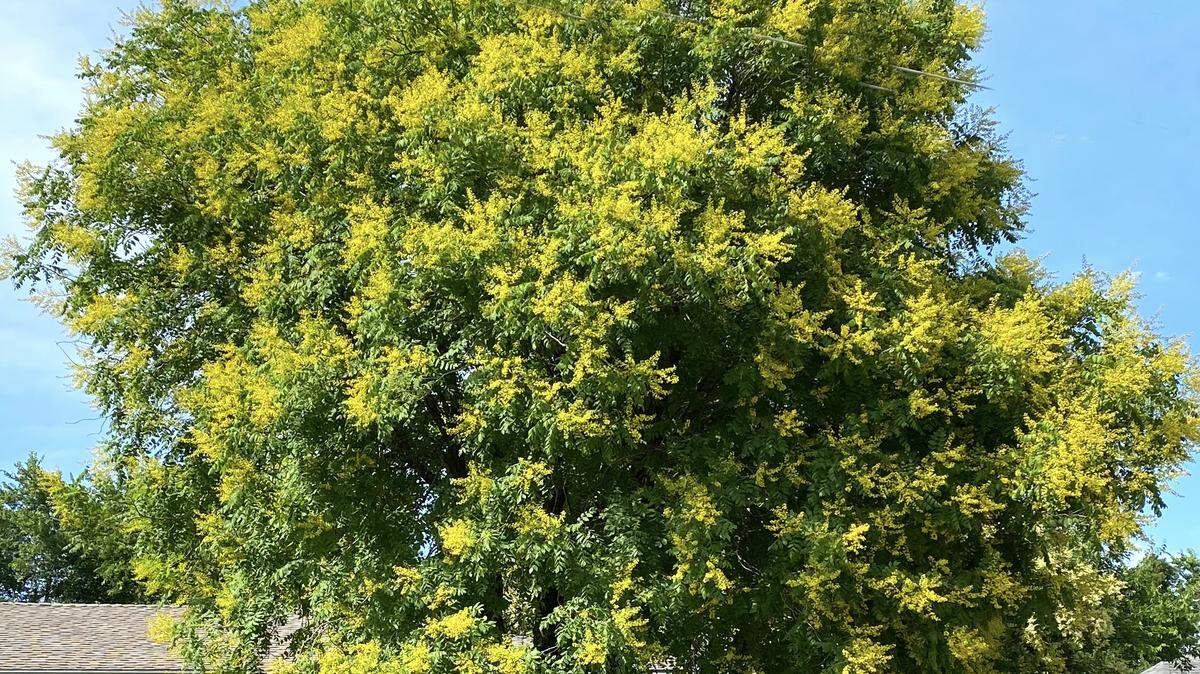
- Golden raintree. I began with one of my favorite plants, and I’ll end with another. These are lovely small to medium-sized landscaping trees that grow to be 25 feet tall and wide. Their foliage is dark green, often turning attractive shades of yellow, red and orange in the fall.
But it’s the late May and June flowers that really set it off. They’re bright, sunshine yellow and the trees cover themselves with them for a couple of weeks. It’s before crape myrtles are blooming, and long after the spring trees like redbuds, plums and pears have finished. More people should be trying golden raintrees. They’re a bit hard to find in nurseries, but they’re well worth the hunt.
You can hear Neil Sperry on KLIF 570AM on Saturday afternoons 1-3 pm and on WBAP 820AM Sunday mornings 8-10 am. Join him at www.neilsperry.com and follow him on Facebook.