
Save yourself a lot of frustration and use these tips to ensure your trees grow strong
Are you thinking about planting new shade trees this spring?
There are some things you can do that will help guarantee their success. Let’s scratch out a list. Who knows – it might save you time, money and a lot of frustration.
- Determine the best placement. Trees ought to be off to the right and the left of the focal point of your home, generally the front door. You don’t want them in the geographical center of either side of your yard, and you don’t want them to line up with any other artificial (man-made) feature. Hopefully your HOA’s rules aren’t going to dictate some unreasonable expectation about type or size of the trees you can plant or where they must be positioned.
- Consider the best species for your locale, also for the space you have available. The best large shade trees for North Central Texas are live oak, Shumard red oak, Chinquapin oak, bur oak, Chinese pistachio, cedar elm and pecan. Southern magnolias are excellent, although they are slower growing. Fast-growing trees are very poor landscaping investments. For medium-sized shade trees, choose from golden raintree, redbuds, Mexican plum and Little Gem southern magnolia.
- Watch proximity of walks, curbs, drives, patios, utilities and foundations. Ninety percent of any tree’s root system will be in the top foot of soil, so you can expect surface roots to expand up and out of the ground. Be sure to plant your new trees far enough away from concrete services that they won’t cause a problem. Root barriers may also be a help.
- Buy from a full-time reputable nursery that sells only true-to-name trees of the best condition and vigor. It’s always good when you can talk to the owner of the nursery face-to-face. And the problem of getting exactly what you think you are buying shows up most commonly with red oaks. Pin oaks resemble Shumard red oaks and are often brought in from southeastern growers and mislabeled by big national nurseries. Look for a Texas Certified Nursery Professional for the best in plant selection advice.
- Ask about details of delivery and planting, also warranty. If you’re buying from a reputable nursery, and if you can tell that your tree is healthy and vigorous, you may not need to buy a warranty with the tree. However, when nurseries deliver and plant their trees, warranties are usually included in the process.
- Plant the tree at the same depth at which it had been growing in its container or in the nursery. This begins with digging the hole exactly the same depth as the ball of soil in the root ball. If you dig the hole deeper than necessary, the weight of the root system will allow the tree to sink. Having a tree’s root flare below grade is one of the surest ways to kill it. It won’t happen quickly, but it will weaken the tree and eventually cause it to die five or 10 years later.
- Look for encircling roots that could end up girdling the trunk or another critical root. Trim them as needed to prevent that from happening. Use lopping shears to cut the encircling roots in one or two places at the time of planting. It’s much more difficult to come back and do it after the fact.
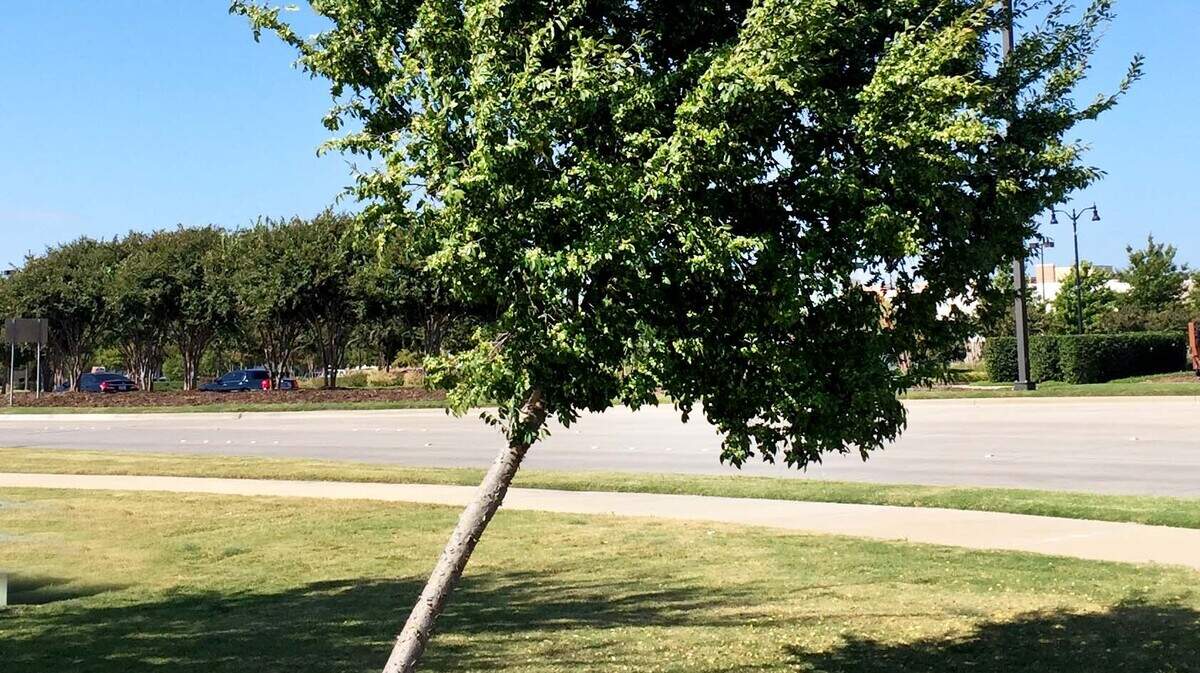
- Be absolutely certain that the tree’s trunk is plumb when it is planted. You never get a second chance to make things right unless you’re willing to dig and reset it. I wish I had a dime for every person who has asked me if they can pull or push a tree into a straight position. Even if you do that, as soon as you release it years later it will go back to its former lean. Get it straight from the outset.
- Stake and guy the tree carefully to keep it precisely vertical. Pad the trunk with cloth to prevent damage to the bark from the cables you use. Use three cables equally spaced around the tree and secured by stakes driven into the ground. Keep the cables taut at all times. Allowing cables to be slack creates the possibility of gusts of wind snapping the trunk. Don’t allow the cables to remain in place long enough to girdle the trunk.
- Wrap the trunk to protect it from sunscald and subsequent borer invasion. That’s absolutely non-negotiable with thin-barked trees such as Shumard red oaks, Chinese pistachios and red maples. Wrap them from the ground up to the lowest branches. Leave the paper tree wrap in place for the first couple of years.
- Water your new tree by hand every two or three days for its first two growing seasons in your landscape. Sprinkler irrigation alone won’t get water down deep enough into the soil. This is also true for large shrubs such as hollies. I prefer to use soil left over from digging the planting hole to create a donut-shaped berm around the tree. That berm serves as a reservoir when I water my new tree. I use a garden hose with a water bubbler attached so that I can run the water at almost full volume without washing the soil.
You can hear Neil Sperry on KLIF 570AM on Saturday afternoons 1-3 pm and on WBAP 820AM Sunday mornings 8-10 am. Join him at www.neilsperry.com and follow him on Facebook.