
Try these plants and designs to get the most out of your North Texas backyard
Cooler weather of the past weekend allowed us to dream that months of great patio and garden entertaining and relaxation are in the near future. Let’s outline some of the ways we can get the most out of our backyards. I’m going to start at the back fence and proceed up toward the house.
Privacy is a valuable commodity in today’s squeezed urban surroundings. Your plants can help in several critical ways, but we gardeners must choose and use them correctly. I’m going to help you sort through the details.
Plants are great at breaking up lines of sight. Perhaps it’s a screening hedge that lets us forget a busy street just a few feet away. Maybe it’s a dense evergreen carefully stationed to block the view from a neighbor’s living room window. Use plants but do choose and position them with critical factors in mind.
.jpg "9.01.25 Antique street pavers complement modern globes where you need color in shade (Sperry landscape).jpg")
Start with the mature size that you need. Mark off a piece of PVC plastic pipe in 1 foot increments using blue tape. Have someone hold the pipe vertically where you’re going to be planting your screening shrubs. That will give you a fairly accurate idea of the height of plants that you’ll be needing to block the view. And just to have mentioned it, with most shrubs planted in a hedge row, you’ll want to space them approximately two-thirds as far apart as they are tall. So, a row of 9-foot-tall shrubs would be planted 6 feet apart.
If you need privacy and sound deadening year ‘round, you’ll want a type of dense evergreen shrub. People want to include crape myrtles and roses-of-Sharon as their privacy plants, for example, and both of those, while lovely in summer, would be bare and drab in the winter. Half a year into their plantings they would realize their mistakes.
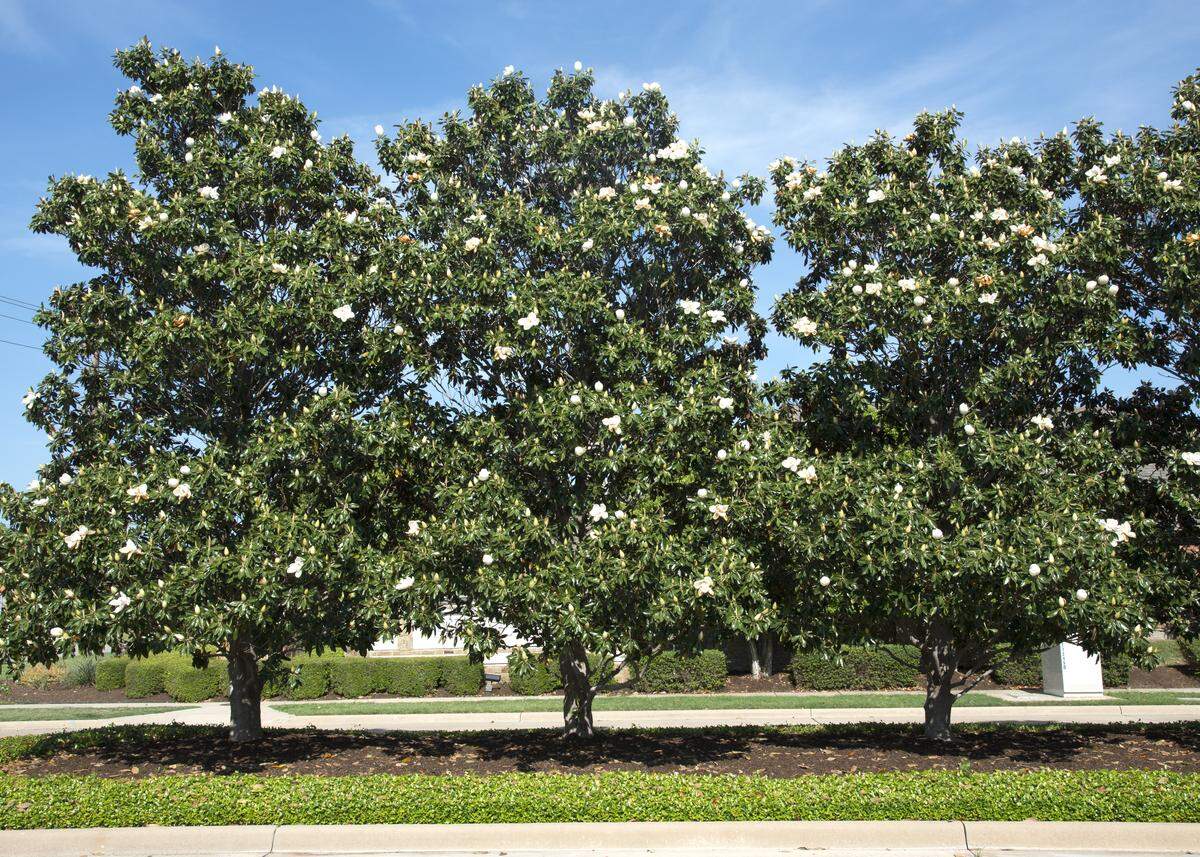
Choose a type of shrub that won’t outgrow the space you have available for it. If you need a shrub that grows to 9 or 10 feet in height, don’t choose one that grows twice that tall. You would find yourself pruning it back perpetually, and over time that would cause it to run out of steam — to lose lower branches and become leggy and unattractive. You want to choose a plant that grows to the desired size and stays there. Do your homework ahead of time.
If you have a large area you’re trying to screen, consider doing so with two or more groupings of evergreens rather than one long, continuous row. That will keep things from getting boring, and it will give more variety to the look of your landscape. Gentle sweeps and curves are better than straight rows that merely repeat the legal lines of your property boundaries.
Break up the plantings of shrubs with clusters of attractive evergreen trees. Little Gem dwarf southern magnolias, for example, would be beautiful if flanked by a medium-sized holly (dwarf Burford or Willowleaf) on one side and by Sea Green junipers on the other. Those are just examples. You’ll have your own favorites.
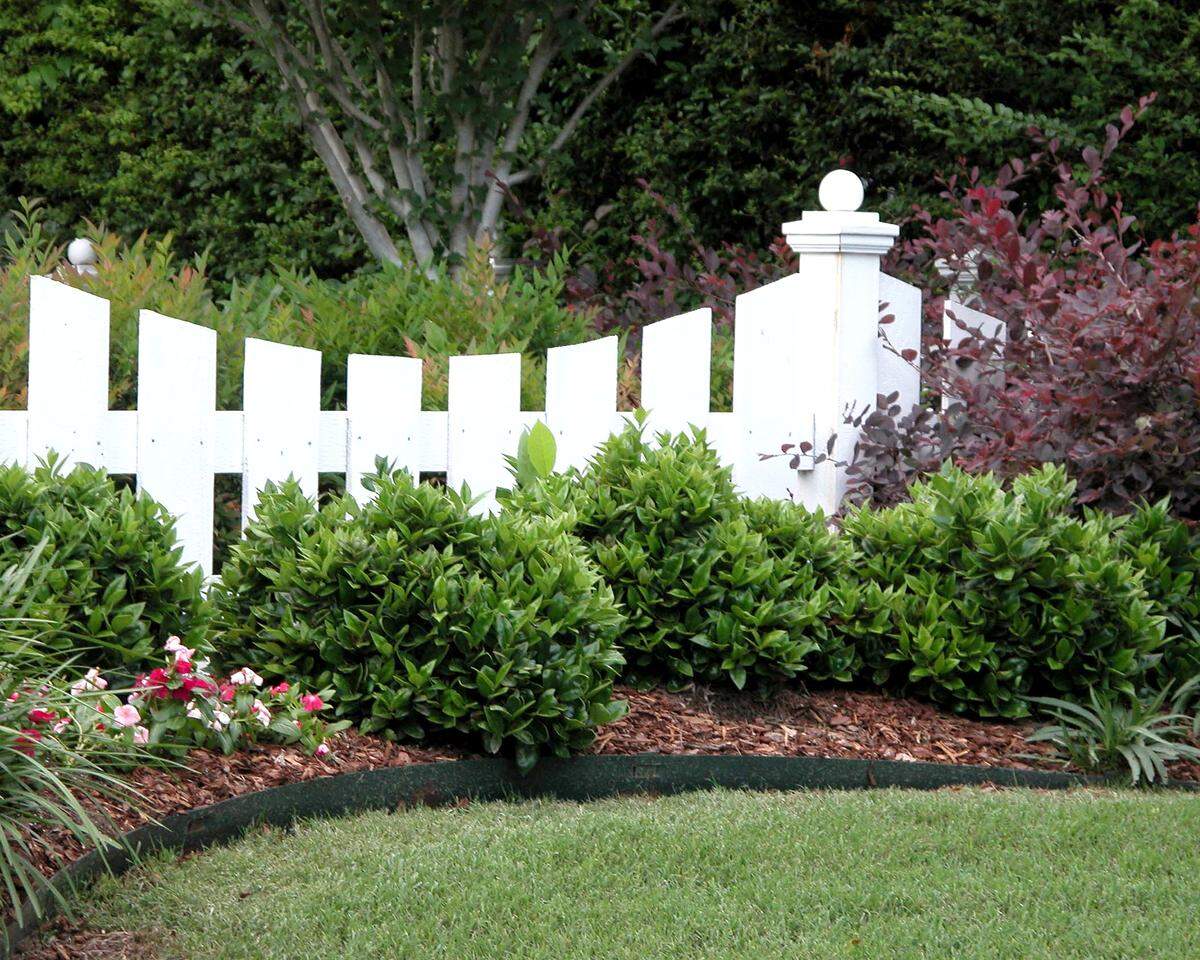
If a fence is involved, soften its lines with greenery. Once again, your goal is to avoid repeating the boundary lines of your property. Fences on their own can look very imprisoning.
You have several options. Consider planting a vine and letting it sprawl over both sides of the fence. Or you might plant a grouping of an odd number of upright shrubs such as Oakland hollies that can grow 4 to 5 feet out from the fence (to give them space to grow in width). Some people use espaliers (shrubs trained to grow flat on trellises) on or alongside their fences.
All these possibilities can camouflage fences in the background. It’s best to limit the uses of such plants to short parts of the fence in case maintenance on the fence might be needed later. You’re just trying to break up the monotony of straight rows of manmade materials.
Put a sweeping bed in front of all this. Plant color in the foreground to draw viewers’ eyes to that part of the landscape. That will distract any views of the neighbors’ patios or houses that might linger until the shrubs fill in. Use a garden hose to provide the design. A flexible hose will conform to any shape that you want when you lay it in place on a warm, sunny afternoon. Use a long, gentle sweep for the most natural look.
When developing that sweeping curve of your backyard design, it’s usually best to have it be asymmetrical. In other words, you don’t want it to extend up the sides of your yard the same distance. That wouldn’t look natural. Choose one side or the other — whichever looks better to your eye. It will become the visually “heavier” side. You’ll have more shrubs and other plantings on that side, so you’ll want to use at least one taller plant on the opposite side to balance things out visually.
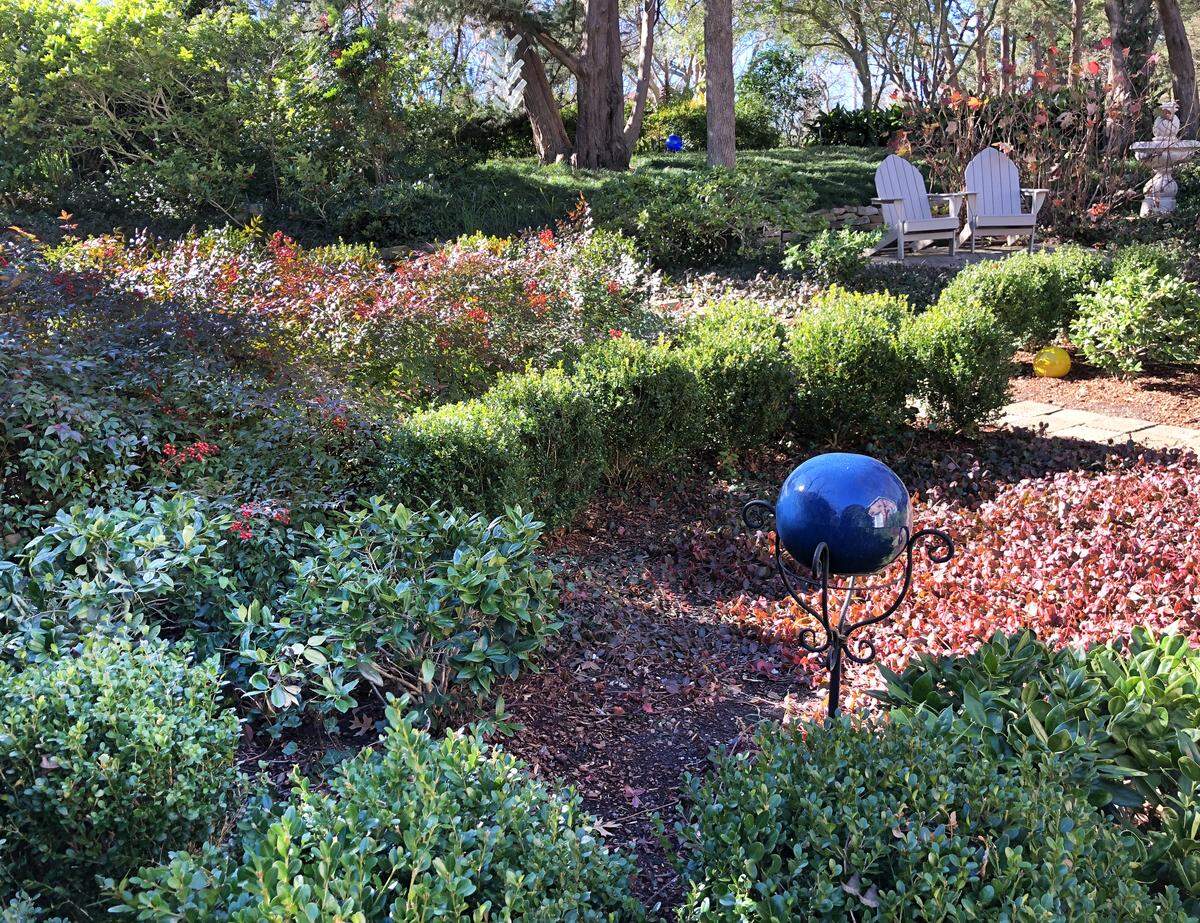
If color is out of the question because of shade or other limitations in the landscape, garden art can step in to your rescue. A tasteful garden statue placed at the logical focal point of the backyard design will again distract eyes to it instead of out across the fence and into others’ areas of entertainment. Colorful ceramic globes of varying sizes are also attractive, or you might like a gazing ball placed atop a short pedestal.
Bird feeders carefully positioned from your largest trees’ branches can give color and motion to the winter landscape. Choose the proper feeders and feed and you can have activity year ‘round.
That brings us up to the patio, and that’s a story all of its own. We’ll save that for another time, another space. This ought to be enough to keep you busy for a little while.