
Beware of adding these unwanted beauties to your North Texas landscape
Have you ever planted something, only to wonder a few years down the road what you must have been thinking? We have some plants that are like that. Lovely when you first see them, but before you know it, they’ve pretty much taken over your entire garden design. For the as yet uninitiated, I’ll point out a few such plants and what you can do to get rid of them.
Fast spreading golden bamboo can consume a yard
It seemed like such a great plant when those folks set it out for a privacy screen – something dense that would stop intruders, deaden sounds, and blank out wandering eyes. Unfortunately, golden bamboo sends out underground runners that sprout up in the worst of all soils. It can spread several feet in all directions every year until, before you know it, it’s consumed an entire backyard. Literally. It easily goes beneath sidewalks and sprouts up in parkways and neighbors’ lawns, and before you know it, angry crowds are circling your house.
Bamboos are grasses, so one would think that conventional grass killers would be up to the task. But even the best of them all, glyphosate sprays used at its top rate of application and applied in late spring/early summer when bamboo is growing most vigorously won’t give total control. Cold weather wounds it, but it always survives.
Commercial landscapers bring in small front-end loaders and dig it out manually. If you have very much, that’s probably the best thing to do. I’d suggest hiring a landscape contractor to do this job for you. They’ll know how to handle it all. Above all, don’t ever plant golden bamboo in the first place!
.jpg "6.23.25 Golden bamboo choking eastern redcedar (note height of power lines).jpg")
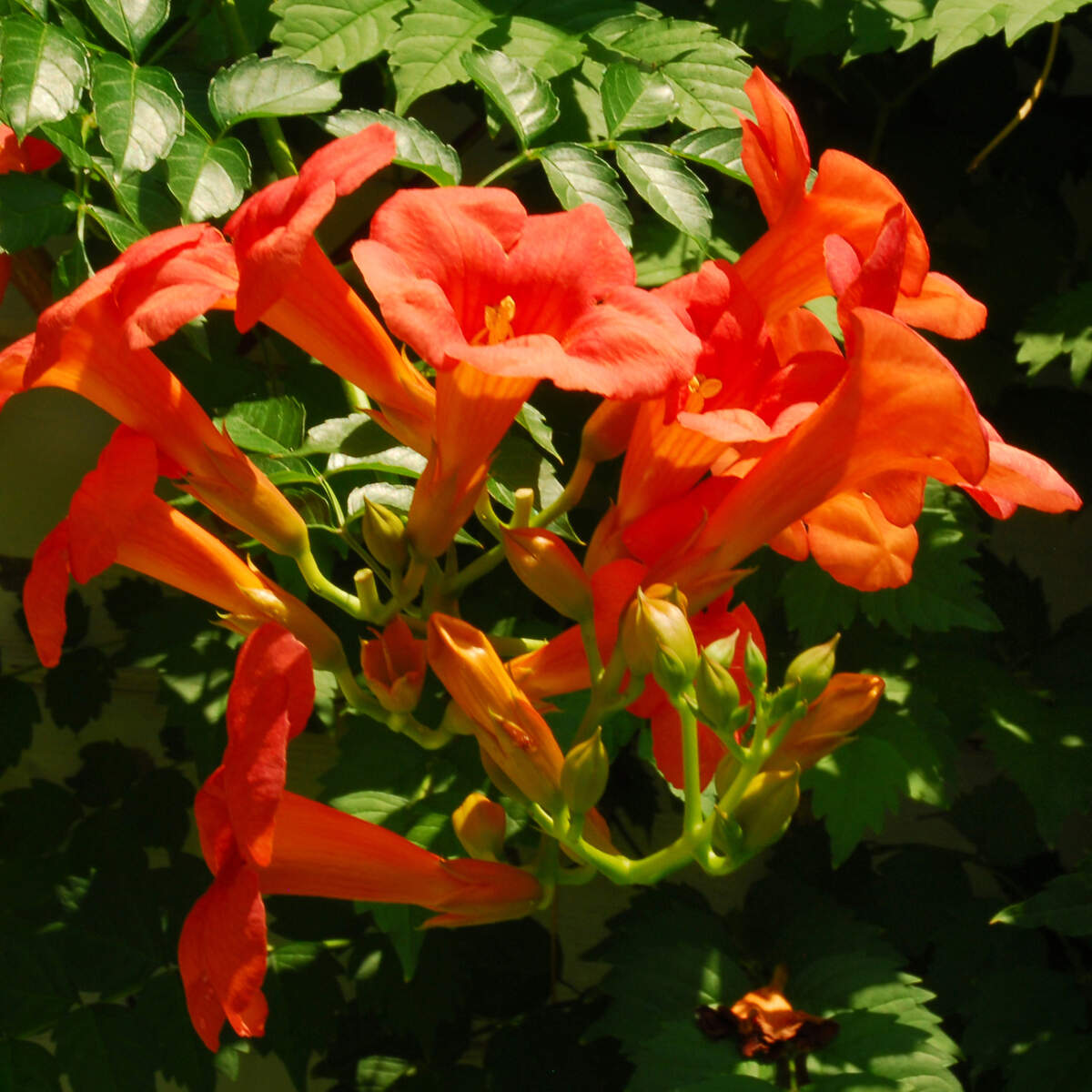
Trumpetvine sends roots all over surroundings
The wild native trumpetcreeper, aka trumpetvine, is a compelling vine. It’s beautiful in nature as it flowers on and off all through late spring and summer. Its tubular flowers put hummingbirds into a frenzy. But the plants send up root sprouts all over their surroundings. You’re much better off planting the improved selection called Madame Galen trumpetcreeper. It has larger flowers and is much more mannerly in its growth.
If you have a native trumpetcreeper already, and if the sprouts are coming up everywhere, sever each one with a sharpshooter spade. They’re all tethered to the mother plant by “umbilical” roots. Dig and remove each sucker if you’re able. If they’re already too large, cut them off at ground line. Drill into their stumps to create pencil-sized reservoirs to receive a broadleafed weedkiller (containing 2,4-D) poured in at full strength. Let it soak in overnight, then fill each reservoir a second time. The plant will carry the herbicide to all the roots, so the entire plant will be killed.
Hopefully you’ll be able to do the same thing to the mother plant. In many cases, however, it ends up being on the wrong side of a fence that’s shared with a neighbor. In that case, if the neighbor is unwilling to get rid of their plant, all you can do is to cut a trench 24 or more inches deep along your property line, install a root barrier, and set about digging the sprouts that have already gotten a start in your yard.
Privet hedge and its sister, Japanese privet, among most invasive
These may be the most invasive shrubs in all of Texas. They both have large sprays of white flowers in the spring, and gardeners think they’re doing pollinators a real favor by growing them. However, every flower yields a juicy blue fruit, and it seems like every fruit gets consumed by one of our state’s birds. They digest, “plant,” and “fertilize” the seeds all in one process, and before we know it, our landscapes and woodlands are overrun with the seedlings. Entire city blocks are consumed by privet undergrowth.
We live in a rural area, and one of our absentee landowner neighbors has Japanese privet along the county road several hundred yards from our little acreage. I have to hire two men for one week every couple of years to grub out the privet seedlings beneath our pecans.
.jpg "6.23.25 Japanese privet (ligustrum).jpg")
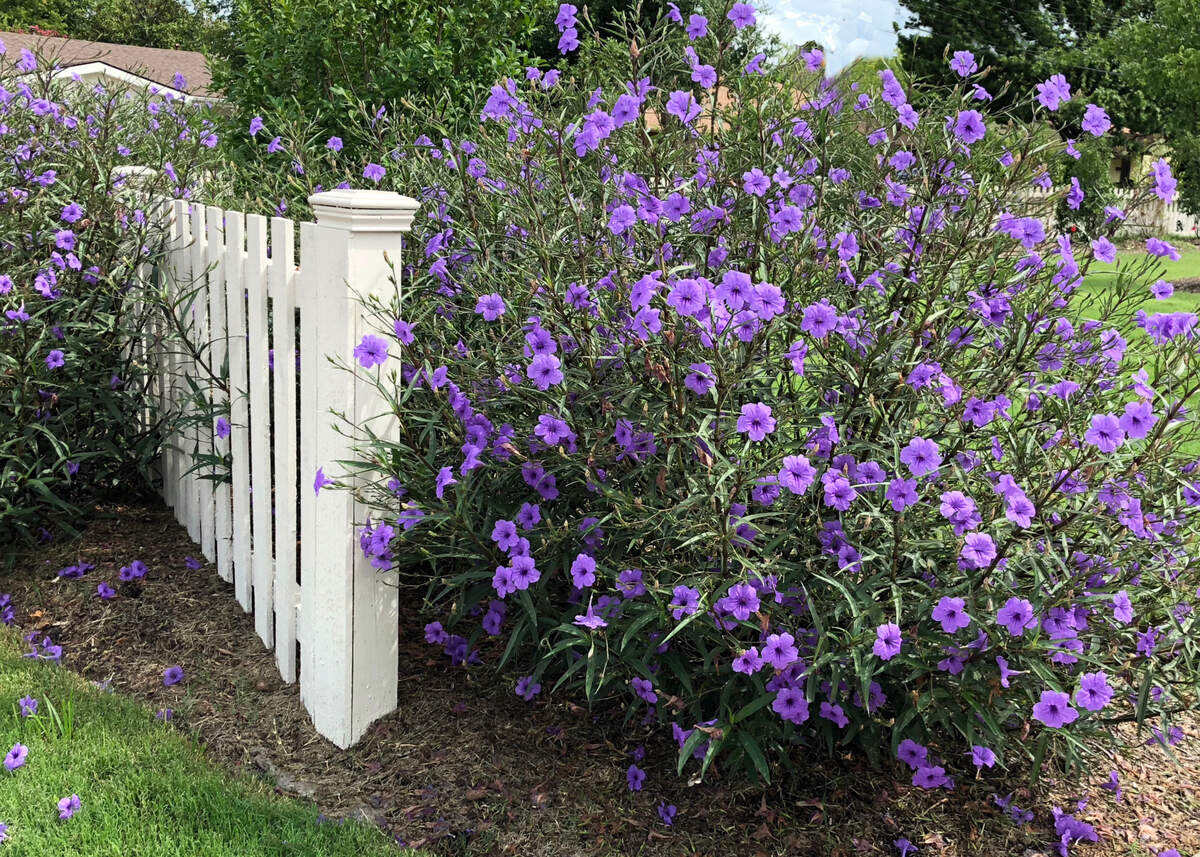
Mexican petunia (Ruellia) is impossible to keep in bounds
I hate it that I’m writing this paragraph. This is a beautiful perennial. The standard upright Mexican petunia grows to 3 to 4 ft. tall and wide. It’s most commonly blue flowering, but pale pink and white forms are also available. They’re all quite beautiful while they’re blooming spring through the fall, and they’re well suited to a variety of shade and part sun conditions. But they develop very aggressive root systems that conquer adjacent beds and turf areas. Without some kind of deep or wide impenetrable surface, it’s impossible to keep them in bounds.
Katie’s dwarf and pink and white dwarf forms get around the issues of excessive height and aggressive behavior, but they’re almost too restrained. We need a selection somewhere in the middle.
Aggressive spearmint easier to keep in bounds
Spearmint is also aggressive, but it’s easier to keep in bounds. It generally won’t jump across a sidewalk or deep metal edging. In fact, I’ve even had good luck growing it inside a 5-gallon pot with the bottom cut out. I dig a hole deep and wide enough to sink the pot flush with the surrounding grade. I fill the pot with my best potting soil and I plant my mint inside it. Its stems and roots are confined by the hard plastic walls of the pot.
Inland sea oats spreads by seed and roots
I’d love to have a second chance with inland sea oats. I would never have put it in my basket. The grass looked so serene in the nursery so I bought it. I planted a few square feet with it 15 years ago. Then it was “over there.” Now it’s “over here,” “out there,” “out back,” “up front,” and just about everywhere. It spreads by seed and tenacious roots. I guess it’s great that it has a will to survive. I just wish it would survive somewhere else. We finally applied glyphosate to it three weeks ago. Hopefully that will put an end to it once and for all.
This story was originally published July 8, 2025 at 11:34 AM with the headline "Beware of adding these unwanted beauties to your North Texas landscape."