
Here’s how to keep a good line of sight to the special places in your garden
One of your biggest goals in landscaping is to create strong visual contacts with your home and with nature. Identify focal points in each part of your garden’s design and do everything you can to bring viewers’ eyes to them.
Whether it’s the entryway for the front of your house or a pool, fountain or prime garden bed in the backyard, keep a good line of sight to that special place. Don’t do anything to distract or block those critical views, and don’t do anything off to the sides that might draw attention away. Let’s take a look at some of the specifics.
▪ The view to the front door. This is your first impression to all who pass by. It’s your welcoming statement to all who stop by for a visit. It needs to be visible, and it needs to be safe and attractive.
Somebody once described the front landscape as a “visual funnel,” with tallest plants off to the sides and tapering down to short plants near the entryway. Whether guests realize it or not, their eyes will be guided right where you want them. Don’t plant any tall shrubs where they would interrupt that visual flow or block that view.
It’s best to plant in sweeping beds that carry across the front walk, and if the alignment of windows allows, it’s nice to have one taller accent plant out 12 or 15 feet from the front door. It might be a tree-form crape myrtle or holly. Nothing overpowering — just an exclamation point where you want the attention. But don’t let it block the views of the door.
That entryway garden will look most natural if you avoid long, straight rows of a single species, and especially if you stay away from formal shearing. Those draw attention to the overall lines of the house, not to the front door.
▪ Out from the back door and across the patio. Now let’s look at things in just the opposite way. You’re inside your house, but you’re wanting to see the lovely vista that is your backyard. Maybe it’s a private garden surrounded by other homes, or maybe you’re lucky enough to have a park, creek, or a pastoral field for your overlook.
Those perspectives are quite different. In the first you control the entire setting, so you get to determine where and what your focal point is. Hopefully it will be fairly far back in the garden, so you’ll be able to take advantage of as much space as possible. That’s when you position the fountain, gazebo, or other significant piece of garden art in the prime space and you landscape around it. Keep it simple and use color wisely. Include evergreen shrubs and groundcovers for good looks 12 months a year.
Since you’ll probably have neighbors or businesses behind you in this first category, you’ll want some manner of privacy. That is not a line of sight you want to maintain. You don’t want to see those houses or apartments. Determine how tall those tall shrubs or small trees will need to be, then let a Texas certified nursery professional help you with plant choices and spacing. A repetitive row of one species might look good if it’s not long enough to get boring, or you might prefer a combination of two or three complementary plants. Those plants, however you choose and place them, will become the backdrop to your private backyard.
Or second, if you have the wide-open setting where you have a magnificent view behind your home, and if that view will probably not be changing from new building development, keep most of your plantings off to the sides. Shade trees especially should be planted to the left and the right to frame the view. Wrought iron fencing will contain pets and children without blocking your view.
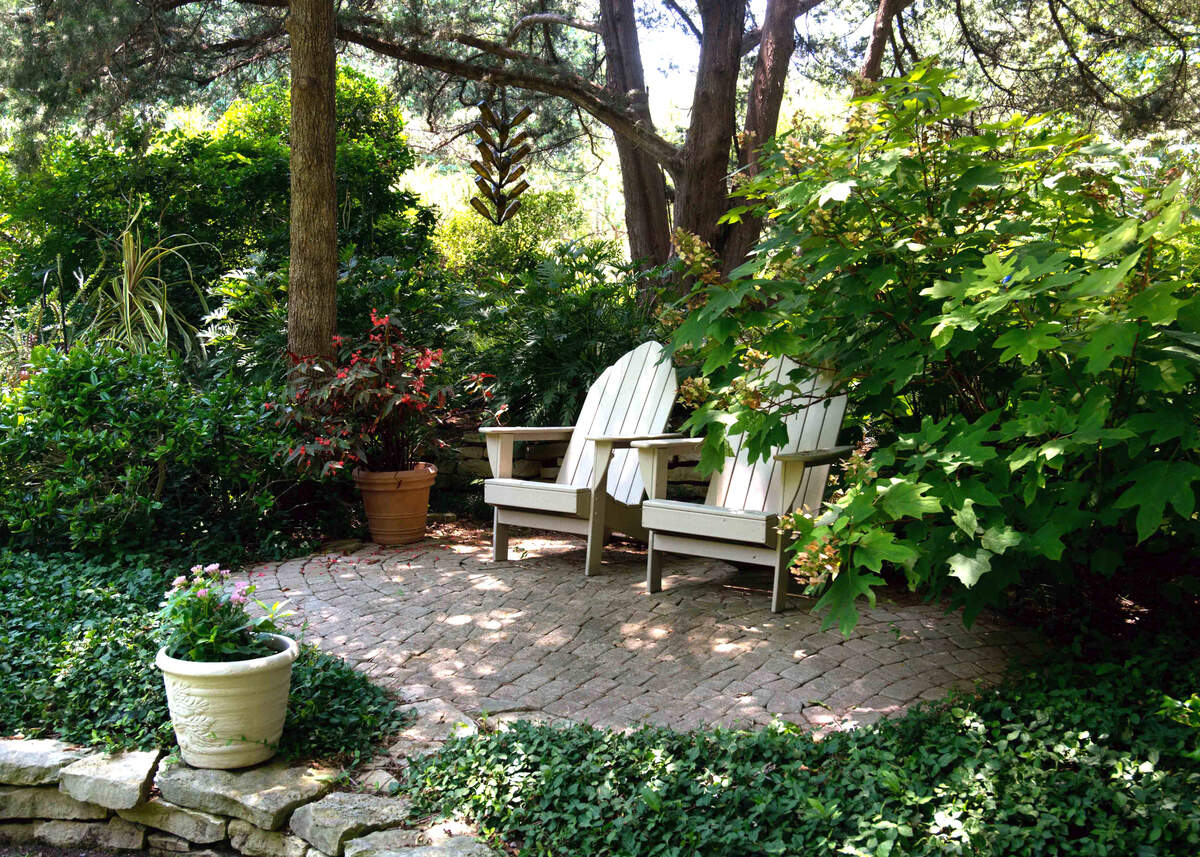
▪ Special “rooms” in your landscape. Unless you have a zero-lot-line home with a very small landscape, odds are that your garden will have a couple of hidden nooks. They might be off the kitchen or bedroom. They’re small spaces where you can tuck a tiny seating area for morning coffee or a private evening snack. It would be the place you could grow kitchen herbs or cut flowers. Whatever the use, it would be out of the main line of sight to protect its own privacy.
The greenhouse gardener in me suggests that this could also be the place where you tuck your hobby greenhouse. Be sure it’s all up to code and HOA restrictions, but once you jump all those hurdles, you’ll find that having a place to spend time gardening in the cold winter months is restoring to the soul. Since I was 11 or 12 years old when my dad and I built my first greenhouse, I’ve never been without one. You need one, too.
I started this column talking about lines of sight, so I probably need to circle back to that topic. To a degree I’ve somewhat broken my own rule by wandering off course. Such it is with gardening. The point to remember is that you always want to have a focal point to any part of your landscape, and you want to keep a laser beam set on that point so that it will always be the spotlight for all your time and effort.