
Keep these things in mind when planting a tree in a North Texas landscape
When I was a younger horticulturist, most developers were planting cheap trees with their new homes. That was “cheap” as in inexpensive, but it was also “cheap” as in “next-to-worthless.” Worst of the worst: Siberian elms. Arizona ashes. Silver maples. Trees that didn’t last as long as the first roofs.
Things have gotten better in the ensuing years. Builders are planting live oaks, red oaks, cedar elms, and Chinese pistachios now, among other types. Those are immensely better as species go, but too often the landscapers are not careful in where they’re planting them. Those are all very large shade trees, and each will command a great part of an average urban landscape.
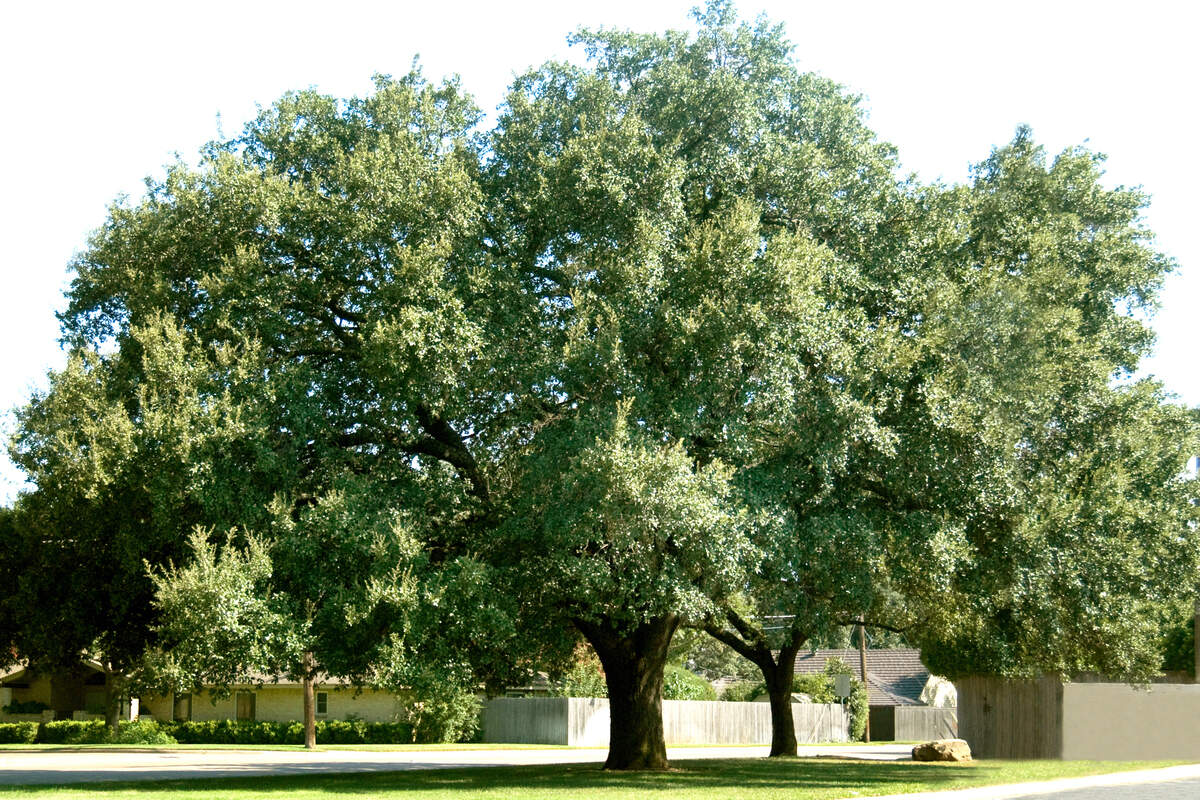
Live oaks are a great starting point for the discussion. They’re native to Texas, so they’re adapted to our soils and our climate. They’re majestic as they mature. Truth be known, they would have made a great State Tree for Texas, although who’s to quibble with our pecans?
Live oaks grow to be 35 or 40 feet tall. That’s perfect for most landscapes. However, their wingspans average 60 to 75 feet. One live oak will cover an entire front yard of most city lots, yet you see developers, commercial landscapers, and even cities themselves planting them on 20- or 25-foot centers, frequently in parkways and medians — in places where their low-hanging branches will soon cause problems with passing vehicles. Add to that the issue of their prominent surface roots. Those roots are signature items of which live oaks are famous. They become as large as the lowest branches as they grow up and out of the topsoil. They’re certain to do damage to curbs, sidewalks and streets.
Pruning isn’t the answer with live oaks. Placement is your solution. Use them by all means but position them carefully.
Current sweethearts of commercial developers seem to be bald cypress and lacebark elms. Both are lovely trees where they’re adapted, but once again you need to think your choices through before you settle on either of those.
Bald cypress trees grow quickly in nurseries, so they’re comparatively inexpensive for landscapers to buy. But they struggle with shallow, alkaline soils, especially those that are underlaid with white rock caliche as many of our soils are here in the Metroplex. Iron deficiency starts to show up after a few years and there is nothing a homeowner can do to correct it. At maturity bald cypress trees grow to be 50 or 60 feet tall (or taller) with trunks 20 to 40 inches in diameter. It’s completely impractical (and impossible) to think about applying iron to correct such a deficiency. Plus, bald cypress roots (“knees”) are especially challenging when it comes time to mow. Bald cypresses are on my “never again” list here in North Central Texas. But that’s just one guy’s opinion.
And then there are the lacebark elms. They’re comparative newcomers to our landscaping world. We knew of them, but they didn’t hit the “big time” until 30 or 35 years ago. It was after 10 or 15 years of growing them that we discovered their susceptibility to cotton root rot, a fatal soil-borne fungus that attacks a wide range of landscape plants. We have no preventive measure, and there is no cure. But we found out the hard way that it does attack lacebark elms.
Their other serious shortcoming is they have a difficult time standing upright. As they mature they commonly seem to develop a case of the “leans.” By the time we realize it, there’s not much we can do to correct it. So, for both of those reasons, cedar elms will serve you much better.
.jpg "Imagine trying to maintain turf with these bald cypress roots (knees).jpg")
Chinese pistachios are handsome trees. They offer excellent fall color in large, rounded shade trees. They grow to 40 or 45 feet tall and wide. They’re dark green all summer, turning all shades of red, orange, and yellow in the fall. A downside might be that the female pistachio trees bear fruit that does sprout up occasionally in beds, but one quick swipe with the hoe can eliminate the chance seedlings just as it would for oaks and pecans.
If you want perhaps the perfect compromise to all that we’ve discussed, consider a chinquapin oak. Like bur oaks and Shumard red oaks, they’re native to the Fort Worth/Dallas area, so they’re perfectly suited to our soils and our climate. But the neat thing about chinquapins is that they’re still relative newcomers to landscapes. You’ll see them being used in fine gardens and large commercial plantings, and savvy home gardeners have come to love them, but they’re not nearly as common as most of the other trees under discussion today.
Chinquapin oaks grow to 45 or 50 feet of height and width. They have large, oval leaves that are dark green all summer with silvery-gray reverses and wavy margins. Fall color isn’t especially showy, but it doesn’t last very long anyway so it’s not a big deal. Their bark is platy dark gray and distinctively fissured. These are beautiful trees that are finally getting the attention they deserve.
I know we’ve discussed the importance of choosing quality shade trees before here, but after seeing too many landscapes recently where good trees have been ruined by bad designs of close plantings, I thought it might be a good idea to go back over the basics one more time. I hope this has been of help as you plan your next plantings.