
Here’s how to build your own walkways and patios to create a beautiful, antique look
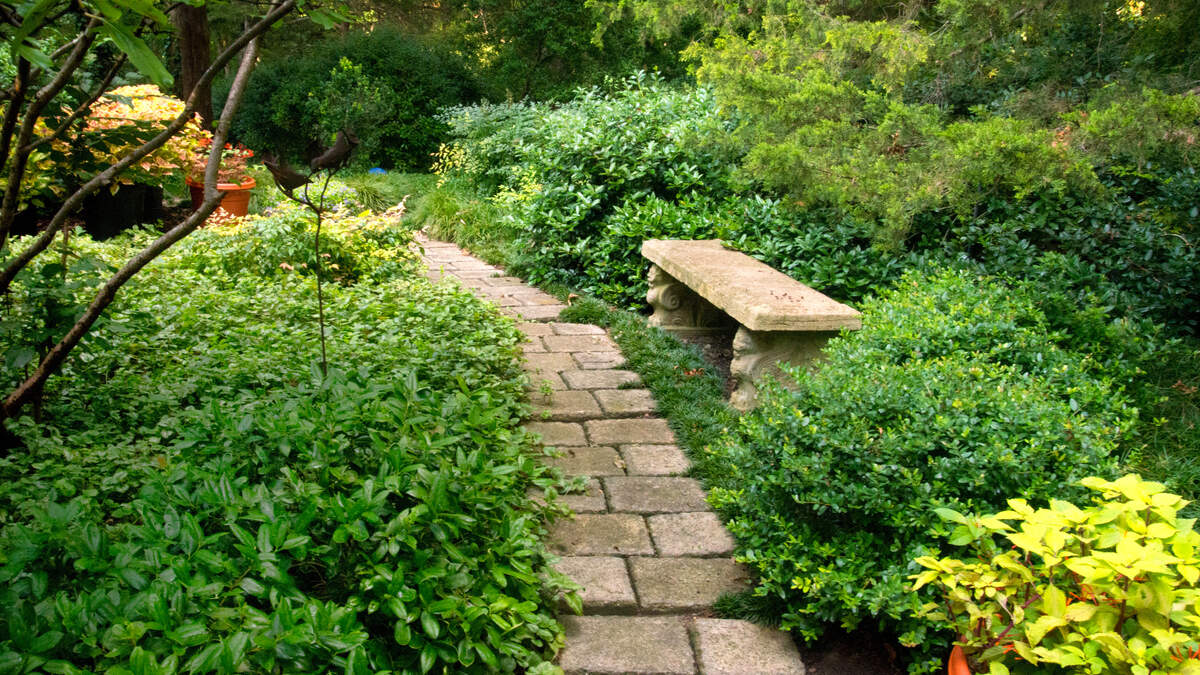
I’m thinking back 35 years ago. The Sperry family was touring Northern California, the Bay Area, the Big Trees and Napa Valley.
It was that last stop about which I’ll tell you today. We’re certainly not wine connoisseurs, but if you’re that close to all those beautiful vineyards you have to stop to see at least one of the wineries. We chose Robert Mondavi’s.
I honestly don’t remember anything about the winery itself. The family went inside. I eventually joined them, but my mind was elsewhere.
For the longest time I was out on the front walk taking photos and gathering ideas of something I could hardly wait to come home and try.
I’ll explain what I think they had done by giving details of what I tried with great success. This has been a conversation starter around our house ever since. I’ll tell you about the 264 “antique” steppingstones I made the rest of that summer.
I needed frames. I used 1x6-inch lumber ripped in half. That meant that each stone was just shy of 2-1/2 inches thick. Most of them were 12x16 inches, but I also made many square 12x12 inches. Having the two sizes has allowed me to alternate them for a more pleasing appearance.
I cut the bottoms of my forms out of 3/8- or 1/2-inch plywood. I used double-headed nails so I could easily pull the sides of the forms apart between pours. I reused those boxes time after time. I think I had about 15 boxes, so that would make almost 20 pours.
I did all of my pouring on a flat piece of bare ground. It was summer so the concrete would cure fairly quickly. I troweled it as soon as it quit puddling using the same masonry trowels I’d borrowed out of my dad’s workshop to use in our sandpile when I was a kid. I troweled a very slight bevel around each edge just to get rid of any sharp corners.
I wanted a somewhat fossilized look for some of my stones, so I collected leaves from around our landscape and pressed them into perhaps 10% of the stones. Boston fern fronds looked great, as did red oak and holly leaves. I kept it simple, working hard not to overdo it. As the stones dried, so did the leaves. Within a few days I could use a wire brush to get rid of all the dead tissues.
Remembering the pitted look of the concrete at the Mondavi Winery, I sprinkled ice cream salt across each stone and gently pressed it in flush with each surface.
When the concrete was still “green” the next day I knocked the stones out of their forms and used a special rock hammer very carefully to chip the edges off all the stones. My goal was to give them an aged look.
Carrying that one step further, I purposely broke several of the stones into two pieces, carefully keeping them together so I could lay them in place in my new patio or walk.
The last step in all of this was to sweep all the rock salt, now dried back into its original grains, into a pile and put it back into a bucket for use on the next pour. That was important because I didn’t want salt soaking into our soil.
I placed our walks and patios on beds of packed brick sand. My first job was to dig out about 3 inches of the black clay topsoil. Then I added 1 inch of washed brick sand and raked it smooth with a garden rake turned upside-down.
I used an inexpensive string line level to establish a grade to be sure I wasn’t creating any low spots where water might stand. I placed the stones in an attractive arrangement and walked on them for a prolonged period to settle them tightly against the sand.
I then spread a 1/2-inch layer of dry sand over the top and swept it in with a stiff broom, then sprayed the surface gently to clean it. I added one more round of dried sand a few days later just to fill in the voids.
A separate patio …
One special project toward the back of our landscape involved cutting the stones to form a circular patio. I drew the pattern on my bed of packed sand, then laid the stones in place. Once I had the area covered, I drove a rod in the ground in the center. We took a length of string with a piece of chalk attached to it and marked the precise circle.
We used a masonry blade to begin cutting the stones. It required 15 or more blades to cut all the stones, and the “circle,” of course, was made up of many short, straight cuts, but the finished product was very satisfactory.
One of the nice things about these homemade concrete patio stones is that they are completely portable. If you decide that you want a walk or a patio somewhere else in your landscape, all you have to do is lift them out and move them on to the next place. Some of our stones are now in their third homes.
You can hear Neil Sperry on KLIF 570AM on Saturday afternoons 1-3 p.m. and on WBAP 820AM Sunday mornings 8-10 a.m. Join him at www.neilsperry.com and follow him on Facebook.