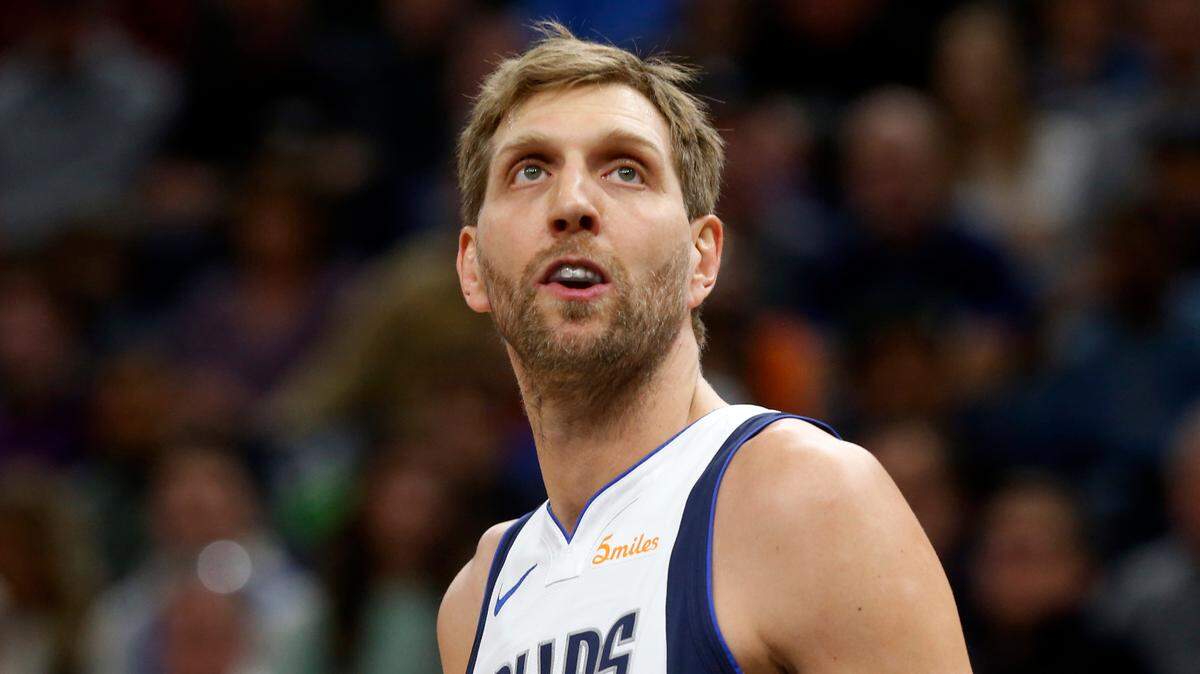
Dirk Nowitzki’s legacy is beyond basketball. He changed the way the world views Germany
Walking around the concentration camp Dachau near Munich, Germany in the summer of 2006, a few high school students sauntered behind the rest of the group speaking in their native German, and one of the kids stood out because of his shirt.
He wore a blue Dallas Mavericks No. 41 Dirk Nowitzki jersey.
The high school kids didn’t want to be here, even if it was the chance to be out of the class room for the day.
The Holocaust is a mandatory subject taught in German schools, but for these kids it was just another dull subject from a dull history book.
These kids knew far more about Dirk than their countries’ own history. Their parents, and grandparents, however, lived it.
On Dirk Nowitzki’s long list of achievements there is one we missed; it’s a feat that doesn’t come with a trophy, a plaque or ceremony. You can’t quantify, or package, something like this.
Dirk changed not only basketball, but the way a world views a nation.
For 80 years, the world’s view of his native Germany was that of war, of horror, of terror, of a dictator, of the Holocaust, of the Cold War.
This month, filmmaker Ken Burns released his latest documentary on PBS, “The U.S. and the Holocaust.”
It’s a necessary reminder of not only the Holocaust, where six million Jews were murdered during Adolph Hitler’s regime, but a history lesson for all of us who thought the United States welcomed Jewish people when they tried to escape Europe.
World War I, World War II, the Holocaust, Hitler, the 1972 Summer Olympic Munich Massacre, the steroid infused members of the East German swim team in 1976, and the Cold War shaped the world’s views Germany for decades.
Multiple generations of citizens all over world associated Germany, and Germans, based largely on those events.
Those impressions don’t fade. Some of them, tragically, are forgotten.
Dirk was born in 1978. He came to the U.S., and the Mavericks, in 1998.
In between his birth and his arrival to the United States is when Germany was reborn.
The Berlin Wall came down on Nov. 9, 1989. As the former Soviet block crumbled, Germany was unified.
A war can end, a wall can come down, but the cleanup and the restoration can be messy, painful, and takes generations.
It takes people like Dirk.
People like Dirk, tennis star Boris Becker, figure skater Katarina Vitt, model Heidi Klum, F1 driver Michael Shumacher, and author Eckhart Tolle helped alter the way the world sees a new Germany.
“It’s very sweet of you to say but when I first left Germany I never thought about stuff like that,” Nowitzki said in a recent a phone interview. “Representing Germany was the last thing I was thinking about. I wanted to make it in the NBA, and have an impact and be successful. That was why I came over; I just wanted to compete in the best league in the world.”
After spending the past few weeks at the EuroBasket tournament overseas, he’s back home in Dallas.
On Sunday at SMU, he will host the “Dirk Nowitzki Pro Celebrity Tennis Classic” for his foundation; recognizable names such as Andy Roddick, Mardy Fish, John Isner, actor Ben Stiller and Mavs forward Luka Doncic are slated to play.
In the span of his 21-year NBA career, few athletes have ever been as universally respected, beloved, appreciated and celebrated like Dirk.
By the time Dirk was drafted by the Milwaukee Bucks and traded almost immediately to the Mavericks in 1998, there had been other Germans, and Euros, who had played in the NBA.
None of them made Dirk’s impact.
“It’s been such a long journey; if you had told me after 21 years I’ve changed some of the way people think that’s a huge honor to me,” he said. “To have that impact, it’s very humbling. I just wanted to be the best version of myself, and to be myself on the court.
“I didn’t try to put on some spiel. I tried to enjoy my time and if changed some people’s minds, that’s great.”
What happened in Germany Dirk had nothing to do with.
He didn’t intend to do it, but Dirk being Dirk changed his countries’ future.
“Every country goes through a lot of stuff. I mean, look at all of the stuff that happened in the last few years with the pandemic,” he said. “When I first got to the U.S., there was no Internet. The world has changed so much, and it’s all so different than when I first got here.
“I still go back to my roots and to see my family, and my friends from school when I go home. They’re still the same, and we’re all happy to see each other. Since I don’t live there any more it’s hard for me to say how their lifestyle has changed.
“Germany will always be a nice country with nice people. That’s what I see.”
Nothing can change Germany’s past, but thanks to Germans like Dirk Nowitzki, it’s what the rest of the world sees now, too.
This story was originally published September 23, 2022 at 8:29 AM.