Inside NFL’s blackout era, when Dallas Cowboys fans used special antenna to watch games
Remember the first time Emmitt Smith scored a touchdown on the Dallas Cowboys’ home turf? It was the beginning of the fourth quarter in a game against the Tampa Bay Buccaneers. Smith’s white jersey, splashed with sunshine coming through Texas Stadium’s distinctive hole in the roof, looked immaculate compared to Tampa Bay’s creamsicle orange uniforms, and his shoulder pads puffed out almost as high as his head. Troy Aikman, in comparatively less bulky pads, pitched him the ball from the Bucs’ 14-yard line. Smith cut inside and dodged a tackle at the 14. He darted outside and picked up speed, avoiding a diving defender at the 8 and splitting between two more at the 3. He was in. It took less than five seconds. The score put the Cowboys ahead, and they would go on to win the game 14-10.
That play happened 30 years ago this fall and, given Smith’s record-breaking career, should be ingrained in the memories of all diehard Dallas Cowboys fans. Except, it probably isn’t. Unless you were at Texas Stadium, nobody in the Dallas-Fort Worth area was able to see it. The game was blacked out.
Because the Cowboys didn’t sell enough tickets for a full house against the Buccaneers, the NFL barred the local TV affiliate in Dallas-Fort Worth from showing the game. For 75 miles in every direction from Texas Stadium, it was unavailable on TV. You couldn’t watch the Cowboys at a house on Fort Worth’s west side, at an apartment in Uptown Dallas or even a bar in the area once known as Restaurant Row, where the NFL would sometimes send undercover agents to threaten $50,000 fines against Dallas proprietors using satellite dishes to beam the game to a wide audience.
If this all sounds like a vaguely distant memory, if not a custom from an alternate sporting universe, it should. Today the concept of a blackout, particularly of the Cowboys, seems as bonkers as it does outdated. NFL TV revenues are estimated at $6 billion annually, exceeding stadium revenues, and TV provides the foundation of the league’s relationship with the vast majority of fans. The Cowboys are the No. 1-viewed team nationally, and 30% to 40% of DFW TV sets typically tune in when they’re playing.
But from the franchise’s beginnings in 1960 through that 1990 season, blackouts of home football games were the norm. Sundays in DFW regularly passed without the promise of a televised Cowboys game. And it didn’t change until Smith, Troy Aikman and Michael Irvin restored the franchise’s winning ways, Jerry Jones introduced an egalitarian style of sports marketing, and a high profile grocery store executive came to the rescue.
This is the story of the Dallas Cowboys’ blackout era.
The rise of blackouts and Cowboy antennas
Approval of NFL blackouts started in the halls of the Capitol Building. NFL executives, fearful of TV diluting the size of their stadium crowds, lobbied the federal government for help, and Congress granted them an antitrust exemption in 1961.
Just like that, professional football had unquestioned power to black out all home games on local television. The ruling was based on the justification that blackouts maintained the league’s financial stability, which Congress reasoned was good for the general public because it meant professional football would survive and remain available as a product. Of course, this line of thinking was a massive paradox: Thomas Torrens described the exemption in a 1972 Cornell Law Review article as “a restriction on public access to professional sports contests to promote public access to professional sports contests.”
The blackout rule had almost no exceptions, even as the NFL’s popularity soared. In the 1960s and early 1970s, local fans were prevented from watching some of the most iconic football games in NFL history unless they were fortunate enough to have scored a ticket. Pittsburgh residents missed Franco Harris’s Immaculate Reception in 1972, Kansas City fans couldn’t watch one minute of the longest game in NFL history in 1971, and Green Bay fans only saw the Ice Bowl against Dallas in 1967 if they were freezing in the seats of Lambeau Field.
Cowboys general manager Tex Schramm was among the staunchest supporters of blackouts. After all, they had helped turn the Cowboys into America’s team: Fans in other cities who couldn’t watch their blacked out home team had grown enraptured by the successes of Don Meredith, Roger Staubach, Tom Landry and the rest of the Cowboys. Plus, Schramm had one of the largest stadiums to fill at the Cotton Bowl and later a large number of luxury boxes and seat licenses for Texas Stadium.
He once called the DFW residents who wanted to watch football on television “freeloaders waiting for home delivery.” “I have very little sympathy for the man — you can’t use the word ‘fan’ — who wants something for nothing,” he said. Randy Galloway, the former longtime columnist and reporter for the Star-Telegram and Dallas Morning News, says television conflicted with Schramm’s cardinal rule as general manager, which was to never give away his product. “I heard that sermon particularly after Tex had had five scotch and waters,” Galloway says.
In the 1960s and 1970s the Metroplex was apparently teeming with some of the most innovative “freeloaders” in the country. To escape blackouts, Cowboys fans rented hotels outside the boundaries in places like Waco or Denison. “It almost became a social event to go out of town,” Galloway says.
Others upgraded their TVs with the aid of local companies that manufactured “Cowboy antennas.” These gadgets intercepted signals beyond the DFW market. The picture wasn’t always clear, unless people got creative. One fan who bought a Cowboy antenna in Fort Worth, designed by an engineering firm, bolted it to a 50-foot tower and bragged that his setup not only picked up faraway signals but amplified them. “It hones in on them babies,” he told the Star-Telegram. “That picture shoots in here from Waco like gangbusters.”
Apartment complexes got in on the action, too, using Cowboy antennas to entice prospective tenants. One complex on South Hulen noted in a classified ad, “Large pool and club room. Shag carpets and drapes. Cowboy antenna.”
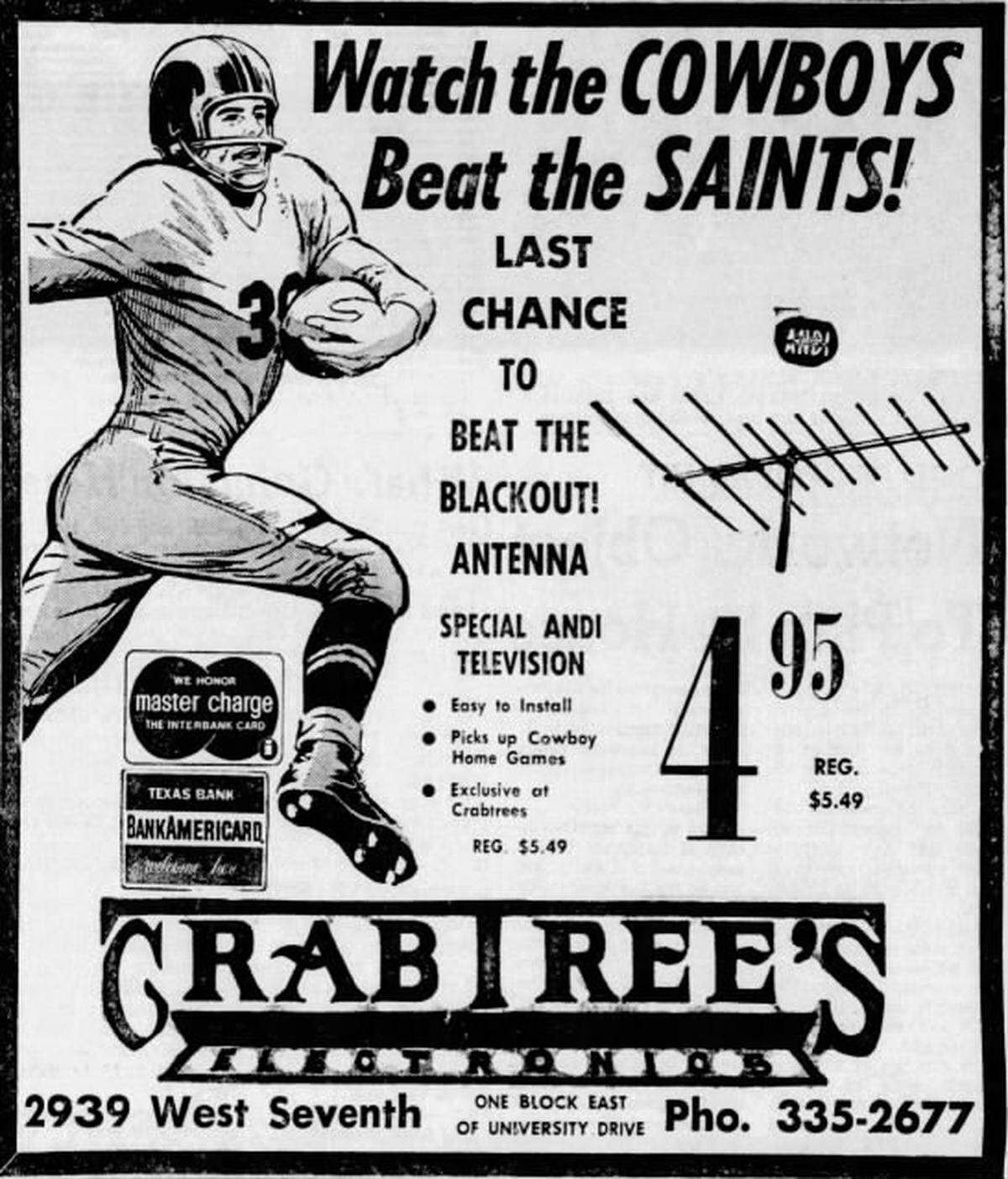
In a 1971 survey, the team estimated 50,000 Cowboy antennas had been sold in the Metroplex. That same survey looked at a region encompassing Garland, Irving and Plano and discovered that 10% of all TV sets during a Sunday afternoon Cowboys game were tuned into a Sherman-Denison station they were not supposed to receive. “That was as many sets as were tuned into Channel 8 at the same time,” team vice president Al Ward told the Star-Telegram at the time. Ward referred to the antenna users as “technological freaks”and ahead of the 1971 season the team punished Dallas-Fort Worth residents by barring the Sherman-Denison station from airing home games.
In 1973, Richard Nixon, an adopted fan of the Washington Football Team, provided a partial victory for all the freeloaders. He signed a bipartisan bill forcing NFL teams to televise home games in local markets if the games were sold out at least 72 hours before kickoff. For most of the next 16 seasons, a run of 11 playoff berths and and three Super Bowl appearances, sellout crowds of 60,000-plus fans filled Texas Stadium, so nearly every game aired on TV. Blackouts crept in again during a strike-affected 1987 season and a 1988 season that marked Landry’s worst year since his first season.
But by the time Jones arrived in 1989, raising fans’ ire as the Arkansas outsider who fired Landry and alienated Schramm, the crowds were gone and with them the opportunity to be on TV. The difference between Jones and Schramm was that Jones wanted to do something about it.
Jerry’s marketing moves
In 1989, Jones paid $60,000 out of his own pocket to buy the remaining 2,500 seats and ensure his first home game as owner, a preseason match with the Houston Oilers, would be televised. There was electricity and a buzz to knowing a game was sold out and that all local fans could watch. Green Bay and Pittsburgh and even division rivals like Washington and the New York Giants experienced that buzz every weekend. But typically anywhere from one-third to one-half of all NFL games in the late ‘80s and early ‘90s were blacked out. The Cowboys, whose pedigree placed them with the Pittsburghs and Green Bays of the world, found themselves among the Tampas and Phoenixes, the NFL’s plebeian class. In 1989, six of Dallas’ eight regular season home games were blacked out.
“Around the NFL if you didn’t sell out your games, you were perceived or viewed as one of the have-nots,” says Rich Dalrymple, the Cowboys’ communications director, who joined the team in 1990.
Jones also believed the Cowboys had more national than local resonance, in part because blackouts made them invisible in DFW for half the season. Steve Orsini, who was the Cowboys’ director of administration, remembers a prevailing question when Jones arrived was, “How do we build our brand better in our own market?”
Orsini spent 10 years with the Cowboys: five with Schramm, five with Jones. He praises both men’s Hall of Fame achievements, but notes the difference between them was stark. Schramm, who devoted all his energy to the on-field product, essentially had no marketing department. The ticket sales department, helmed for decades by Kay Lang, followed a technique she once described as “Never push. Just wait for the people to come to you. If you’ve got a good product, people will buy it.” Laissez-faire strategies worked in playoff seasons. They did not work in lean years. They had also, unintentionally, cultivated an elite following more reflective of old, provincial Dallas than the rapidly growing and changing Metroplex.
“A large majority of your crowd ... was high income,” Galloway says. “It was a high income type of environment.” Jones sought to extend the Cowboys’ local reach to a broader, more diverse population. “With the marketing, we were reaching out to people,” Orsini says. “Like, ‘Hey we’re here. We love you. This is your team.’”
Jones exhibited this strategy on a sizzling July night in 1990, when he hosted Texas Stadium’s first ever open house. About 10,000 fans came to meet and greet the cheerleaders and players and collect Jones’ autograph. Jones tried to play the role of an everyman, directing the fans onto the field himself. The Cowboys sold about 500 season ticket packages that night. This counted as a triumph, lifting the number of season ticket holders above 41,000 for the first time since 1986.
To further stoke local interest in the team, Jones convinced the Irving City Council to pass a zoning exemption for a beer garden in Texas Stadium’s parking lot called “The Corral.” He struck a deal with the radio station KVIL where KVIL would refund — and then give away on air to someone else — the season tickets of any dissatisfied fan who had purchased the tickets. The higher-end clientele was not forgotten either: The Adolphus Hotel offered a Cowboys package for $280 that included a Saturday night stay, two tickets to the Sunday game and free transportation to Irving.
Even with the promotional efforts, the question of whether the Cowboys would sell out and avoid blackouts hung over the 1990 season. “It was one of the main storylines for the team and organization and media: ‘Is the game going to be sold out?’” remembers Dalrymple. The answer, in Week 1, was a hard no. About 48,000 fans showed up to watch the team spring an upset against the Chargers. It was, at least, a few thousand more fans than the last home game of 1989.
The Cowboys started the season 3-7. Then, something crazy happened. The defense became as stingy as any in the league, and the offense, led by Emmitt Smith, who was on his way to the NFL Offensive Rookie of the Year award, made just enough plays to eke out dramatic victories. They won four games in a row. People started coming back to Texas Stadium. For the first time since 1983, attendance reached 60,000 for five consecutive games.
But people still couldn’t watch the Cowboys on TV in DFW. The tickets sufficient to cancel the blackout were not purchased far enough ahead of the 72-hour deadline. Getting on TV for good, just in time for Aikman-Smith-Irving dynasty to hit its stride, required another marketing effort from Jones and his friends.
Saved by Kroger
On Sept. 6, 1991, ahead of the Cowboys’ Monday Night Football season opener, a man named Bill Parker made an announcement that launched a thousand phone calls.
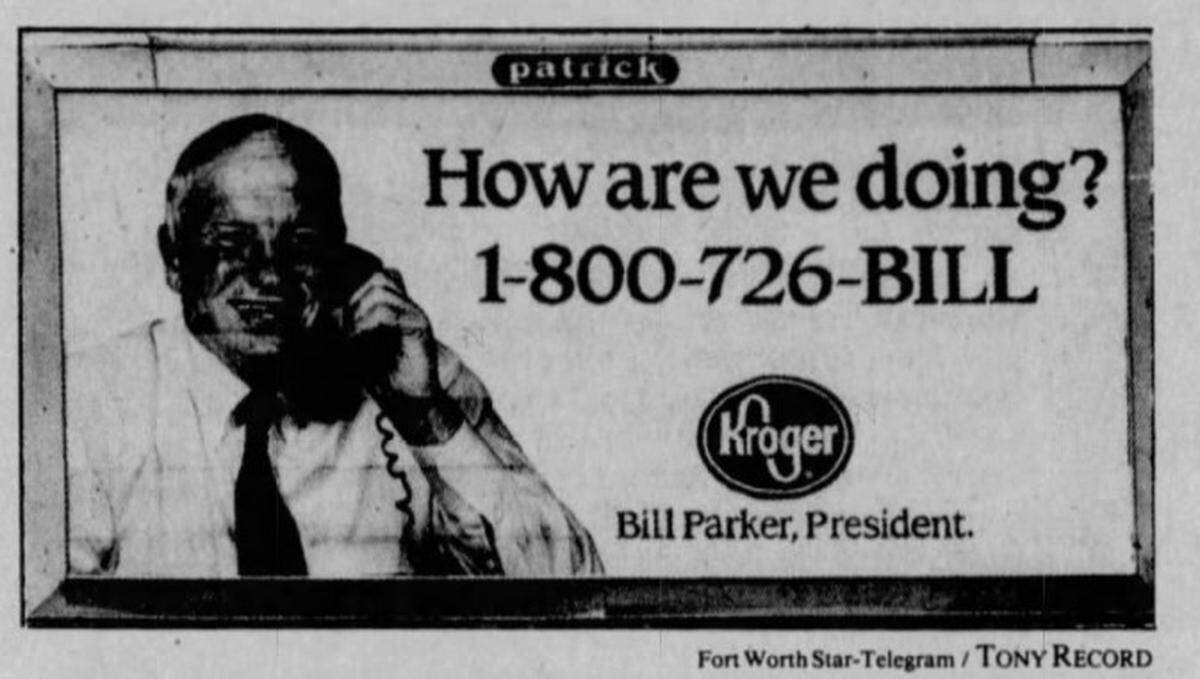
In the early ‘90s, it felt like everyone in the Metroplex knew Parker. He was a meat cutter from Indiana who worked his way up through the corporate offices of Kroger, taking a position in North Texas to lead the grocery chain’s regional operations. This was in an era when a used car dealer with a great jingle could become a local celebrity, and Parker had something even better than a jingle: billboards, plastered throughout DFW, including on Interstate 35 near downtown Fort Worth. The billboards featured Parker in a suit and tie holding a landline telephone to his ear. To his left was the number 1-800-726-Bill. Customers were encouraged to call in with questions, comments or complaints that, allegedly, were routed to Parker.
Jones had met Parker through their mutual friend Don Tyson, then-CEO of Tyson Foods, and Kroger became a major sponsor of the Cowboys. By the first week of September, when it was unclear how ready fans were to invest in a promising but still unproven team, Parker bought some 2,000 remaining tickets available for the home opener, as well as several thousand more for the next two games at Texas Stadium. The tickets were distributed among Kroger employees, sold at grocery stores and donated to families and children.
The 726-Bill hotline, which typically received a few hundred calls per week, was inundated with people asking him for tickets or thanking him for getting the game on TV. And, yes, sometimes Parker himself would return people’s calls to the hotline from his own home.
“In the early going in the ‘90s, he was the reason we got more games on the television,” Dalrymple says, “and then the team had a bit more of a winning streak.”
Still, Parker, who died last year, had to swoop in again for an early season game against the Cardinals in 1992, buying the necessary tickets for Dallas to avoid a blackout. “We did this so over 5 million people could see the game,’ Parker told the Dallas Morning News. “I don’t know if discouraged is the right word, but it’s highly unusual for a 2-0 team that may be on its way to the Super Bowl not to be able to sell out a home game.” The Cowboys, of course, did make the Super Bowl that season. The team’s championship success and Jones’ marketing machine combined to make it almost impossible to find tickets to Cowboys games, and every home game began airing on TV.
“I’ve spent 30 years with the opportunity of having not work but having more fun every day maximizing the platform of the Dallas Cowboys,” Jones said in August. “Somebody looks the other way I say, ‘Whoa come back look over at the Cowboys.’ And when it got a little dull I tried to liven it up from time to time.”
The last blacked out home game in team history ended up being the final game of the 1990 season. There was a close call in the 2001 Quincy Carter-Ryan Leaf era and rumors of a potential blackout in 2009, the year Cowboys Stadium opened. This is no easy feat: As recently as 2010, 10% of NFL games were blacked out for home markets, and teams with strong fan bases, like the Indianapolis Colts and Seattle Seahawks, endured blackouts after 2000.
Even in down years and with the fourth-largest stadium to fill in the country by seating capacity, longtime observers say Jones has ensured sellouts by placing an equally powerful emphasis on marketing as in his early days and by creating the festive atmosphere that appeals to a wide spectrum of fans. “He wants to put on a show,” says Brad Sham, the radio voice of the Cowboys. “And I don’t know if it was the case as much in 1989 but it certainly became the case very quickly that putting on the best show involved putting on a great show for television.”
Sham recalls being at the same marketing meeting as Jones in the early ‘90s when Jones discovered a study about the reach of TV. The takeaway was that only 7% of NFL fans had been to a stadium; the vast majority of interest stemmed from television. It was Jones who helped bargain for bigger TV contracts in the 1990s that have grown enormously over the last two decades. And in 2015, the NFL owners, over whom Jones wields enormous power, voted to effectively nix blackouts, appeasing Congress and the FCC, which had been targeting the NFL’s power for years.
In early August, when Jones recently held his first press conference in months, he brought up that 7% statistic. TV will never be more important to the NFL or the Cowboys than this season. “We all know what’s going on in this country,” Jones said.
At best, it seems AT&T Stadium will be half full. The home opener will likely be the first time since the 1990 season the Cowboys have fewer than 50,000 fans in attendance. But at least this time there will be no blackout.
This story was originally published September 10, 2020 at 6:00 AM with the headline "Inside NFL’s blackout era, when Dallas Cowboys fans used special antenna to watch games."