
Block or charge? It’s a tough call either way
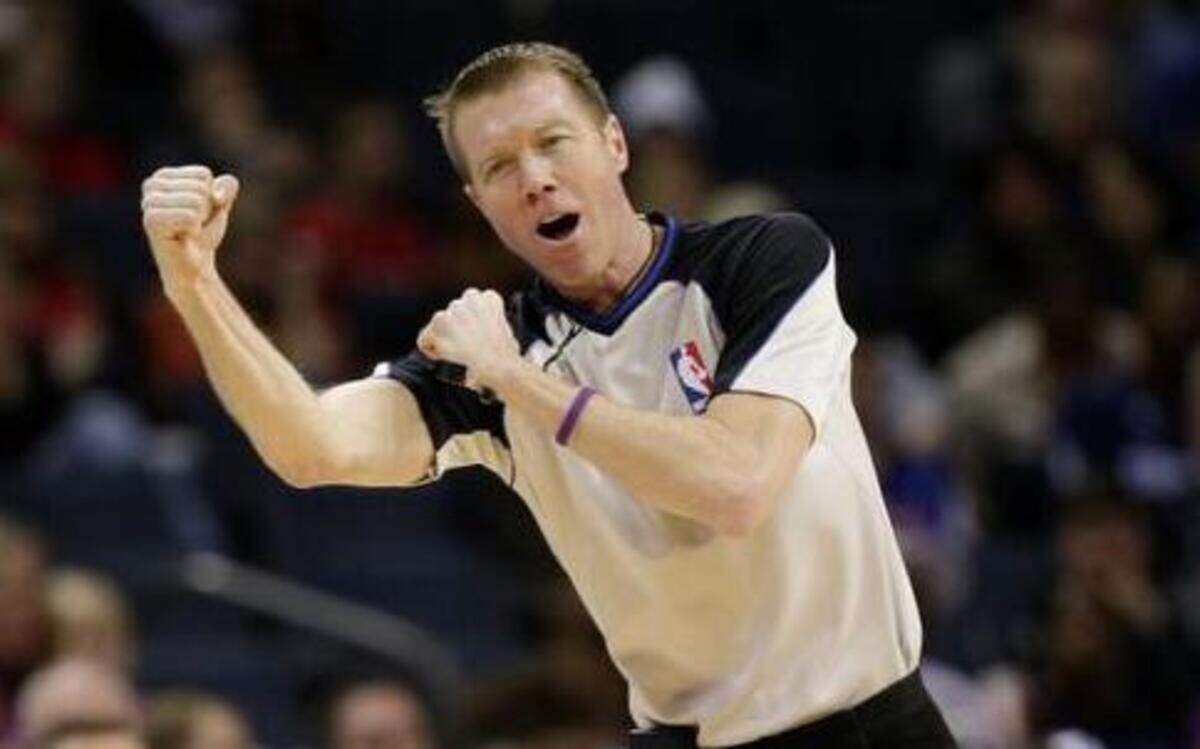
Block or charge?
Blocks and charges might be the toughest calls in basketball and one of the hardest to make in sports.
By definition, “a block or charge foul occurs when a defender tries to get in front of his man to stop him from going in that direction. If he does not get into a legal defensive position and contact occurs, it is a blocking foul. If he gets to a legal position and the offensive player runs into him it is an offensive foul.”
It’s a difficult call on any level of basketball, but particularly in the NBA, where the skill level and athleticism is at its best. It’ll draw even more attention when the playoffs begin a week from Saturday.
“It is one of the toughest calls in the league, in our game because of the bang-bang nature of it. But I do believe they do get the majority of them right,” Dallas Mavericks coach Rick Carlisle said.
There are a lot of factors involved in an NBA official making the call.
▪ Is the player in a legal guarding position?
▪ Is the player outside the lower defensive box?
▪ Is the player inside the lower defensive box?
▪ Did the defender allow enough space for the offensive player to stop and/or change directions outside the box?
▪ Did the defender allow an airborne offensive player enough space to land inside the box?
▪ Did the offensive player lead with his knee or foot?
An official must decide all those factors within seconds.
“I think that and goaltending are probably the two toughest calls to make in our game. But the block/charge is by far the hardest, because it’s tough. You’re looking at so many things,” Los Angeles Clippers coach Doc Rivers said. “The league has done a great job with us in trying to tell you exactly when you can set. It used to be once you left your feet. Now it’s whenever you gather yourself in a motion of jumping, that guy has to be set.
“They’ve at least given us a clear vision on how to get to a charge. That’s a bang-bang play. You know how quick that is?”
Chuck Cooperstein has been a regular on the Dallas/Fort Worth sports scene since 1984 and is in his 10th season as the radio play-by-play voice of the Mavericks. He has seen the call many times during his career.
“It’s right at the top. It’s the hardest call for any basketball official to make, doesn’t matter the level. The one angle as an official — did they slide in squarely into the ball handler, who got to their spot first — there’s a lot that’s there,” Cooperstein said. “It’s not always cut and dry. The circle helps, but ultimately it comes down to the athleticism of players, especially the defenders — can they get to that spot in time before the offensive player goes up with the ball.”
Officials have a backup late in NBA games. They have triggers, actions or situations, that allow them to go to the scorer’s table to see the replay on calls made during the final two minutes of a game and in overtime.
Other than that, it’s strictly left up to the officials at the time of the call.
“They’re never going to get it all right, but hopefully most of the time they get it right,” Mavericks point guard J.J. Barea said.
Momentum swings can happen in many different forms. A three-point play, steal and transition basket, and a jumper at the end of the shot clock. Taking a charge also falls in that category.
“You take a charge, it’s a momentum play. If you successfully take one, it can really swing the momentum in your favor, and that’s really an important thing,” Carlisle said.
Mark Followill, in his 10th season as the Mavericks’ television play-by-play voice and his 14th overall with the team, has seen many games swing positively or negatively after a block/charge call.
“It’s huge. First of all it’s a possession, which clearly grows in significance later in the game. And it sets a great tone for the rest of the team to see players sacrifice and willing to put themselves in harm’s way,” he said.
In 1997, the NBA adopted the restricted circle, a 4-foot radius under the basket in which a defender can’t take a charge at any time. That defender must be outside the “restricted area” in order to obtain an offensive foul on the opposing player.
“I think creating that circle has helped them a tremendous amount. It is such a hard call,” Rivers said.
Inches and seconds count when determining the location of a defender.
“You just try to get to the spot before somebody. That’s a big play if you can get a charge. I think it’s worth trying to take it because the games come down to one possession here and there, so if you can get a charge it gives you an extra possession,” Clippers guard Dahntay Jones said. “I think that’s a great thing anytime you can do it.”
Everyone in the league is not a fan of the restricted circle or how the block/charge calls are made.
Mavericks owner Mark Cuban said the block/charge call ranks third in his opinion for the hardest call in the NBA.
“Three seconds in the key is the one missed the most. Then traveling,” Cuban said. “Blocks and charges aren’t the hardest because you have a 50/50 chance to get it right — it’s just the most visible.
“I think we should move the circle out so it is easier to call, and a wrong call would be less likely to affect the outcome of a game.”
Clippers forward Matt Barnes took the issue a step further by saying he doesn’t like anything about the block/charge call.
“It shouldn’t happen. I just think it takes away from the game. If you’re going to play defense, play defense. If you’re going to come help, try to block the shot,” Barnes said. “I just think the block/charge is such an up-in-the-air call, and a lot of people get hurt from it from landing wrong.
“I just don’t even like it. Period. It’s a bang-bang call with a lot of other stuff going on. I like it better back in the day when they didn’t have it.”
Staff writer Dwain Price contributed to this report.
Game changers?
Four notably difficult calls that sports officials have to make in games:
Basketball’s block/charge: A block or charge foul occurs when a defender tries to get in front of his man to stop him from going in that direction. If he does not get into a legal defensive position and contact occurs, it is a blocking foul. If he gets to a legal position and the offensive player runs into him, it is an offensive foul.
Football’s pass interference: When any player movement beyond the line of scrimmage significantly hinders the progress of an eligible player of such player’s opportunity to catch the ball. Offensive pass interference rules apply from the time the ball is snapped until the ball is touched. Defensive pass interference rules apply from the time the ball is thrown until the ball is touched.
Baseball’s check swing: A batter begins to swing at a pitch, but stops, realizing that the pitch is out of the strike zone. The umpire rules whether the batter interrupted his swing in time, usually determined by whether the bat crossed the plate.
Hockey’s goalie interference: An attacking player, either by his positioning or by intentional or deliberate contact, impairs the goalkeeper’s ability to move freely within his crease or defend his goal.
This story was originally published April 8, 2015 at 6:21 PM with the headline "Block or charge? It’s a tough call either way."