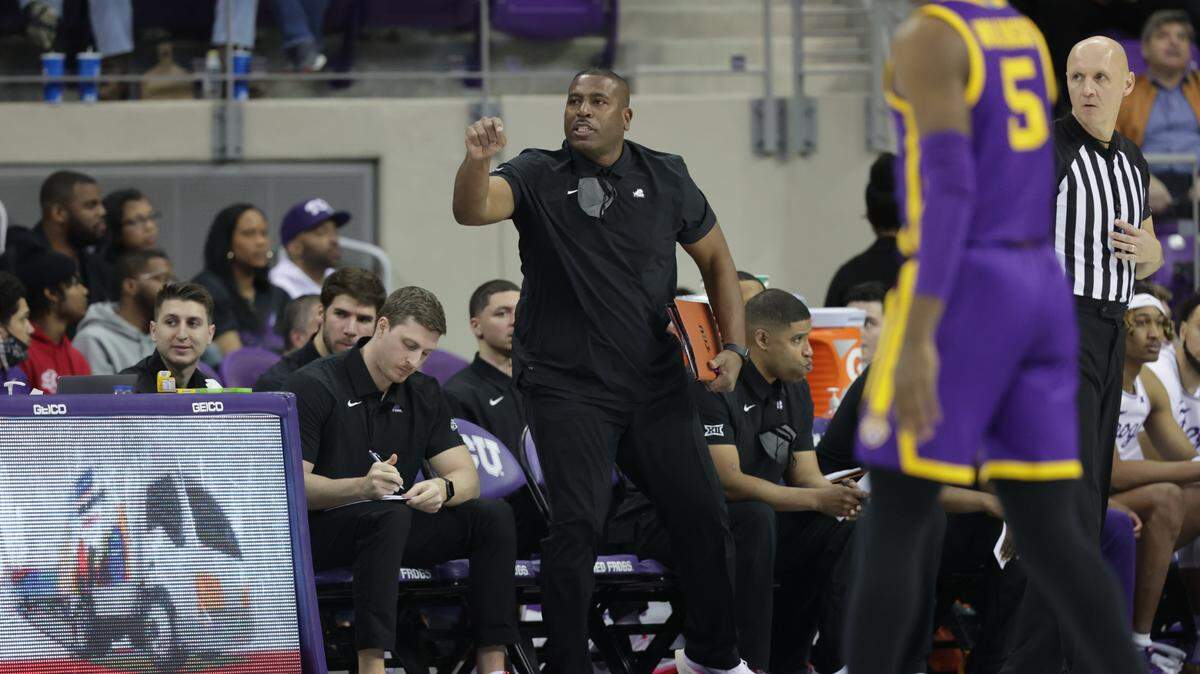
Assistant Tony Benford is one of the unsung heroes in TCU basketball’s turnaround
If you’re looking for a statistic as to why TCU basketball has returned to March Madness, look no further than the rebounding department.
TCU has gone from 170th to fourth in the country in rebounding margin (0.3 to 8.4). The Frogs also jumped from 167th to 10th in offensive rebounds per game, and 203rd to 29th in total rebounds per game.
Much of the credit belongs to associate head coach Tony Benford, the former North Texas head coach who is known for his work with post players. TCU has become more physical and dominant in the paint with the development of players such as center Eddie Lampkin and forward Xavier Cork.
“Tony’s been huge for us this year,” TCU athletic director Jeremiah Donati said. “Everybody on the staff has their role and Tony has a lot of really good experience, not only coaching bigs but being a former head coach. He’s been great.”
TCU becoming an elite rebounding team is part of the reason it could make a run in the NCAA Tournament. The 9-seed Horned Frogs get their journey started with a first-round matchup against the 8-seed Seton Hall Pirates at 8:57 p.m. Friday in San Diego.
The Frogs will be focused on winning the rebounding battle once again. They did it for the most part during the regular season, going 18-7 in games they outrebounded their opponent.
As Benford said, possessions will be coveted in these postseason games. Teams that manufacture more possessions tend to win. For TCU, manufacturing possessions will start by winning on the glass.
“It’s going to be huge from my experience coaching in the tournament,” said Benford, who served as LSU’s interim coach during its Sweet 16 run in 2019.
“The games are usually called pretty tight. The game within a game is, ‘Where can you get extra possessions?’
“Shooting percentages are always lower in the NCAA Tournament, so can you go rebound? That’s one area where we think we can get more possessions is by offensive rebounding. That’s why we’ve built this team the way we’ve built it.”
Players bought into that mindset, too. Lampkin dropped 70 pounds in the offseason, going from a little used reserve to a starter averaging 6.5 points and 6.0 rebounds per game.
Cork has added 15 pounds over the course of the season and has steadily improved. Emanuel Miller, a transfer from Texas A&M, has remained a consistent rebounder and leads the team with 6.3 boards per game.
The Frogs have long and athletic wings who are capable rebounders in Chuck O’Bannon Jr. and Micah Peavy. And guards Damion Baugh and Mike Miles are above-average rebounders for their position.
“We talk about gang rebounding and doing it by committee,” Benford said. “One of the things that coach Dixon talked about when we put this team together is, ‘We’re not a great shooting team.’ If you’re going to shoot it, you better go chase it and get some second-chance opportunities.
“One of our game standards is plus-10 on the rebounding battle and we try to get 40% of our misses when we can.”
Benford has become a favorite among players and staff in his three years with the program. TCU is hopeful to keep him on board for years to come, although it wouldn’t be surprising if he gets an opportunity to become a head coach again with the success he’s had.
In the meantime, the focus is on this year’s team and making a run in the tournament.
Miller called Benford an “amazing coach” who has helped him become a better rebounder. Lampkin echoed those thoughts, saying Benford has been a mentor since they first met during Lampkin’s freshman year in high school.
“He’s been pushing me every day since the end of last season,” Lampkin said. “He’s told me that I can do what every other big man in the league is doing, that he believes in me. He just keeps pushing me. As he always says, he’ll never cheat me.”
For Benford, the “never cheating” mindset is a way of saying he wants players to reach their full potential. He’s never going to stop coaching them until they do.
“First of all, you have to have a great relationship with them and trust,” Benford said. “All of our coaches pride ourselves on having a great relationship with our guys. When you have a relationship with them, you can hold them more accountable. Every player wants to be the best version of themselves. We’re not going to let you cheat yourself.
“When you’re not doing something you should be doing, we’re going to address it. When you’re doing great things, we’re going to address that too.”
This story was originally published March 17, 2022 at 5:00 AM.