TCU football’s Garrett Riley hopes offense takes off under his vision of Air Raid
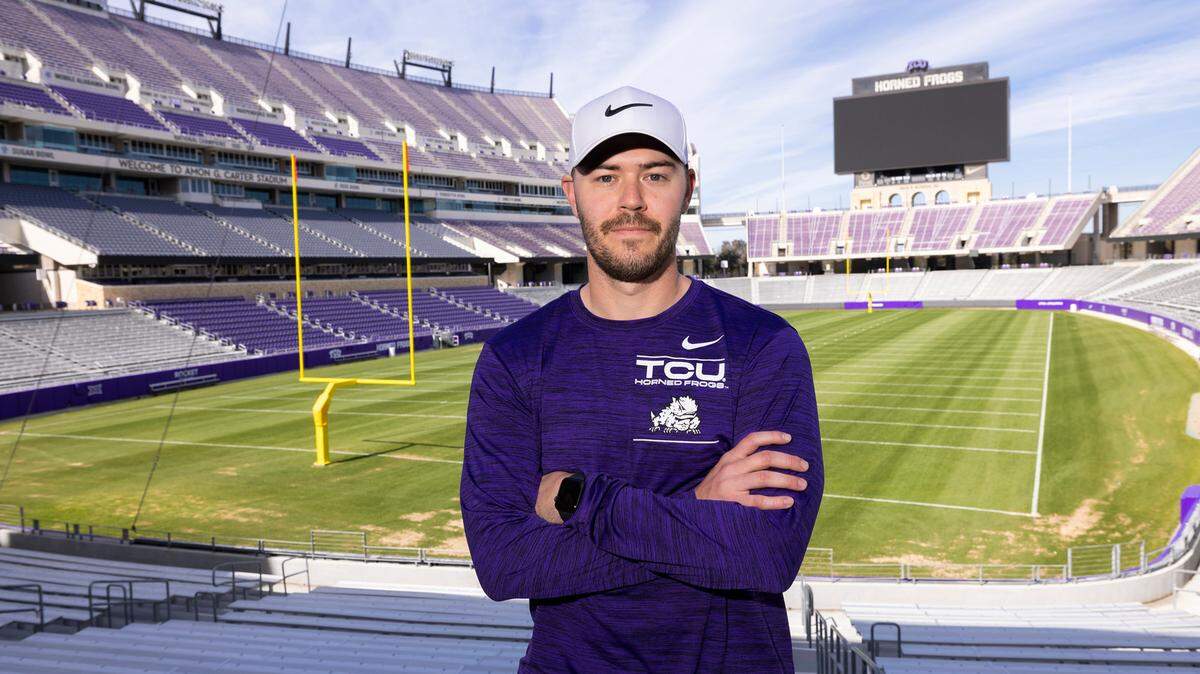
TCU offensive coordinator Garrett Riley is still settling into his new office. He’s described the last couple of months as a “whirlwind,” following Sonny Dykes from SMU to TCU, but he’s used to it by now. TCU is the sixth college he’s worked at in the last 11 years.
“Anytime you transition, it’s kind of a whirlwind for coaches and players, but in a great way,” Riley said. “We were excited to get over here in Fort Worth and be a part of this league again. It’s been really cool seeing two months into it, the transformation that’s been happening with your players.”
Riley, the younger brother of former Oklahoma coach Lincoln who is now at USC, last worked in the Big 12 as an assistant at Kansas from 2016-18. Now he’s joining a program with visions of becoming a powerhouse in the league with flagships Texas and Oklahoma departing in the coming years.
Riley is expected to play a significant role in that by trying to turn TCU’s offense into one of the top in the country. SMU ranked 13th in total offense last season, and 12th in total offense in 2020.
TCU’s offense fared well in 2021, checking in at No. 36, but Riley could help it reach another level. The formula for success in his Air Raid offense is simple.
“There’s such a premium on execution,” said Riley, who will be the Frogs’ offensive play-caller and plans to call the game from the field.
“We don’t do a million different things because it’s hard to do that and get really, really good at it. So it’s about repetitions and just executing at a higher level than the defense is in stopping it. That’s our philosophy.”
For it all to work, it comes down to ball distribution and explosive plays.
In its victory over TCU last season, SMU had passes caught by eight different receivers and used four different ball carriers. In a victory over UCF last season, SMU had nine different players catch a pass.
“If you’re at a place, and we feel we are now, where we have really good athletes on offense, then ball distribution is what you’re aiming to get,” Riley said. “Don’t make it more complicated than it needs to be. We need to spread the ball out to those guys and let them and their God given ability take over, you know what I’m saying? A system where our guys are going to be very confident. That changes year to year.
“Our 2020 team offensively at the other place was a lot different than our 2021 offense. There’s a lot of similarities, but it’s going to be different every year. The main reason is you’ve got to tailor it to what your guys are good at and what you feel like you have.”
Riley added that explosive plays are a necessity in today’s game. Explosive plays are considered runs of 12-plus yards and passes of 15-plus yards.
SMU had its fair share last season, averaging 465.9 yards per game.
“It’s just hard to win and move the ball and score at a high rate if you don’t have those,” Riley said. “It’s just tougher nowadays. Again, it feels like we have a brand of offense where we have a lot of opportunity for that. That’s the good part about it and that’s going to be something we emphasize.”
TCU’s QB room
Along with his offensive coordinator and play-caller duties — he prefers being on the field during games, saying “there’s something about looking your quarterback in the eye” — Riley is the quarterbacks coach.
So far, Riley is impressed with what TCU has in the QB room, headlined by Max Duggan and Chandler Morris, even though he didn’t personally recruit them.
“You’ve got a couple of guys who have played and really played, which is always good to have some people in there who have true experience and have been productive,” he said. “I’m excited to see how they transition into this offense and take the reins and see how they do here this spring.
“You’ve got experience, you’ve got talent, you’ve got a good mix of personalities in our room. And we’ve got guys who love football, which is always important. It kind of sounds like that should be understood, but once you get to this level and the grind that college football is, sometimes that fades away. But I think we really have some hungry people in our room and on our team who love football.”
Duggan enters his senior season in 2022, although he could have two years of eligibility left with the NCAA granting a COVID year in 2020. For his career, Duggan has thrown for 5,920 yards and 41 touchdowns. Those numbers rank fifth in program history in both categories. He’s also rushed for 1,433 yards and 19 TDs.
And Morris has as many as four years of eligibility left. He had a breakout game in leading TCU to an upset victory over then-No. 12 Baylor on Nov. 6. He finished the season 50 of 76 passing for 695 yards with three TDs and no interceptions.
Others on the roster include redshirt freshman Sam Jackson and true freshman Josh Hoover.
As Dykes has alluded to throughout the offseason, Riley reiterated that it’ll be an open competition at quarterback.
“They’re going to get opportunities,” he said. “We have to evaluate that within everything that we do and see what we think is best and what is going to put our team in the best position to win. At the end of the day, that’s all that matters. It will be a total evaluation all spring, generally it’s going to go into summer and fall camp. Typically that’s how it goes, but if we know in the spring then great. If we don’t, we’ll let them compete until we do know. That’s how this deal goes.”
Emphasis on the run
A common misnomer about the Air Raid is that it doesn’t prioritize the running game. That simply isn’t the case.
In fact, the running game is an essential part of the offense and nobody knows that better than Riley. This is a guy who played in the Air Raid under one of its top minds, Mike Leach, and has now developed his own version under other top Air Raid coaches.
At each stop, a successful Air Raid offense could move the ball on the ground.
“You’ve got to be able to run the ball. You just do,” Riley said. “That’s part of ball distribution, too. That doesn’t mean you have to throw it this many times a game. That’s talking about the running back, too. He’s got to touch it in the passing game and obviously touch it in the run game.
“TCU has had a very rich history of running backs, so that needs to continue to be the trend here.”
The Frogs’ rushing offense has ranked in the top three of the Big 12 the past three seasons, including leading the league in 2020. That is not expected to drop off under the new staff.
At SMU last season, Riley had two running backs finish with more than 600 yards rushing in Tre Siggers (728 yards) and Ulysses Bentley IV (610 yards). Bentley had 913 yards rushing in 2020.
Before his SMU stint, Riley coached running backs at Appalachian State in 2019. The Mountaineers went 13-1 that season and were led by running back Darrynton Evans (1,250 yards and 20 TDs).
“You’ve got to be able to run the ball if you’re going to position yourself to win championships,” he said.
Landing at TCU
When Sonny Dykes had an offensive coordinator opening at SMU following the 2019 season, he zeroed in on Garrett Riley to join his staff.
He liked the Air Raid experience Riley had from his playing days and previous coaching stops at schools such as East Carolina under former Texas Tech assistant Ruffin McNeill. Dykes also liked that Riley thrived with the running game at Appalachian State.
“He came from two backgrounds that were very well versed and had answers for what the defense was doing to stop them,” Dykes said. “Both offenses were kind of ahead of their times in some ways. And we shared a lot of the same philosophies, the less is more and being able to execute what you do at a high level.
“He’s been everything we thought he was going to be and then some. Very calm, great demeanor, mature, analytical thinker and a good communicator. We were lucky to get him hired.”
Riley likes being part of the Mike Leach coaching tree once again, too. He never worked under the longtime Texas Tech coach, but he played under Leach in 2008-09 before finishing his college career at Stephen F. Austin in 2010.
Lincoln Riley is firmly in the Leach coaching tree, along with McNeill.
“I played under Coach Leach for two years,” Riley said. “He was my position coach for two years, so there’s just a lot of philosophy that goes back to what we learned being with Mike and there’s a lot of things that we carry over from that.”
Riley paused and added, smiling: “He may not claim me, but I’m going to claim him.”