‘It’s football, man.’ TCU defensive coordinator stresses simple scheme, playing fast
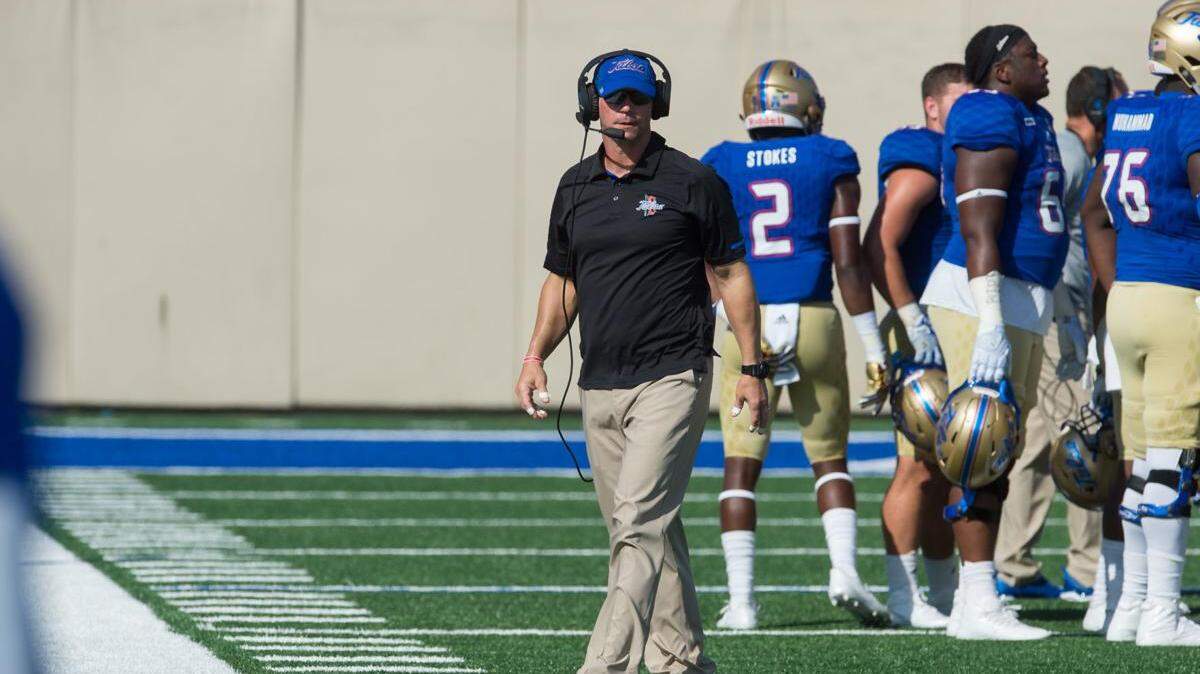
TCU football has been known for its defense the last two decades thanks to Gary Patterson.
Patterson is regarded as one of the top defensive minds of this generation. The Horned Frogs led the nation in total defense five times during his tenure. But Patterson and TCU parted ways on Oct. 31 with the defense playing some of its worst football in years.
Joe Gillespie is now the man tasked with following in Patterson’s large footsteps and getting the defense back on track as the defensive coordinator under Sonny Dykes.
“Obviously you have to recognize what Gary Patterson has done and what he has accomplished and what type of defensive mind he’s been,” Gillespie said. “I’m certainly not going to pretend to be that, so you have to embrace it. At the same time, we’re going to do what we’re going to do. My job is to elevate this. That’s all of our jobs — make this elevate and carry on that tradition.”
Gillespie will be implementing his own defensive philosophy and mindset. Patterson became known for his signature 4-2-5 defense to slow down spread offenses. Gillespie runs a 3-3-5 defense similar to what Iowa State has had success with in recent years.
In describing his defensive approach, Gillespie likes to use the Navy’s “KISS principle” (keep it simple, stupid). Much like former Dallas Cowboys defensive coordinator Rod Marinelli, keeping it simple and fast is something Gillespie wants his players to embrace.
The worst thing Gillespie can do is have a defender play slower because he’s overanalyzing a formation. A safety who runs a 4.4-second 40-yard dash needs to play every down with 4.4 speed rather than being bogged down to the point where he might play as though he runs a 4.7-second 40, according to Gillespie.
“Sometimes defenses and schemes can become like brain surgery, but this isn’t brain surgery. It’s football, man,” said Gillespie, who plans to call plays from the field.
“Our defensive approach is an extremely fast approach. We’re sitting here recruiting the best players in the nation to come play for TCU, so you’re talking about the 1% players. Because our players are 1% guys, let’s let the 1% guys go out there and showcase their talents in a variety of ways and don’t paralyze them by overanalyzing.
“When you can sit there and think less, you play fast. When you play fast, you make plays. When you make plays, you produce. And production wins games.”
Gillespie sees plenty of carryover from Patterson’s defense to his, but there will be a learning curve and roster turnover.
For instance, Gillespie needs a big-bodied nose tackle to anchor the three-man line, something the program feels incoming freshman Damonic Williams can develop into but also a position they’ll be searching for via the transfer portal this offseason.
At the end of the day, Gillespie has his work cut out in rebuilding the roster and replacing a legendary coach. The Frogs’ defense dropped off significantly this season, ranking 119th of 130 teams in total defense.
“There’s going to be some carryover from the 4-2-5,” he said. “Obviously there’s going to be some things we ask our guys to do that they’re real used to doing and then quite a few things that are a lot different. But every one of these young men who are here are going to have a role in this.
“Our scheme is simple, but we’re going to ask a lot of positions to do a lot of different things. That’s where, for me, if I would’ve played in it, I would’ve loved it because I would’ve been able to play very versatile — whether I’m in man coverage or zone, whether I’m a hard set edge or dropping out into the flats — that’s where it gets fun for the young men and for the coaches because we can do a lot of different adjustments out of it.”
Selling Dykes
Dykes has repeatedly talked about the importance of playing great defense in order to achieve his desired goals of competing for championships on a yearly basis.
And Dykes, known for his offensive mind, never enjoyed when his former SMU team faced Gillespie’s Tulsa defense.
“His defenses always gave us fits,” Dykes said. “We were consistently one of the better offenses in the country and we never wanted to play against those guys. They were always a pain to play against.
“What impressed me is how hard his guys played. He really did a fantastic job of identifying talent and recruiting specifically to his scheme. The guys were long. They were athletic. They played really hard. They were really sound fundamentally. They were a nightmare to play against.”
Given the success that Iowa State has had running a similar 3-3-5 scheme in the Big 12, Dykes felt more than comfortable with Gillespie making the jump from running a defense in the American to the Big 12.
After all, this is a guy who developed a first-round talent at Tulsa in linebacker Zaven Collins, the 16th overall pick by the Arizona Cardinals in the 2021 NFL Draft. Tulsa hadn’t had a first-round draft pick since 1977 and had never had a first-round defensive player taken in program history until Collins.
With TCU being at the Power Five level and its defensive tradition under Patterson, the thought process is Gillespie will have even more success than he did at Tulsa.
“The more I dove in and looked at him as a potential candidate, I never found one person who said anything bad about him,” Dykes said. “I think it meant a lot to him to be back in Texas and coaching close to home, close to Stephenville. It was just a perfect marriage. I got a guy who really wants to be here and cares about TCU. At the same time, he has a great track record of success at Tulsa.”
Texas roots
Gillespie landed the TCU job based on what he accomplished at Tulsa. He joined Philip Montgomery’s inaugural staff there in 2015 as linebackers coach and worked his way up to defensive coordinator in 2019.
He was groomed by the late Bill Young early on, and then tweaked Tulsa’s 3-3-5 defense from being a third-down defense into an every-down defense.
Prior to working his way up the college ranks, though, Gillespie made a name for himself in the Texas high school ranks. He was a longtime assistant at Stephenville and became its head coach in 2008.
Gillespie went 72-23 in seven seasons at Stephenville, including winning a state championship in 2012.
“The main thing that I remember about Joe is that the players loved to play for him,” said Chad Morris, the former SMU and Arkansas coach who was Stephenville’s head coach from 2003-07 when Gillespie was an assistant.
“He’s a guy who gets the players’ respect and they truly play hard for him. How they respond to him is a reflection of his knowledge of the game.”
Gillespie also worked under former Stephenville head coaches Mike Copeland and Art Briles. He considers Copeland one of his biggest mentors as he played for him in high school, worked for him as an assistant and then hired him back as an assistant when he became Stephenville’s head coach.
“Mike Copeland is a legend in Texas high school football,” Gillespie said. “When I became head coach, he was on the hiring committee and he was my first hire. I said, ‘Hey, you’ve gotta have something left in the tank.’ And he did.”
Gillespie’s biggest coaching mentor and idol is his father, Joe Sr. He was a longtime assistant football coach and head track coach at Tarleton State. As the football team’s defensive coordinator in 1978, Joe Sr. had the Texans ranked as the country’s No. 1 defense. They went 8-0-1 in the regular season and reached the Division II playoffs that season.
“Obviously growing up as a young man, my dad was a very successful coach,” he said. “I just wanted to follow in his footsteps.”