
Does TCU coach Gary Patterson expect any in-season transfers?
Auburn, the No. 10 team in the country, has seen multiple players transfer since the beginning of the season, including starting wide receiver Nate Craig-Myers last week. Craig-Myers wasn’t happy with his playing time.
Oklahoma State saw one of its players, receiver Jalen McCleskey, bolt because he wasn’t happy with his number of targets.
A handful of college football players across the country are using the NCAA’s new redshirt rule as a reason to leave their respective teams in the middle of the season. Players who haven’t previously redshirted will receive a redshirt season as long as they play in four games or less.
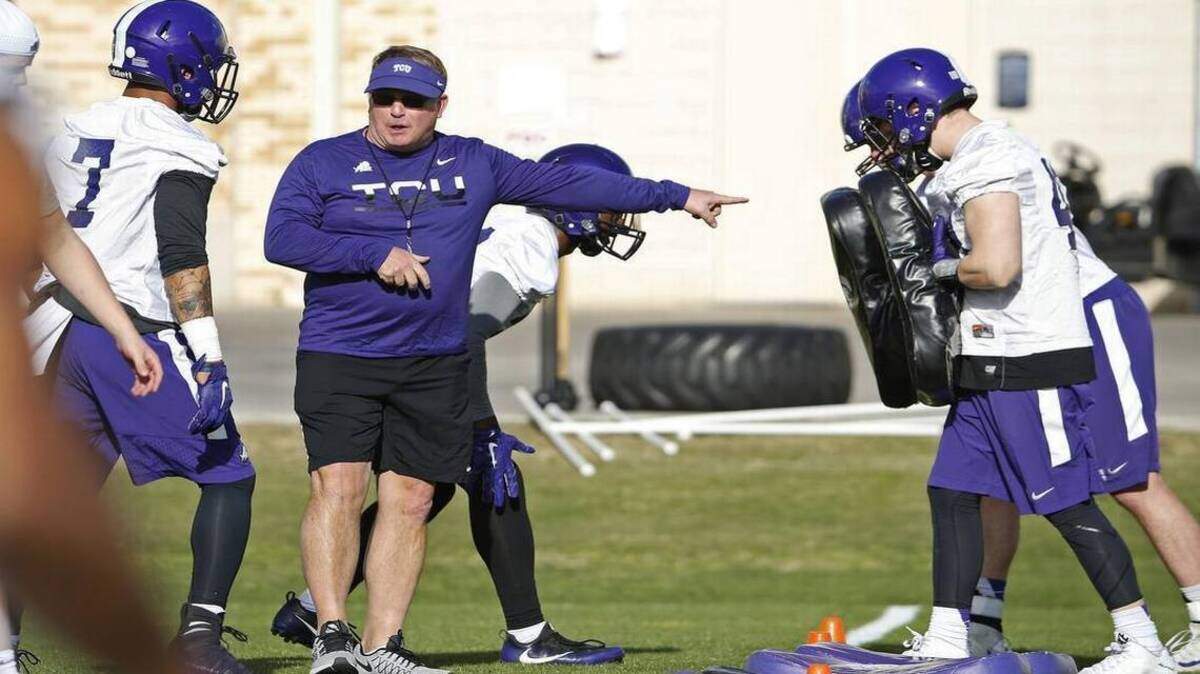
TCU coach Gary Patterson doesn’t expect this issue to happen with his program during the season.
Asked if he knew of any players considering leaving midseason after the Frogs’ first four games, Patterson said: “If they are, no one has said anything to me.”
Technically, the players don’t have to receive approval from Patterson or other members of the coaching staff. Along with the new “redshirt rule,” the NCAA implemented a new “transfer rule” that prevents schools from blocking players from leaving for specific institutions.
Players simply have to inform the school of an intention to transfer and then they’re placed in a national, public football transfer database set up by the NCAA.
Patterson has been critical of the transfer rule since the offseason, and continues to believe it hasn’t been structured properly. He said earlier this week that the people who designed it “underestimated” how players would use it to their advantage.
“I think it’s going to end up being like the NFL,” Patterson said, referring to the college game now having a free agent-like system.
Patterson, who is on the board of the American Football Coaches Association, actually voted in favor of the transfer rule. However, he thought there would be more stipulations on it.
For instance, Patterson would’ve liked the NCAA to set a date as to when players must declare they’re going to transfer that gave schools enough time to recruit players at those positions. Instead, a player could opt to transfer after spring ball, which would leave the school and team in a bind to fill that void.
Additionally, Patterson would’ve implemented a freshman ban because he believes the jump from high school to college is significant and most players need time to adjust to the demands.
Just about every freshmen, Patterson said, considers transferring at some point their first season.
“I worry about teams, if they have 20 or 30 guys leave, it becomes like a death penalty. It’ll be interesting to watch,” Patterson said. “My biggest worry next spring guys don’t think things are going the way they want them to, they leave, but there’s no way for us to go out and recruit anybody to help our team.
“I don’t think it’s fair to the university, nor the programs, to not have some stipulations on when everything can happen. Right now, we’re all in it for the players, but I think we all need to take a look back and understand some are young enough and not mature enough to make those decisions yet.”
TCU senior defensive end Ben Banogu transferred to the Frogs from the University of Louisiana Monroe after the 2015 season, but didn’t have much of an opinion on today’s players using the rules to their advantage.
After all, there’s always give and take. Patterson and other college coaches may not be fond of players bolting midseason. But the teams benefit from the redshirt rule when a younger player can gain game experience without burning a year of eligibility.
“I know that sometimes when people transfer, they transfer for different reasons,” Banogu said. “I don’t think it’s up to me to make that determination or to look too much into that. I, myself, transferred and I had my own reasons, so it really just depends on the person, the coach and the player.”