Sports betting is legal in Texas now. Just don’t call it sports betting | Opinion
When I told my friends in Las Vegas I was moving back home to become the Star-Telegram’s sports editor, I got a common question.
“Aren’t you going to miss sports betting?”
It turns out I don’t have to.
Sports betting is legal in Texas now, if you haven’t heard. Just don’t call it sports betting.
I spent last weekend on the couch, betting on football games Saturday and Sunday right on my cellphone with the Kalshi app. Or, as Kalshi would prefer I call it, “investing in prediction markets.”
That is a critical distinction, and one that is already being fought over fiercely in the legal realm.
States gained the right to legalize sports betting in 2018 when the U.S. Supreme Court overturned the Professional and Amateur Sports Protection Act. Before then, PASPA, which was passed in 1992, allowed full-fledged sports betting only in Nevada, with more limited variations in three other states. Since the Supreme Court ruling, sports betting has expanded to 39 states.
But Texas is not among them, despite intense lobbying efforts, in keeping with the Lone Star State’s aversion to casino gambling.
That’s of no concern to Kalshi, which says it is a prediction market, not a sportsbook. As such, it can only be regulated at the federal level by the U.S. Commodity Futures Trading Commission, meaning it can operate in all 50 states.
So far, the CFTC has shown little interest in reining in Kalshi. In May, the commission dropped an appeal of a court decision that allowed Kalshi to offer markets (betting) on political election outcomes. President Donald Trump’s nominee to lead the CFTC, Brian Quintenz, sits on the Kalshi board of directors, and Donald Trump Jr. is a strategic adviser for Kalshi.
Kalshi’s rise has been maddening to the sportsbooks who jumped through all the regulatory hoops to gain legal approval, as well as the states that are counting on revenue from those sportsbooks. They don’t want to see their users’ dollars shift to Kalshi.
Perhaps states will be able to ban Kalshi in the future, just as they can continue to reject legal sports betting.
But right now, sports betting — I’m sorry, investing in prediction markets — is here in Texas.
To be sure, Kalshi does not operate like a traditional sportsbook in many respects. It offered prediction markets on a variety of topics — politics, entertainment, business, even health — before only recently offering sports.
Now markets such as “Next US Presidential Election Winner?” and “How much will Ozempic’s price fall before February?” sit on the app next to markets for betting — I mean investing — on the point spread, total and money line for Sunday’s Cowboys-Giants game.
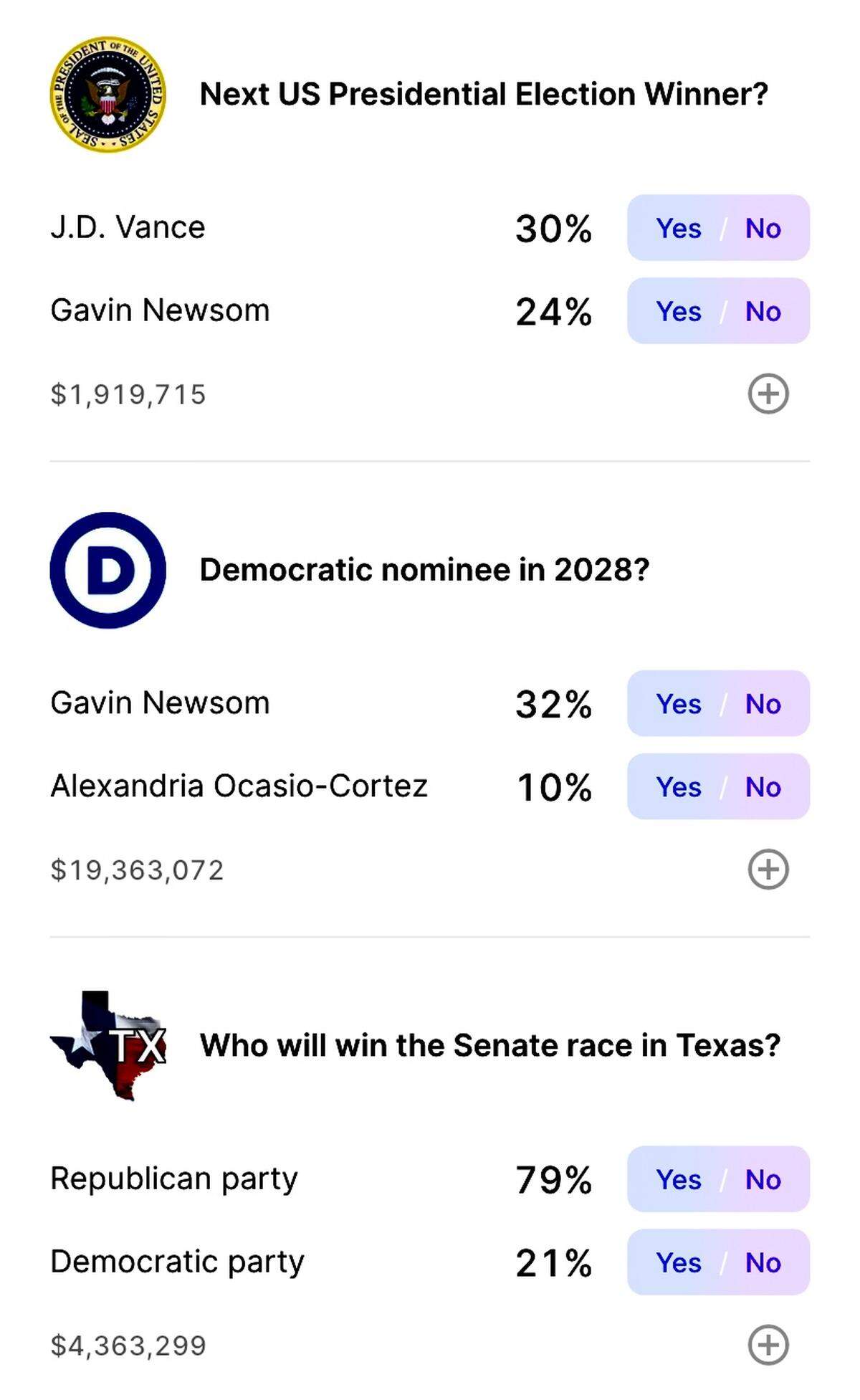
The most significant difference for bettors who are used to traditional sportsbooks is that you are no longer betting against the house. Bettors on opposite sides of a wager — I mean investors making opposing predictions — are matched up by Kalshi, which merely takes a transaction fee. It has no stake in the outcome.
Two days in the prediction markets
I registered for a Kalshi account, connected it to my bank and successfully transferred $300 to my new investment fund. The whole process took 11 minutes.
Last Saturday, I started investing. Texas will beat San Jose State by over 37.5 points — I predict yes. My fund appears robust when the Longhorns take a 28-0 lead early in the second quarter, but their offense grinds to a halt and they win merely 38-7. The portfolio takes a hit.
At the same time, I am monitoring my investment in Baylor to defeat SMU. The Bears appear to be cooked, trailing by 14 with under six minutes to play, but they rally to force overtime.
The prediction market remains active throughout the game, with the odds changing with the swings in scoring. Fearful of an SMU victory, I am able to cash out of my bet — I mean sell my Baylor stock — at a tiny profit before overtime begins. I am immediately punished when the Bears win 48-45 in OT, having missed out on the chance to collect fully on my investment.
And on it goes.
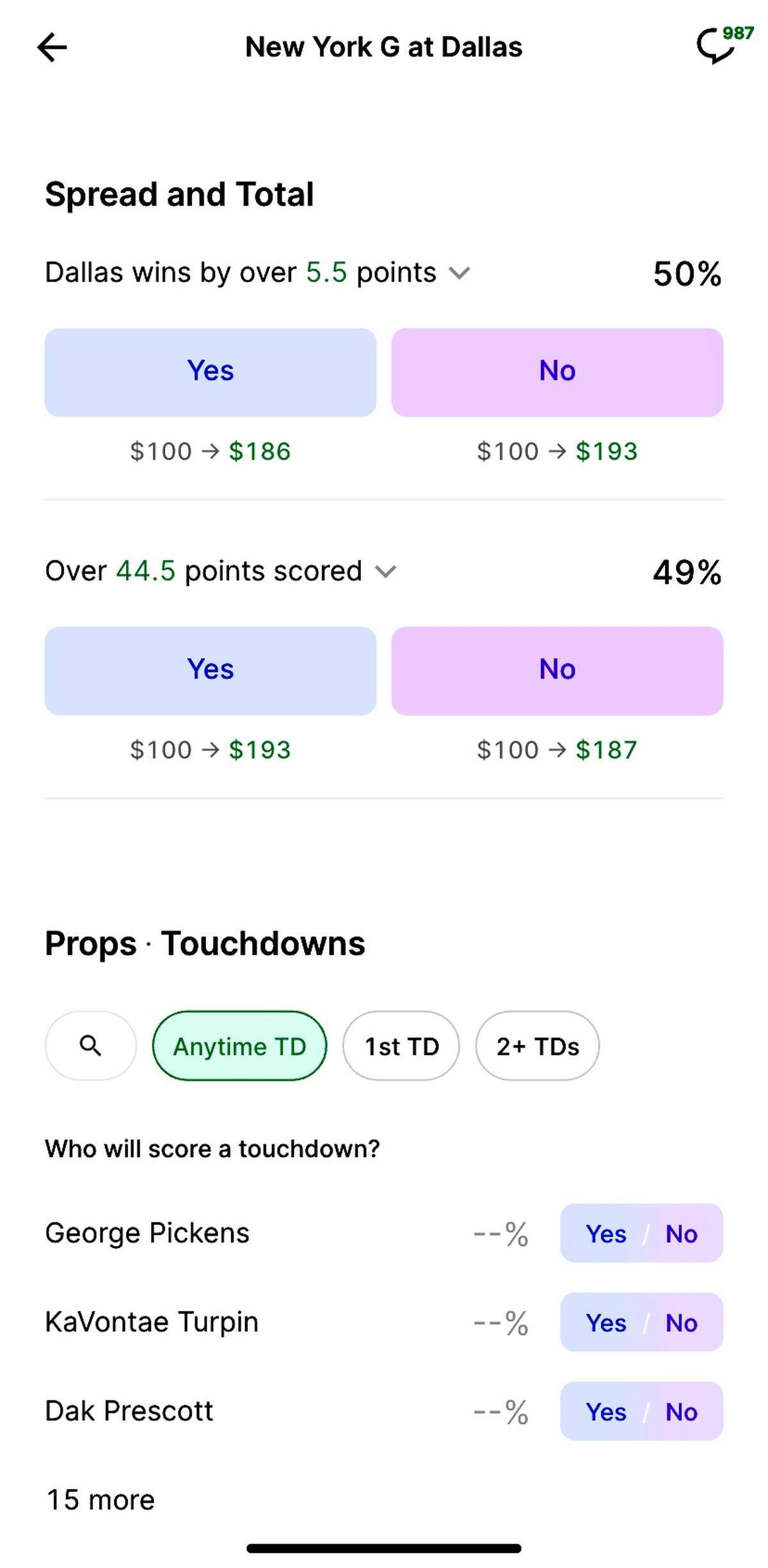
By the time the NFL kicks off on Sunday, I am investing at a furious pace. Some decisions are prudent, such as the Las Vegas Raiders to defeat the New England Patriots at a nice underdog price. Others are not. I would not advise investing in the Miami Dolphins very often this season.
I even dip my toe into touchdown prop bets — derivatives, let’s call it. My most successful investment of the day comes when New Orleans Saints running back Alvin Kamara scores the first touchdown of their game against the Arizona Cardinals. My $10 in Kamara stock has an Apple-like surge to $72.
However, my read of the market wanes as the day goes on. It’s starting to feel like 1929 on my couch.
Instead of diversifying what is left of my portfolio, I invest everything I have in the Baltimore Ravens to beat the Buffalo Bills on “Sunday Night Football.”
If you stayed up for the end of that game, then, well, you know I’m now working on raising capital for my next venture.
Cards on the table
Jokes aside, I believe sports betting should be legal. It’s better for vice to be taxed and regulated while offering protections for consumers.
After living in Las Vegas for 13 years, I also believe people won’t be missing out on anything if they never place a wager. Your chances of being a long-term winner are infinitesimal, and a small percentage of people will develop an addiction that upends their lives.
Most importantly, Texans have not voted for this. Or at least the politicians they have elected have not voted for this.
Some Texans who have long been frustrated by the state’s obstinance on this issue will be elated that they have an outlet to bet on sports. For most people, including me, it is a fun way to make football season or March Madness more interesting. Don’t expect to win, only bet what you can afford to lose and enjoy yourself.
Other Texans will be upset that sports betting has come to the state not through the ballot box, but through some regulatory sleight of hand. Some parents will especially be dismayed to learn that you only have to be 18 to bet on Kalshi, not 21.
Maybe a federal ruling will send things back to the way they were, but until then, there is a new reality in this state.
Sports betting is legal in Texas now. Just don’t call it sports betting.
This story was originally published September 12, 2025 at 4:45 AM.