
Living in a new, new world thanks to César Chávez
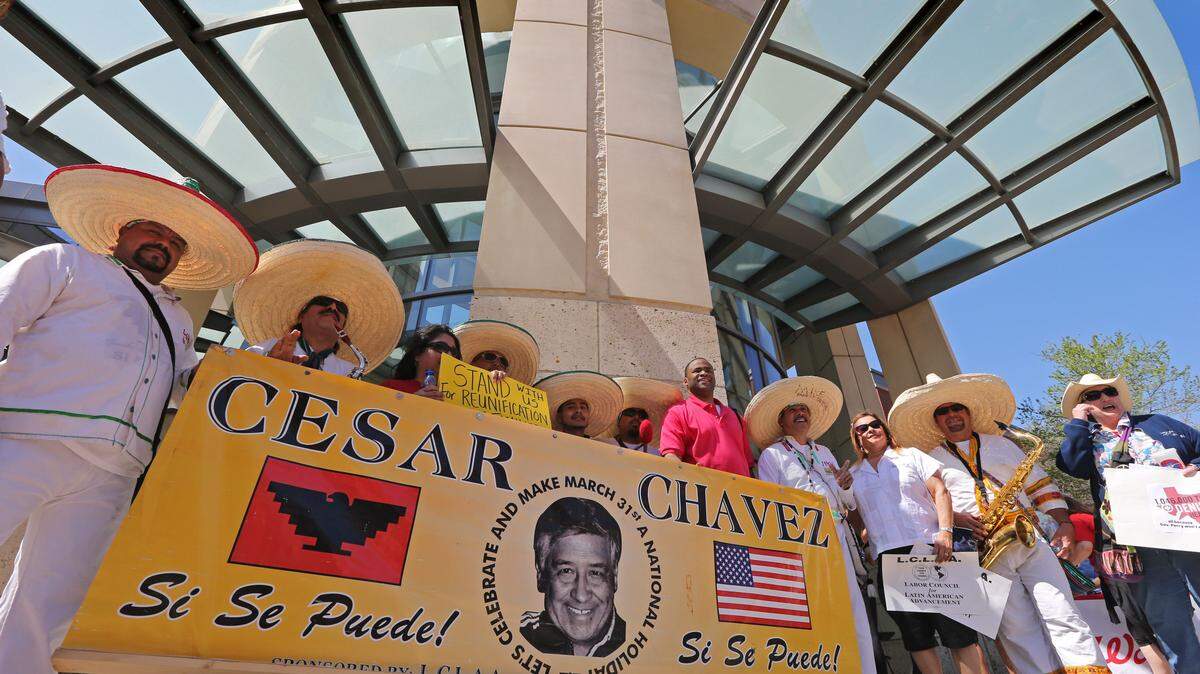
Local Latino activists wanted to honor a saint and shun a sinner when they approached the Tarrant County Commissioners in 2000 to authorize a paid county holiday in César Chávez’ honor. (Full disclosure: I was involved with this effort.) We were grateful that the commissioners saw the value in eliminating Christopher Columbus Day, recognized in October, and creating the Chávez Holiday, celebrated on the last Monday in March. We reasoned if holidays were to mean more than store sales and a pseudo-vacation day, then it was paramount to honor a true American hero rather than a European invader who enslaved and murdered First Americans.
César Chávez, born in Yuma, Arizona, 1927, was a WWII Navy veteran and advocate for farm workers to earn decent wages, clean water and air, and safe working conditions. He organized impoverished farm workers, created the United Farm Workers Union with the assistance of Dolores Huerta, and inspired Latinos throughout the country with his Si Se Puede determination. Activists still alive from the 60s and 70s remember with fondness the strikes, boycotts, marches and the militant camaraderie. Some recall Chávez’ halting but firm voice, his unassuming posture, his courage to stand for the poor against the mighty. He was our Latino David clutching the sling to face the corporate Goliaths in the grape fields. His dark-skinned, Indian features offered us a mirror which reflected on us as valiant Chicanos and Chicanas. We were Raza royalty, descended from Mexica and Mayan might.
We shunned the over-obedient, quiescent, self-defeating deference, and wore brown berets, walked out of repressive schools, wrote poems and plays, formed a third political party and voted. We refused to assume the role of strangers in a land where our distant First American ancestors had farmed maize and hunted mammoths.
The history of the Chicano movement is often not told in schools. Instead, school children hear how Columbus “discovered” America. It’s as if the Americas was brought to life once the Spaniards planted the Spanish flag of Queen Isabela and King Ferdinand on the land they called Hispaniola.
Cristobal Colon sought trade with Japan and instead seized land of the American indigenous and enchained the inhabitants for the Spanish Crown. In the tradition of European conquests of 15th century and beyond, Columbus and his Spaniards raped, captured and murdered the Indios. He opened the gates to European rapacious conquistadors who brought steel blades, terror, and disease to the Americas. A European conquest race ensued with competing Western countries vying to grasp as much of the New World land for their respective Crowns.
Some historians argue we should not rush to judgment of the Europeans since the moral compasses were quite different then. Despite the fact most of the invaders were Christians who eventually baptized millions, the conquistadors couldn’t see the conflict in the Gospel teachings and their actions. The Spaniards in the fifteenth century had finally defeated the Moors and reconquered the Iberian Peninsula from the 781-year Muslim rule. Non-Christians were savages and in the Europeans’ ethnocentric minds, the Christian God had ordained them to slaughter the heathens. Since the start of the Crusades when Pope Urban II called for the recapture of the Holy Lands from the Saracens, Western invasions of the world escalated in maddening rapidity as written in history books.
Yet this conquest spirit still exists in interracial relationships in the 21st century. Modern American conquerors insist that “illegals” — not humans — should stay in their own country. They forget or possibly never knew or cared the Americas had been inhabited thousands of years before the first Norseman or Spaniard set foot on the First Americans’ land. What was a pristine New World to the explorers was a bountiful Old World home to the millions of inhabitants where mastodons once roamed.
We have a unique American challenge; let us create a new, New World. Let us invent an America as César Chávez visualized: living wages, available health services, clean environment, peaceful conflict resolution, respectful treatment to all. I wish to believe the Tarrant County Commissioners in 2000 ratified this vision when they approved the César Chávez holiday. Since 2001, when the first César Chávez holiday and march started in Fort Worth, Chávezistas have taken to the Panther City streets, to rekindle this vision. They will march again on Saturday, March 31st, 12:00 p.m., starting at General Worth Square at 9th and Main Street.
It’s time to shed the old, New World vision of European conquerors. At high noon on March 31st, walk with fellow residents who recognize no boundaries to humanity. Conquerors, conquer your fears. Live freely and courageously with your neighbors in a new, New World.
Richard J. Gonzales is a local activist, speaker, and author. He has lived, worked, researched, and written about Latino issues in North Texas for 48 years.
This story was originally published March 30, 2018 at 4:54 PM with the headline "Living in a new, new world thanks to César Chávez."