
Fort Worth said no to atheists’ banners. Sorry, their free speech rights count, too | Opinion
Sometimes, it’s better to look at the long game when making decisions and realize that a “yes” now could avoid a lot of trouble in the future.
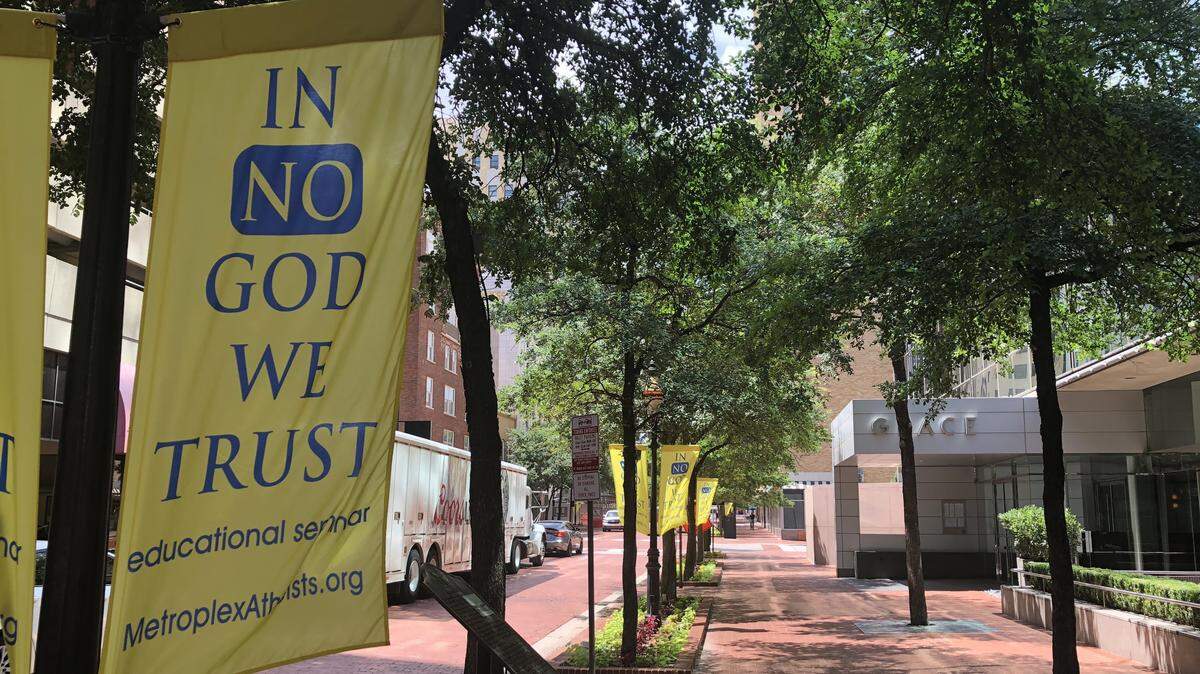
This definitely applies to the city of Fort Worth when it comes to a new free speech lawsuit logged against them by the Metroplex Atheists. The group filed the complaint July 17, charging that the city violated its speech rights by refusing to let the group hang banner advertisements for an event on keeping religion out of public schools, scheduled for Aug. 26.
Fort Worth allows groups to hang banners with ads for events on light poles in various spots downtown, so long as their applications are approved.
Though the atheist group was approved to hang such banners for an event back in 2019 — the banners said “In No God We Trust” — after a meeting between Metroplex Atheists and assistant city manager William Johnson this year, the group was told their event was “not of a ‘magnitude’ to qualify,” according to the court filing.
It’s not exactly clear why the city rejected the Metroplex Atheists’ request for banners.
In the City of Fort Worth’s Banner Policy and Procedures, event magnitude is not mentioned. The application for banner space requests no information about how many attendees or registrants an event has.
“If promoting an event/exhibit, it must be held in Fort Worth and be open to the public, or of common interest to the general community, or recognize /contribute to the cultural fabric of the city,” the policy reads.
One could argue an event aimed at keeping religion out of public schools isn’t of “common interest” to the community, but Fort Worth just isn’t being consistent. It still allowed the group to hang banners in 2019 for a similar event.
It is true that in 2019, when Fort Worth approved the application for the same group to hold a similar event, the city received considerable criticism. The city got at least 100 complaints about those banners, but officials held firm then that it was a free speech issue and they were committed to honoring the principle.
Then-Mayor Betsy Price tweeted “I was appalled when I saw the banners currently being displayed downtown, as I do not support or agree with the message. While many of us may not agree with the message, the organization did follow policies and procedures set forth by the City & Downtown Fort Worth, Inc. ...We must respect freedom of speech. As we approach the Fourth of July, we must remember that many Americans have fought and died for the freedoms we cherish today.”
She was right.
This is clearly a free speech issue, and the city’s inconsistent handling has invited a lawsuit that will end up being more of a headache than if the city would have just gone ahead and approved Metroplex Atheists’ application for banners anyway.
If Fort Worth is going to open this avenue for speech, officials must realize they will be faced with these kind of decisions — and potential lawsuits — under the First Amendment. If they don’t deal with those side effects, they should end the program.
There’s a fine line between giving in to groups with obscure events and fighting a free speech lawsuit you’re likely to lose. On this, we think it would have been better to err on the side of more speech, not less.
BEHIND THE STORY
MOREHey, who writes these editorials?
Editorials are the positions of the Editorial Board, which serves as the Fort Worth Star-Telegram’s institutional voice. The members of the board are: Cynthia M. Allen, columnist; Steve Coffman, editor and president; Bud Kennedy, columnist; Ryan J. Rusak, opinion editor; and Nicole Russell, editorial writer and columnist. Most editorials are written by Rusak or Russell. Editorials are unsigned because they represent the board’s consensus positions, not the views of individual writers.
Read more by clicking the arrow in the upper right.
How are topics and positions chosen?
The Editorial Board meets regularly to discuss issues in the news and what points should be made in editorials. We strive to build a consensus to produce the strongest editorials possible, but when we differ, we put matters to a vote.
The board aims to be consistent with stances it has taken in the past but usually engages in a fresh discussion based on new developments and different perspectives.
We focus on local and state news, though we will also weigh in on national issues with an eye toward their impact on Texas or the Dallas-Fort Worth area.
How are these different from news articles or signed columns?
News reporters strive to keep their opinions out of what they write. They have no input on the Editorial Board’s stances. The board consults their reporting and expertise but does its own research for editorials.
Signed columns by writers such as Allen, Kennedy and Rusak contain the writer’s personal opinions.
How can I respond to an editorial, suggest a topic or ask a question?
We invite readers to write letters to be considered for publication. The preferred method is an email to letters@star-telegram.com. To suggest a topic or ask a question, please email Rusak directly at rrusak@star-telegram.com.