
GOP wins big in Rio Grande Valley district. Does it portend shift of Hispanic voters?
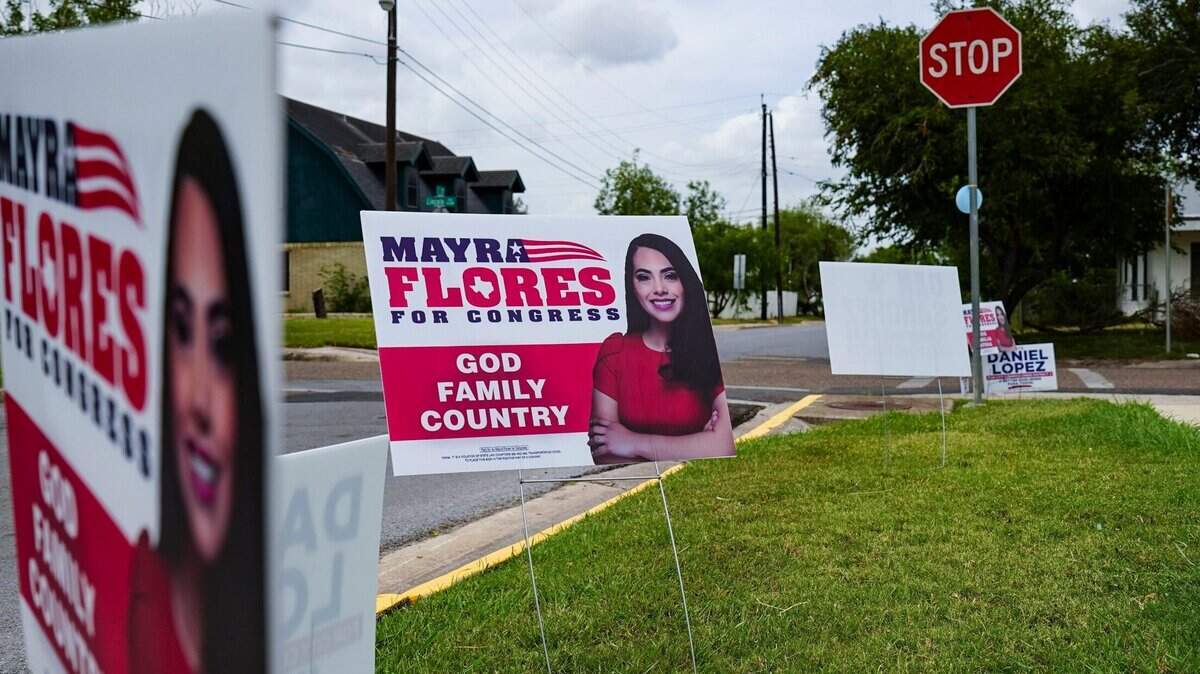
Even if she’s only in Congress for a few months, Republican Mayra Flores is joining the ranks of Texas politicians who’ve made history.
Flores blew out her top Democratic opponent, Dan Sanchez, during Tuesday’s special election for the 34th Congressional District, which covers much of the Rio Grande Valley. Not only did Flores flip an area that’s elected Democrats for 150 years, she will be the first Mexican-born woman elected to Congress – and she’s a strong Republican at that.
Does Flores’ win portend a red wave in November and a shift of Hispanic voters to the GOP?
Flores, a respiratory therapist married to a Border Patrol officer, garnered 51% of the vote; Sanchez had 43.%. There were two other, lesser-known candidates, a Democrat and a Republican, in the race, a special election to replace U.S. Rep. Filemon Vela, D-Brownsville, who resigned to work for the lobbying firm Akin Gump.
“For over 100 years, we have been taken for granted,” she said at her election night party in San Benito. “I will show you what real representation looks like. I will represent all people.”
Forty-five percent of the population in Texas is Hispanic and in the Rio Grande Valley, it’s about 87 percent.
“Even with a special election and only 7 percent turnout, Flores’ win is really seismic in its impact,” former state Rep. Jason Villalba told the Star-Telegram. Villalba, a Dallas Republican, now leads the Texas Hispanic Policy Foundation, a think tank.
The Republican machine, as Sanchez called it, did come out for Flores. With Flores’ and her team spending more than $1 million on TV ads, the GOP outspent Democrats 20 to 1. By contrast, Democrats expended little effort for a seat that reopens in November and was considerably altered by redistricting.
Was Sanchez just outspent or was Flores the better opponent? Perhaps both.
It’s always wise not to take too many signals from a special election with low turnout. But the fact that a Republican hasn’t won that race since the 1800’s is “absolutely incredible,” Villalba said, calling Flores “a very appealing candidate.”
Flores is humble, genuine, active in her community. She campaigned on issues like jobs, border security, and strengthening community, and she underscored the fact that her parents brought her to the U.S. as a young Mexican immigrant.
Flores didn’t focus on divisive cultural issues but did call out Washington, D.C. In one TV ad, she said the Texas border where she lives was “under attack” and promised the cronyism in Washington would not ruin their communities.
“Even in the best case scenario, Democrats should have won this race, so that means something,” Villalba said. “This is one data point among many that suggests Hispanics are willing to vote for Republicans when the candidate is excellent.”
Still, a red wave in the Rio Grande Valley may not easily extend to other areas of Texas that are largely Hispanic. The Valley boasts a very specific set of economic concerns: law enforcement and oil and gas, top issues now as energy prices soar and crime becomes an increasing concern.
Flores’ won’t get much time to get used to Capitol Hill: she will be up for election for a full term in November against Democratic Rep. Vicente Gonzalez, who is switching districts.
Flores’ win is another small signal of Hispanic voters’ openness to voting GOP much more than in the past. Whether we’ll look back at it as the point at which the dam broke remains to be seen.
BEHIND THE STORY
MOREHey, who writes these editorials?
Editorials are the positions of the Editorial Board, which serves as the Fort Worth Star-Telegram’s institutional voice. The members of the board are: Cynthia M. Allen, columnist; Steve Coffman, editor and president; Bud Kennedy, columnist; Ryan J. Rusak, opinion editor; and Nicole Russell, editorial writer and columnist. Most editorials are written by Rusak or Russell. Editorials are unsigned because they represent the board’s consensus positions, not the views of individual writers.
Read more by clicking the arrow in the upper right.
How are topics and positions chosen?
The Editorial Board meets regularly to discuss issues in the news and what points should be made in editorials. We strive to build a consensus to produce the strongest editorials possible, but when we differ, we put matters to a vote.
The board aims to be consistent with stances it has taken in the past but usually engages in a fresh discussion based on new developments and different perspectives.
We focus on local and state news, though we will also weigh in on national issues with an eye toward their impact on Texas or the Dallas-Fort Worth area.
How are these different from news articles or signed columns?
News reporters strive to keep their opinions out of what they write. They have no input on the Editorial Board’s stances. The board consults their reporting and expertise but does its own research for editorials.
Signed columns by writers such as Allen, Kennedy and Rusak contain the writer’s personal opinions.
How can I respond to an editorial, suggest a topic or ask a question?
We invite readers to write letters to be considered for publication. The preferred method is an email to letters@star-telegram.com. To suggest a topic or ask a question, please email Rusak directly at rrusak@star-telegram.com.