Why it took Fort Worth until 1930 to embrace ‘Yankee’ heroes and Memorial Day | Opinion
AI-generated summary reviewed by our newsroom.
- Fort Worth held Memorial Day services by 1885, with Union veterans reading Lincoln.
- In 1918 the Star-Telegram framed Memorial Day as a Northern veterans' observance.
- Fort Worth's formal Mount Olivet observance began in 1930 with dedication of a Doughboy.
Our city was founded as an Army post and was built on defending America with our work in defense plants, devotion and sacrifice.
It seems amazing today to think that Memorial Day was not always celebrated in Fort Worth, or Texas, or for that matter, America.
In the 1850s, when 11 soldiers died of disease or drowning at the original Army fort, defending the western frontier from atop the West Fork bluff, there was no annual ceremony or sounding of taps.
The tradition of decorating graves began during the Civil War in both the South and North, and continued on days in April or May when local communities remembered their Union and Confederate dead.
News archives refer to Memorial Day services in Fort Worth as early as 1885, when Union veterans read Lincoln speeches and fired a salute over a Union officer’s grave. Brevet Maj. Gen. James J. Byrne, an Irishman, went on to become a U.S. marshal before dying in an 1880 West Texas Apache attack.
When Memorial Day was for ‘Yankees’
Even by 1918, nearly the end of the World War I, Memorial Day was still regarded as a Yankee day.
In 1918, the Star-Telegram headlined:
Veterans of the North, Too, Are Eager for Flowers And Autos On Memorial Day, Thursday
“An appeal of the Confederates for automobiles and flowers on their memorial day was answered,” the editorial said, referring to Confederate Memorial Day in April.
“Now, the veterans of the North are asking the people of Fort Worth the same thing.”
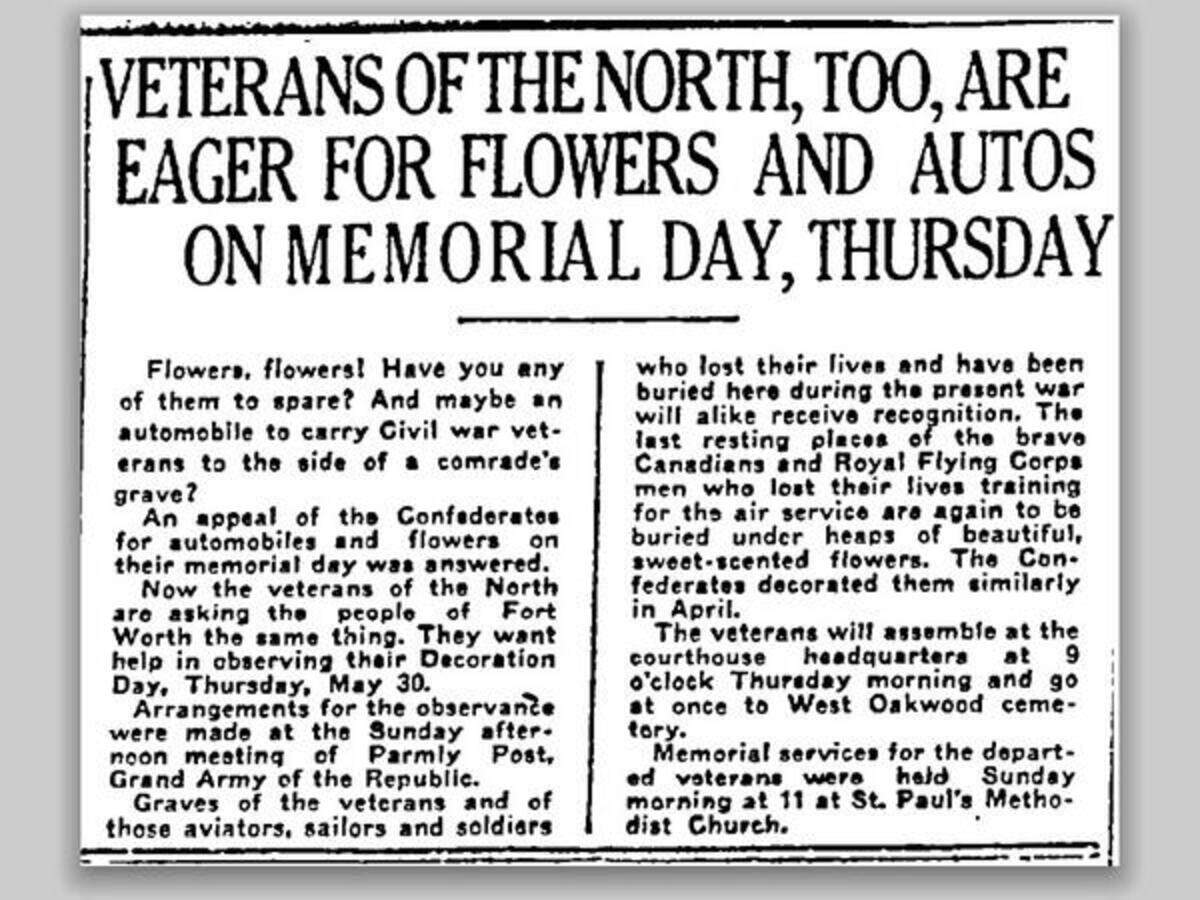
Almost as an afterthought, the editorial added that soldiers, sailors and aviators lost in the World War “will alike receive recognition,” including the 12 British and Canadian pilots killed here in training.
(Their graves in a British-owned plot at Greenwood Cemetery are decorated to this day. A Canadian military ceremony is held in odd-numbered years.
The first World War gave us a formal Memorial Day holiday
That July, Fort Worth lost a son in the war when former Texas Longhorns tackle and Army 1st Lt. Bothwell Kane died on the battlefield in France.
The next year, in 1919, President Woodrow Wilson asked Americans to redefine Memorial Day for “not only the union of our country, but also now the liberation of the world.”
Yet not until 1930 did Fort Worth begin what is today the city’s formal Memorial Day observance at Mount Olivet Cemetery.
A Doughboy statue and more on a Fort Worth day to remember
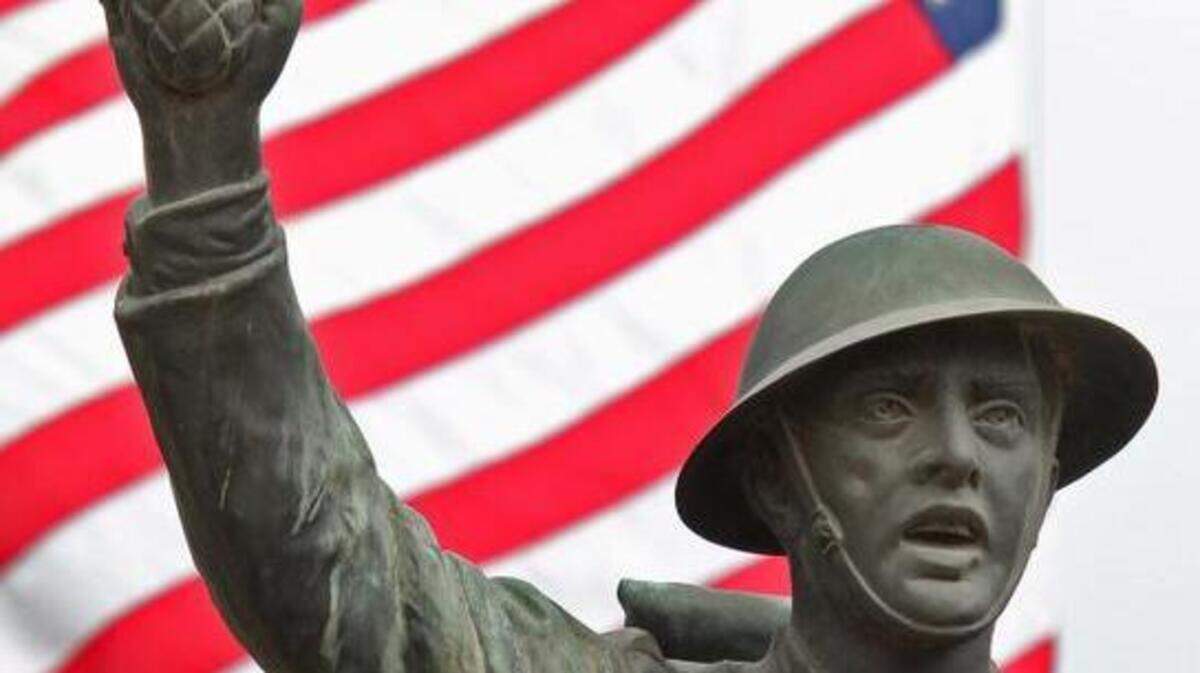
That year, Georgia sculptor E.M. Viquesney’s “The Spirit of the American Doughboy” statue was bought for $1,000 and dedicated to the local American Legion post named for Bothwell Kane.
Among the speakers was Texas National Guard commander and World War hero Gen. John A. Hulen, still remembered along with the name of the World War I Army training post here, Camp Bowie.
In 1980, Italian sculptor Giordano Grassi’s “American G.I.” statue joined the Doughboy, remembering Tarrant County residents lost in World War II, the Korean War, the Vietnam War and the Gulf War.
We need more statues.
This story was originally published May 24, 2014 at 4:00 PM.