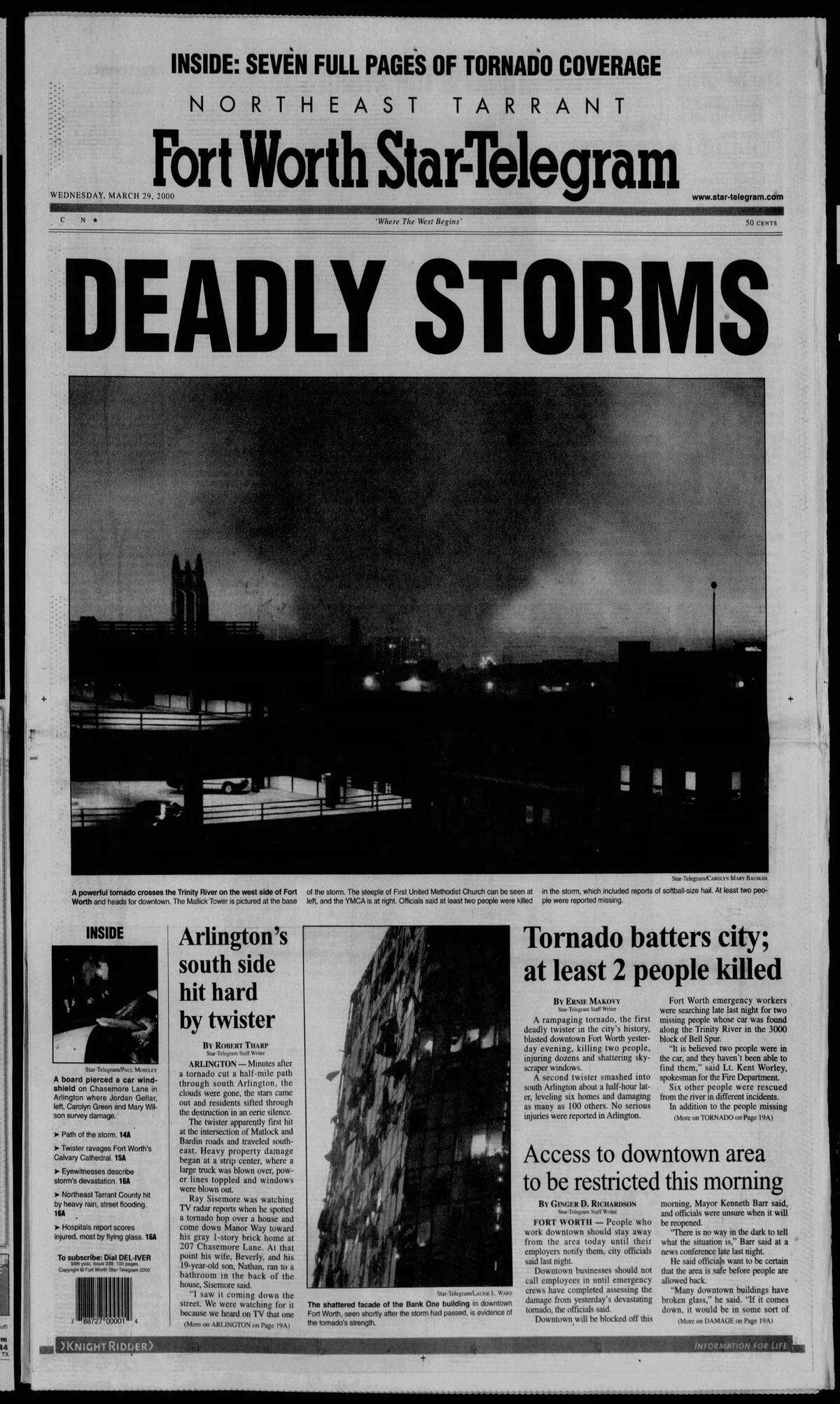
From 2000: In Fort Worth tornado, Cowtown’s good luck finally runs out | Opinion
(From columns published March 29, 2000 and April 4, 2000.)
This is the column I prayed I would never have to write.
When I was 5, I saw a tornado swoop down from the clouds and peel shingles from the roof of the Lena Pope children’s home in west Fort Worth.
I know a tornado can strike Fort Worth. I’ve seen it happen.
I prayed I would never see another.
I’ve met survivors of the previous major tornado to strike Fort Worth, a 1995 twister that tossed cars and demolished apartment buildings near Texas Christian University.
That storm wasn’t even the day’s biggest headline.
It came the night of April 19 — the night of the Oklahoma City bombing.
That tornado left only survivors.
This tornado March 28, 2000, for the first time in recorded Fort Worth history, brought death.
Dallas had tornado deaths, but never Fort Worth
I don’t know how many people really bought into the American Indian legend that a tornado would never strike where two forks of a river come together.
Legend has it that in the early 19th century, tribes camped between the West and Clear forks of the Trinity River because they believed no tornado would strike the river delta. In 1849, the U.S. Army built the original Fort Worth atop the overlooking bluff across the West Fork.
It was just an old story. But it was always a way to explain Fort Worth’s 150 years of grace.
In just the past 50 years, Dallas County suffered 17 fatalities in eight tornadoes, according to federal weather records compiled by the Vermont-based Tornado Project.
That includes 10 deaths in North Texas’ “Big One”: the 1957 tornado that wiped out much of the Oak Cliff neighborhood southwest of downtown Dallas and then danced along the Trinity River bottoms past downtown.
Yesterday, the Fort Worth tornado did not turn along the river.
It did not strike those 1840 American Indians’ campground across the Trinity north of downtown.
It climbed the river bluff and came through downtown.
Storm spotters and chasers warned downtown Fort Worth first
The first siren sounded at 6:11 p.m., when volunteer storm trackers reported a possible funnel cloud near Fort Worth Meacham Airport seven miles north of downtown.
About 10 minutes later, those of us near downtown needed to pay more attention.
A police unit at West Seventh and Arch Adams streets reported the first west side damage between 6:15 and 6:20 p.m.
Volunteer storm trackers relayed the news to the public first on the local spotters’ scanner radio channel, 146.940 MHz. (Listen on almost any scanner.)
At 6:22, a second siren sounded citywide. We heard it in the Star-Telegram newsroom. Before long, we could tell that it was time to hit the basement.
When we came out, we saw the stripped Tower.
Tornado climbed the Trinity River bluff into downtown
In 1875, a tornado supposedly followed the same path west of downtown, according to a 1981 Fort Worth history. But a newspaper back then reported, “When the wind struck the high bluffs .... it was dissipated.”
The bluff may well have weakened this tornado from the force that plowed along West Seventh Street and wiped out a half-block-wide swath across the west side.
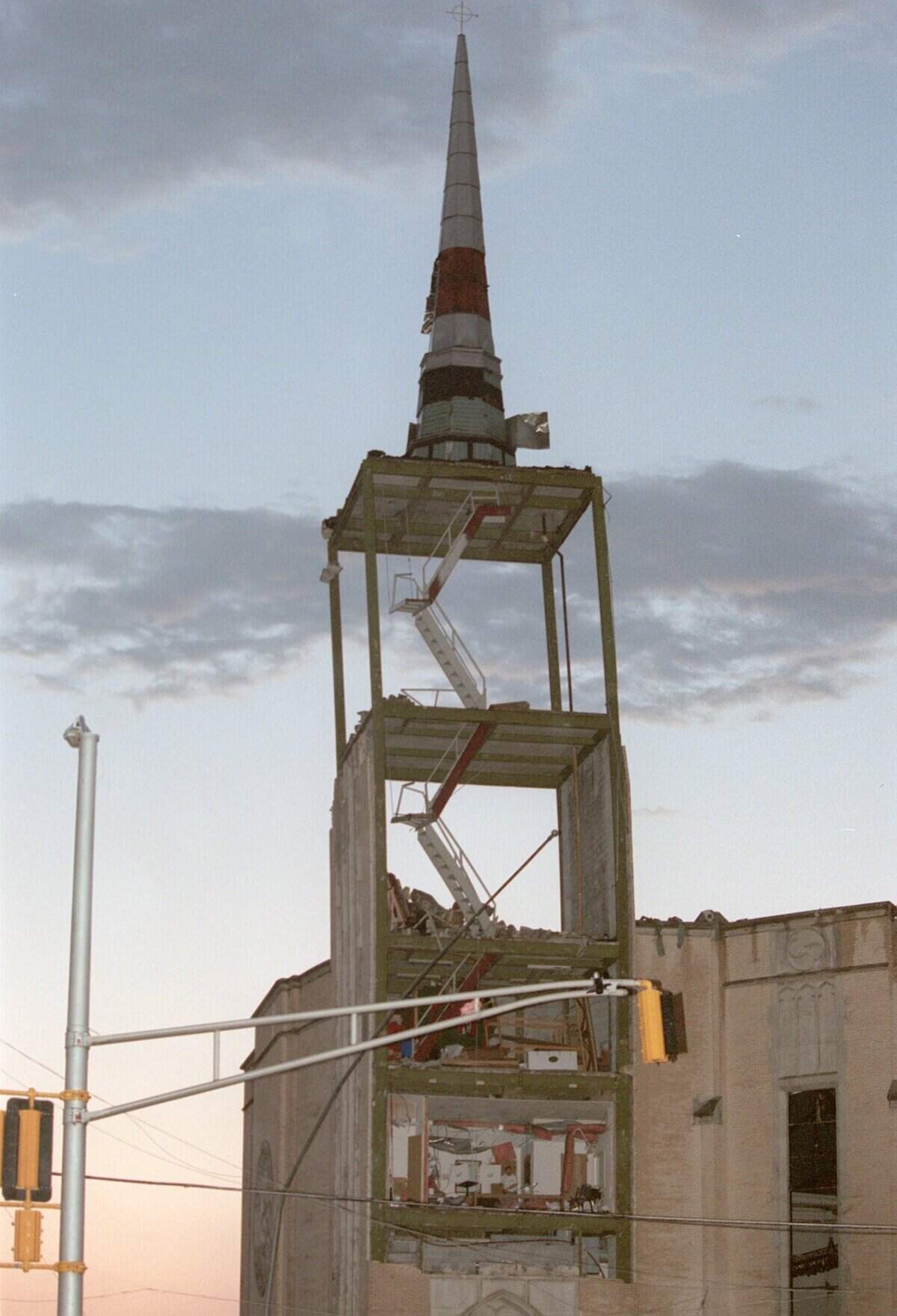
Before it dissipated east of downtown, it stayed strong enough to topple the Calvary Chapel tower, bring down a city library wall and break windows across downtown, including in the back of the Star-Telegram building.
That tornado back in April 1995 tornado near TCU rated an EF2 on the Fujita scale used to rank the force of storms. The worst tornado to hit Tarrant County in the 50 years, at least on the Fujita rating scale, was an EF3 tornado from Casino Beach through Sansom Park and Saginaw that injured nine people May 4, 1960.
Otherwise, we’ve been lucky. In our lifetime, families and entire neighborhoods have been wiped out by tornadoes in nearby Wichita Falls, Waco, Lancaster, Lubbock and recently, near Austin.
Among American cities, we have been singularly spared as the only city with no fatal tornadoes for 150 years, said meteorologist Harold Brooks, a severe storms expert at the National Severe Storms Laboratory in Norman, Oklahoma.
“Your luck has run out,” he said.