Dallas-Fort Worth news-talk radio ratings are down 25%. ‘People are just overwhelmed’
Morning doesn’t start with radio news or talk anymore, and the question is whether listeners will come back.
At a time when Texas remains in a state of emergency and a fractured nation careens toward a volatile election, the listener share for three news-talk radio giants has dropped by about 25 percent.
It’s not a matter of political party. The conservative foghorn talk station, WBAP/820 AM, nearing its 100th anniversary, plunged to No. 17 in the latest Nielsen ratings.
NPR affiliate KERA/90.1 FM fell to No. 18. Center-field player KRLD/1080 AM sank to No. 27.
One reason is obvious: Many listeners aren’t commuting anymore. We don’t need traffic reports.
But the question is whether we’ve just turned off the radio, or whether we don’t want to hear any more Texas coronavirus updates or news about justice protests and political upheaval.
“I think the reason is simple — people turn to music in hard times,” said Jody Dean, a former top-ranked local morning host and talk host now doing podcasts and shows at jodydean.com.
The audience for music stations like classic rock KZPS 92.5/FM and hit radio KJKK/100.3 “Jack FM” is sharply up, on top of the growth in online music streaming.
Music listening is up and news ratings are down because “audience fatigue is a big part of this,” Dean said.
“What you want to do is have some sort of balm for the soul.”
In April, Texas braced for the coronavirus pandemic. But it came roaring back worse than ever after public gatherings were reopened April 30 and bars were reopened May 22.
During the first round, news interest was at an all-time high. Star-Telegram readers actually emailed asking how to watch meetings online and get Facebook updates from Gov. Greg Abbott, Tarrant County Judge Glen Whitley and Mayor Betsy Price.
Our news readership is still high.
But lately, nobody has asked how to spend Tuesday morning watching the Tarrant County Commissioners’ Court.
“People are just overwhelmed,” Dean said.
“Probably even those who are the most connected to what’s going on don’t listen over and over again.”
In particular, both WBAP and KRLD have suffered because listeners are home and most household radios don’t have the AM band or HD. But the stations play on smartphone apps, online streams and smart speakers.
WBAP Program Director Kevin Graham, serving a conservative audience in a market shifting to the middle, put a good spin on the numbers.
“People are listening as much as ever, but in different ways — not in cars,” he said.
WBAP’s audience via streaming, smartphone apps and smart speakers is up 30%, he said.
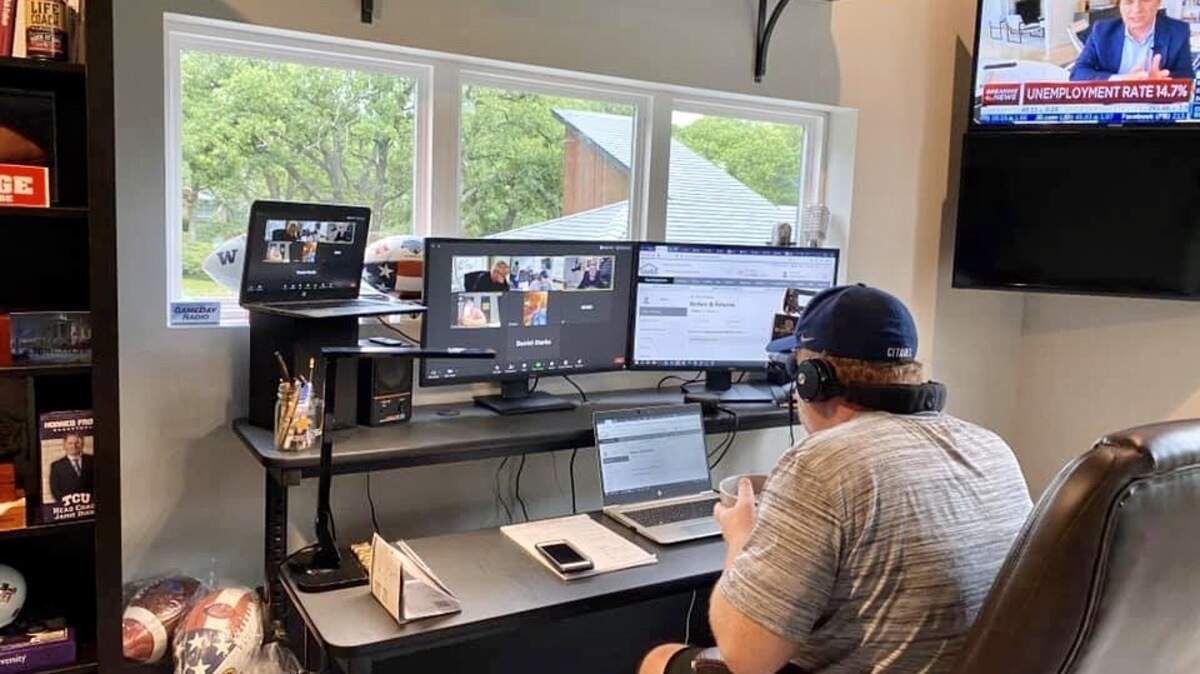
As with most stations, WBAP hosts like TCU sports voice Brian Estridge are working from home.
The legacy Fort Worth station, now based in Dallas and owned by Atlanta-based Cumulus Media, gets just as many phone calls and emails as ever, Graham said.
“The digital numbers are sky-high,” he said.
News-talk ratings nationally haven’t declined, according to Nielsen figures provided by Nashville-based Cumulus executive Charlie Cook.
But NPR stations have been hard hit, with listeners saying they want to hear about something besides politics, coronavirus or protests.
(From our numbers, I’d guess people want to know most about jobs and how to get one, and updates on unemployment benefits.)
In a written statement, KERA Vice President Jeff Ramirez said the station has seen a “slight setback” due to changing commuter habits, but also is seeing more digital and streaming listeners.
“This indicates to us that audiences are changing how they engage with KERA’s services and resources, rather than how often,” he wrote.
A KRLD station manager did not return a message.
Publisher Michael Harrison of Massachusetts-based Talkers magazine, which covers the industry, said the entire rating system is “unstable” right now
“People are home now, and the patterns of society have changed,” he said.
“I think there’s a point at which the stories eventually burn out. But I don’t think that’s the case here. This is one of the most compelling times for all news media. ... The competition for people’s attention is just fierce.”
Trailing the big players are stations like Dallas-based Salem Radio Network’s KSKY/660 AM “The Answer,” where conservative talker Mark Davis is holding steady in the ratings in his 27th year doing a local morning show.
“It was always going to be interesting” to see how the pandemic affected ratings, he wrote by email.
“ ... I have never felt as tightly bonded with listeners as we navigate the health issues, the political issues and the economic issues.”
All three big local news stations “are going to be fine,” he wrote, listing them — “WBAP with its singular lineup of known hosts, KERA as the sole source for NPR product and the great [’Think’ host] Krys Boyd, and KRLD as the all-news outlet.”
But something has changed in us all.
As as child, I listened to KFJZ in Fort Worth and went to school by Porter Randall’s Texas State Network news.
Since then, every morning has started with radio, whether it was Hal Jay’s antics on WBAP, Ron Chapman’s showmanship on KVIL, KERA’s “Morning Edition” with Sam Baker or the “Muse in the News” newsy sports talk on KTCK “The Ticket.”
These days, I listen on a smartphone, although I no longer listen all morning.
But I know friends who wake up to cable TV news.
They never seem to know what’s going on in Fort Worth or Arlington.
Last week, some were paying more attention to canned beans than to the crisis in Texas.
Local news websites, TV stations and radio streams are the only way for us to keep up with each other, and with the latest news about our state and cities.
“We will continue to be the place for human connections,” Davis wrote — “which are even more rare now that normal in-person interactions are harder.”
Don’t turn off Texas.
This story was originally published July 18, 2020 at 5:45 AM.