
Is it against the law to pick a bluebonnet in Texas? Find out

We tell a lot of tall tales in Texas. But some of them are true.
For example, take the tall tale about how Texas will lock you up for picking bluebonnets.
Entire fact-check web pages and TV reports are devoted to labeling that fake news. Reporters and even Google searches pooh-pooh the idea that it's a crime to pluck Texas' state flower.
But I rise today to defend the honor of the bluebonnet, a noble wildflower too often run over or squashed.
From 1933 to 1973, it really was illegal in Texas to pick bluebonnets. And it's still illegal in state parks.
Until 1973, a law originally nicknamed the Wild Flower Protection Act levied a fine of $1 to $10 against anyone who set out to “pick, pull, pull up, tear up, dig up, cut, break, injure, burn or destroy” bluebonnets or any plants in public parks or on private property.
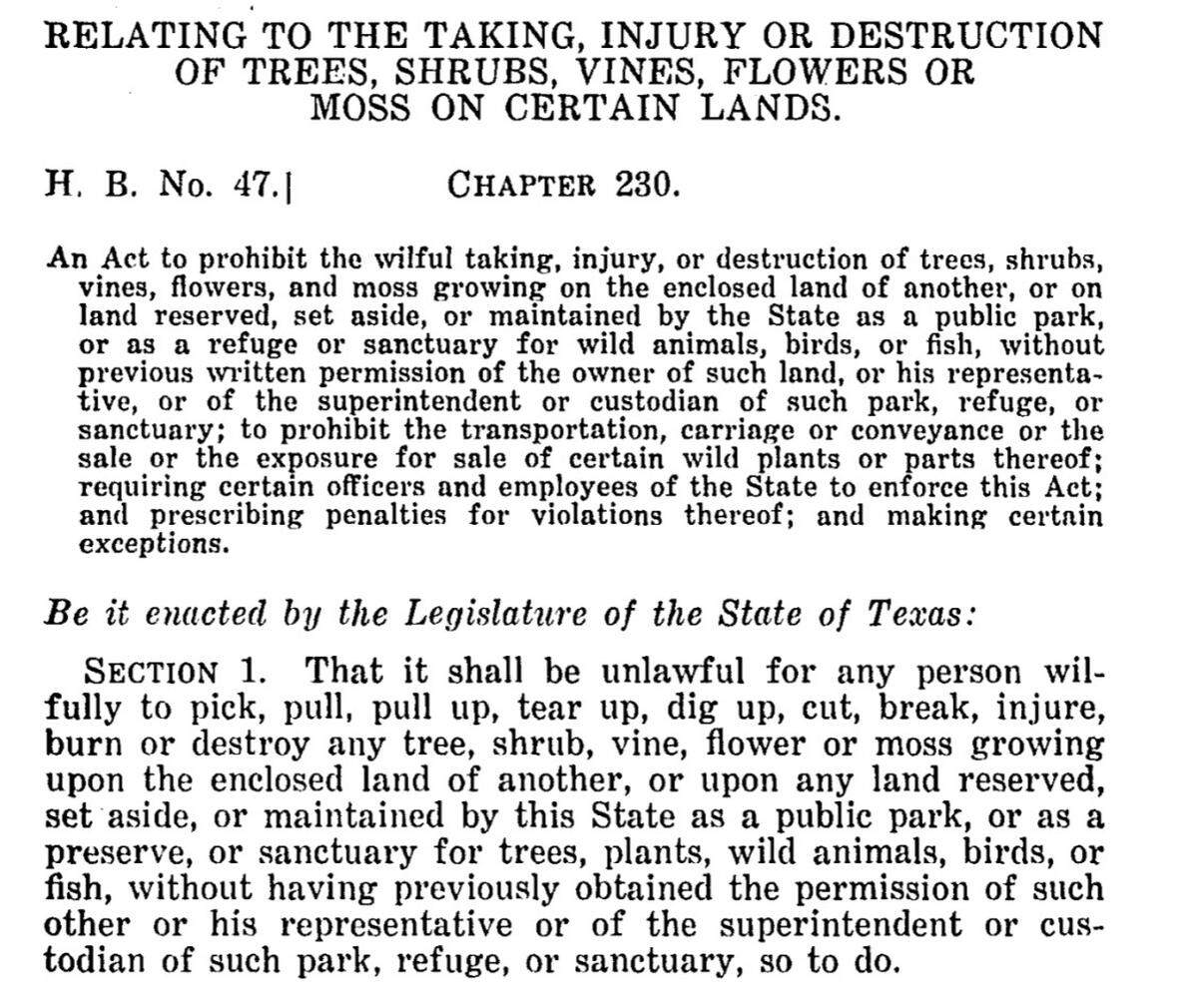
In the midst of the Depression, Gov. Miriam “Ma” Ferguson signed the bill written by future House Speaker Emmett Morse (D-Houston).
Women's clubs and garden clubs wanted the ban. It also outlawed transporting or dealing in illicit bluebonnets or other wildflowers such as Indian paintbrush.
As you might expect, Morse and other Houston lawmakers had to endure a lot of mockery on the House floor.
State Rep. Ben Vaughan (D-Greenville) complained the bill made it illegal for a child to pick a flower for a teacher: “The bees are liable to be arrested for sucking the honey out of the wildflowers.”
A later amendment on the House floor exempted children from criminal prosecution. The House also reduced the maximum fine to $10 after a debate on making the minimum fine 10 cents.
The House also refused to exempt picking poison ivy, jimsonweed or locoweed.
State Rep. Bob Alexander (D-Childress) might have had something on his mind besides gardening.
He called the bill “a direct slap in the face of romance” and said men who want to “take their girls out in the country wouldn't have any excuse.”
Morse still defended the bill, saying commercial pickers around Houston were stealing holly and wildflowers.
State Rep. T.H. McGregor (D-Austin) argued: “A city dweller goes into the country and destroys flowers … and thinks nothing of it. What would he think if the farmer came to town and took his roses?”
The bill passed the House, 68-60.
The law was erased in a 1973 rewrite of the criminal code. But it's still illegal to damage public property.
(The Texas Department of Public Safety has a website warning against harvesting or driving over flowers. The state parks department warns specifically not to collect park plants, animals or rocks. A violation is a Class C misdemeanor punishable by a fine of up to $500.)
I asked the Texas District and County Attorneys Association about the old law.
“One of my kids just asked me this week,” the TDCAA's Shannon Edmonds wrote in an online message.
“He asked if it was illegal to pick bluebonnets or step on them. So the law may have been repealed, but the myth prevails!”
It wasn't a myth. It was a crime with a $1-$10 fine.
But I find no record that anyone has ever been nabbed or fined for the unlawful possession of a bluebonnet.
This story was originally published April 7, 2018 at 3:33 PM with the headline "Is it against the law to pick a bluebonnet in Texas? Find out."