‘Y’all have killed Dr. King’: After assassination, Fort Worth wept, prayed
The 1968 murder of the Rev. Martin Luther King Jr. left much of his work unfinished, not only nationally but also in Texas and Fort Worth.
By 1968, downtown department stores had long since dropped the “white” and “colored” signs from water fountains. A handful of Black students attended five formerly all-white Fort Worth high schools.
“We were pretty much still a totally segregated community,” said retired District Judge L. Clifford Davis, the heroic lawyer who won the court fight to open the doors of all Fort Worth public schools.
After King was killed in Memphis on April 4, 1968, “there was no violence,” Davis said.
“But that was because the people downtown were anxious there be no violence. We were able to achieve some breakthroughs thanks to leadership.”
Back then, Fort Worth was still counting “firsts.”
We had our first Black councilman, the late Edward Guinn; first Black athlete to play for the TCU Horned Frogs, basketball center James Cash; and that same month, the first Black reporter for any major Texas newspaper, the Star-Telegram’s Cecil Johnson.
But when news came of King’s death, some feared the firsts would also be the last.
Linda Hudson of Fort Worth remembers how tough it was just getting a job at the aircraft plant now known as Lockheed Martin Aeronautics.
Then when King was killed, “I cussed out my lead [supervisor] right then,” she told historian Tina Cannon this year in an interview for an upcoming graduate paper.
“I told him, ‘Y’all have killed Dr. King,’ ” Cannon said she kept her job “only by the grace of God.”
The news this week in 1968 was already unsettling.
In Vietnam, two locally built F-111 fighter jets were shot down in three days. President Lyndon B. Johnson announced a prime-time speech, then stunned America by saying he would not run for re-election.
In Fort Worth, school board candidates debated whether to offer free kindergarten and whether to accept any federal funds.
The night King was shot, Star-Telegram reporter Robert Mann was diverted from an assignment in Atlanta. He made it to Memphis in time to cover a late press conference, and the newspaper headlined: “Martin Luther King Slain by Gun Blast In Memphis.”
The next day, Mayor DeWitt McKinley said the city was “shocked and stunned at the violent and lawless death.”
Brite Divinity School professor Harold Lunger, who had hosted a coffee with King in his TCU-area home on a 1959 visit, led students in prayer that King would “accomplish more in his death than the hardness of men’s hearts permitted him to accomplish in his life.”
TCU students mourned two more times, first at a gathering in front of the student center and then with citywide mourners at a Palm Sunday memorial service that drew 2,000 to what is now Schollmaier Arena.
But not everyone mourned.
“One of the women said [that] in her dorm, girls celebrated when he was killed,” said Bryan Feille of Minneapolis. As a student, he led the prayer at the student center. He’s now retired as a Brite professor and administrator.
He said the crowd at the student center memorial was mostly Black campus service workers.
He had protested at the chancellor’s office when TCU was slow to lower the U.S. flag to half-staff, only the third time American flags were ever lowered for a private citizen.
Afterward, Feille found several letters and notes that had been slipped under his dorm room door: “One professor said he was disappointed in me because he didn’t think I was that kind of student — a ‘troublemaker.’ ”
Even Texas Gov. John Connally, a former Fort Worth lawyer, had to backtrack after telling a Weslaco business crowd the night of the assassination that King contributed to “the chaos, the strife and the uncertainty in this country.”
(Connally did add that King “deserved not the fate of assassination.”)
By the following week, the Star-Telegram was filled again with news reports from Vietnam and with Easter week fashion ads.
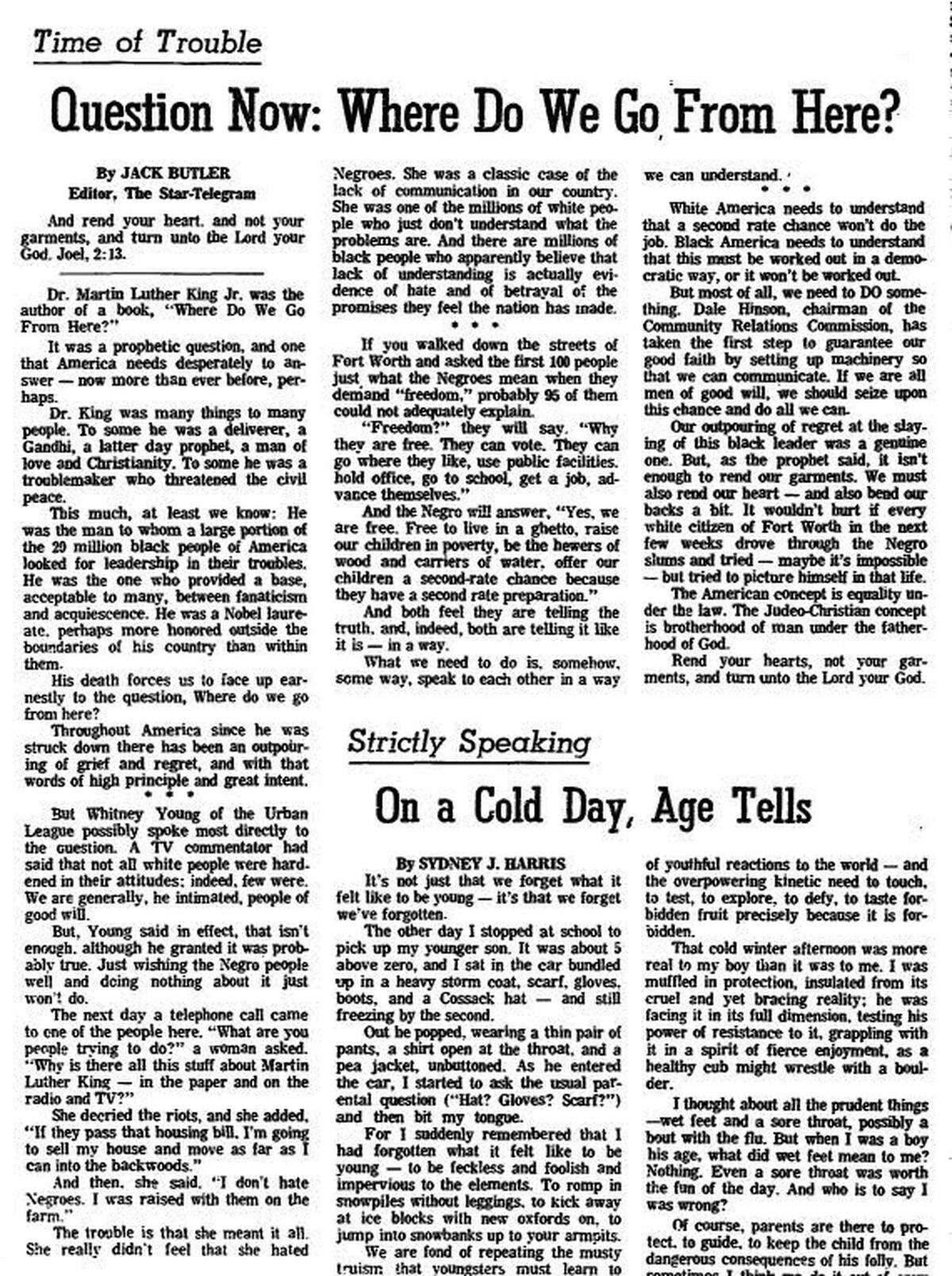
But Editor Jack Butler wrote a moving column quoting King’s 1967 speech and book title “Where Do We Go From Here?”
The day after King died, Butler wrote, a woman phoned the newsroom.
“What are you people trying to do?” she asked.
“Why is there all this stuff about Martin Luther King — in the paper and on the radio and TV?”
Butler called for white readers to work harder toward racial reconciliation, understanding and genuine equality.
“It wouldn’t hurt if every white citizen of Fort Worth in the next few weeks drove through the Negro slums and tried — maybe it’s impossible — but tried to picture himself in that life,” he wrote.
I wonder how many did.
This story was originally published April 3, 2018 at 3:34 PM with the headline "‘Y’all have killed Dr. King’: After assassination, Fort Worth wept, prayed."