Algorithmic assault on our freedoms: Plate readers help feds search for migrants | Opinion

If I had a nickel for every time I read a story on Texas cops using artificial intelligence to extralegally search license plates, well, I’d have two nickels. Which is not a lot of nickels. Still, weird that it happened twice!
A massive release of public records around Immigration and Customs Enforcement (ICE’s) use of Flock, a privately owned, automated license plate reader that the company’s website boasts is used across “more than 5,000 communities” throughout the United States, revealed that Texas police departments were also using the massive database to find people suspected of living in the U.S. illegally. Another look at the data found that a Texas cop used the nationwide license plate database to track down a woman who performed an abortion on herself. According to the technology blog 404 Media, which obtained the data, police generally conduct these searches without requesting warrants, which a number of lawsuits contend violates your protections against unreasonable searches.
My hesitation with artificial intelligence usually derives from chatbots consuming enough energy to power a Spirit Bomb. But instead of using our collective power to defeat Majin Buu or something approximately as cool, AI tools often hallucinate wrong answers or plagiarize skillful creators and researchers, like the person who wrote this. License-plate readers such as Flock use AI to perform a task that is theoretically useful for, say, police trying to catch a car thief or find whoever vandalized an anti-lynching statue in Dallas.
But the tradeoff: forced entry into an unregulated surveillance labyrinth diluting whatever remains of my civil liberties. Like most of you, I don’t read my Terms of Service agreements, but feeling like somebody’s watching is only fun when Rockwell and MJ sing it. The technology behind plate trackers is imperfect — the algorithm confusing a 2 with a 7 could end with ICE pressing my face on the hood of my Sonata.
And in a country run by a president obsessed with finding the immigrants he doesn’t want here, and willing to use ICE to illegally capture, detain and deport said immigrants, that access to everyone’s whereabouts bears a more sinister application. Same goes for the state-level pursuit of people seeking or providing abortions. Remember, people drive and ride in their cars, which means access to the car equals access to a growing network of faces.
So, I ask: Who’s playing tricks on me?
Typically, ICE and law enforcement have distinct scopes of their respective work. Police are tasked with keeping public safety within their jurisdiction, while ICE upholds national immigration law. President Donald Trump is blurring those lines by expanding the 287(g) program, which encourages local and state police to cooperate with national immigration enforcement, even as the president defines such enforcement with flagrant disregard for the Bill of Rights. (Don’t be surprised to hear that the Tarrant County Sheriff’s Department under Sheriff Bill Waybourn is enrolled in the controversial program.)
But many law enforcement agencies, including the Dallas Police Department, exist in cities and states codifying their noncompliance, which made a more Texas-specific review of the Flock license plate data dump particularly disturbing.
Writing for The Barbed Wire, Steven Monacelli identified 17 instances of Dallas PD running searches on Flock for “ICE+ERO” in 2025, despite a department policy prohibiting cooperation with ICE and the aforementioned Fourth Amendment wire tripping. The Houston Police Department, which also operates under rules limiting its ICE cooperation, performed 109 immigration-related searches. Monacelli identified at least three other Texas police departments — including the Texas Department of Public Safety — also using Flock’s nationwide network for immigration searches.
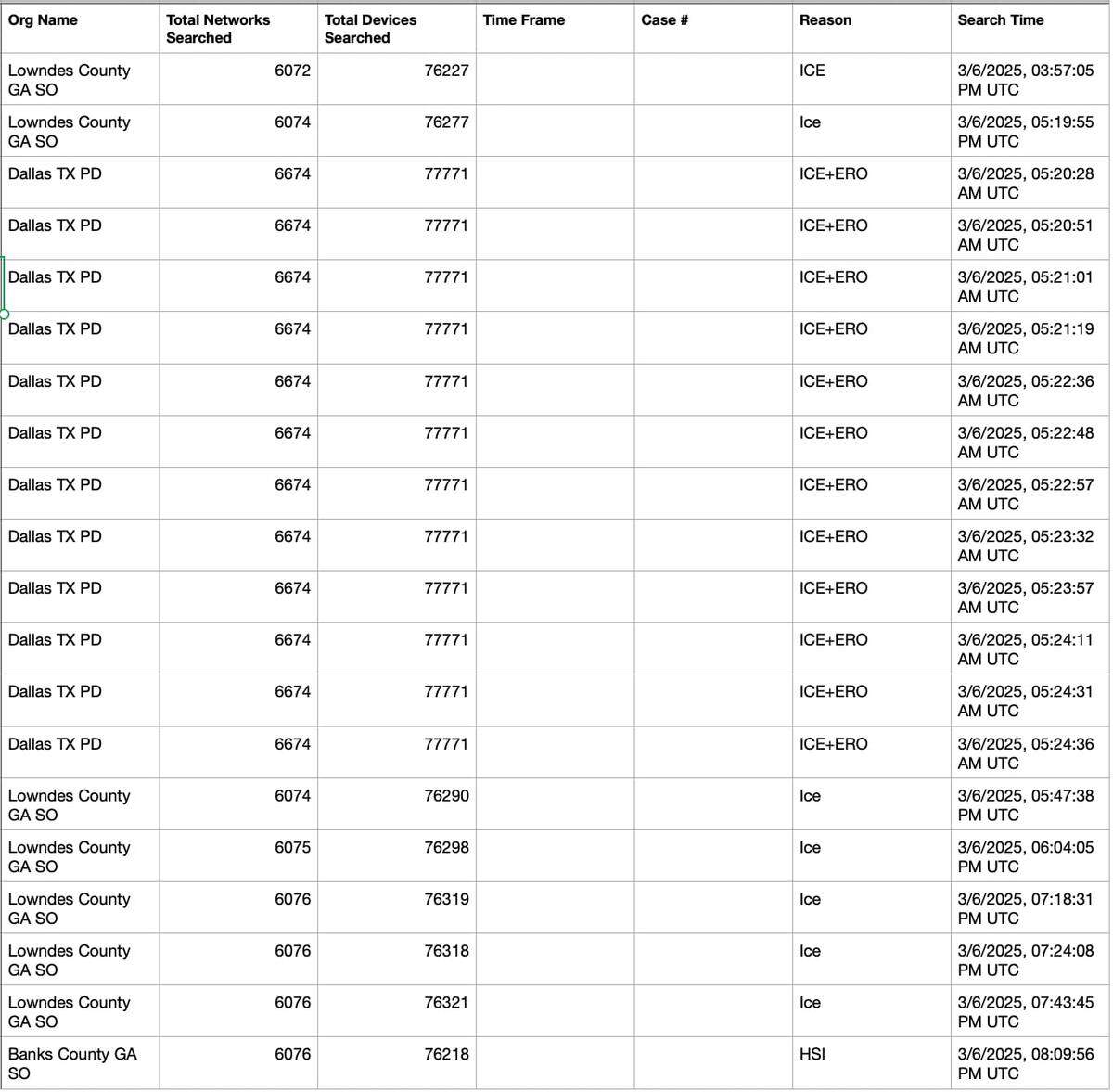
Despite loose access to our data, the police departments were stingy with what they shared to The Barbed Wire on what exactly these searches entailed and the policework being done. What does a license plate search tell you about immigration status? Wouldn’t you like to know!
That’s the problem with tech panopticons — governments obtain boundless knowledge of our lives, and with it, increased power to determine how we live. Regulation for thee, but not for me.
In Fort Worth, even though city police have a contract with Flock, we’ve seen at least some reckoning with what we’re willingly allowing Flock to arrange in local neighborhoods. Last year, West Meadowbrook Neighborhood Association president Carol Peters told the Star-Telegram that Flock’s aggressive selling of its services to residential neighborhoods is “preying on people’s fears about crime,” while the executive director of the Las Vegas Trail Revitalization Project, Paige Charbonnet, said the technology helped reduce crime.
But if the police are possibly committing constitutional crimes to prevent community crimes, are we really coming out ahead?
This story was originally published June 3, 2025 at 5:27 AM with the headline "Algorithmic assault on our freedoms: Plate readers help feds search for migrants | Opinion."