Will Texas have a sunny Easter this year? Here’s what weather to expect this spring

Meteorological spring begins March 1 and runs through May 31.
This year, the season will be warmer than normal, the National Weather Service in Fort Worth says.
Monthly averages for spring in DFW
Here are the average maximum and minimum temperatures for each month, as well as the average precipitation, per the National Weather Service in Fort Worth:
- March — Average high = 68.6F. Average low = 47.8F. Average precipitation = 3.30”
- April — Average high = 76.1F. Average low = 55.2F. Average precipitation = 3.22”
- May — Average high = 83.6F. Average low = 64.5F. Average precipitation = 4.78”
.png "image (4).png")
The hottest temperature on record in February is 96 degrees, which was set on Feb. 25, 1904. We hit 90 degrees this year on Feb. 21, making it the eighth warmest February day on record. In March, there have been two 100 degree days, one on March 21, 1916 and another on March 9, 1911. We have not had a temperature of 95 degrees in March since 1991.
May is the wettest month of the year in Dallas-Fort Worth. The wettest May since 1898 was in 2015, with 16.96 inches. The driest was 1911, with only 0.22 inches. The fourth driest May on record was in 2017, with only 0.70 inches, only two years after the wettest May.
“Having at least normal precipitation in May really goes a long way towards reducing the chances for extreme heat and drought here during July and August,” said NWS Fort Worth meteorologist Victor Murphy. “We often see a lot of rainfall variability in May.”
Short-term spring forecast
According to the March forecast from the NWS Climate Prediction Center, there’s a 57% probability of temperatures being above normal, and only a 10% chance of below normal temperatures. So, the odds are six to one that it will be warmer than normal rather than cooler than normal.
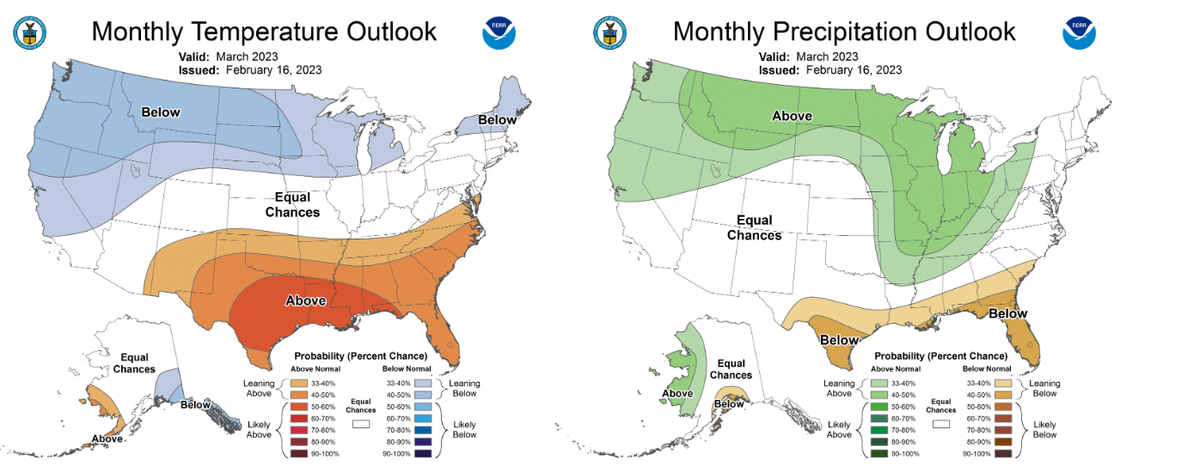
As for precipitation, there are equal chances. There’s a one-third chance of above normal rainfall, one-third chance of near normal rainfall and one-third chance of below normal rainfall.
Long-term spring forecast
Through May, the forecast is similar, with a likelihood of a warmer than normal spring. There is an enhanced chance of 45% for above normal temperatures, and about a 22% chance for below normal temperatures, making the forecast two to one in favor of warmer than normal versus colder than normal.
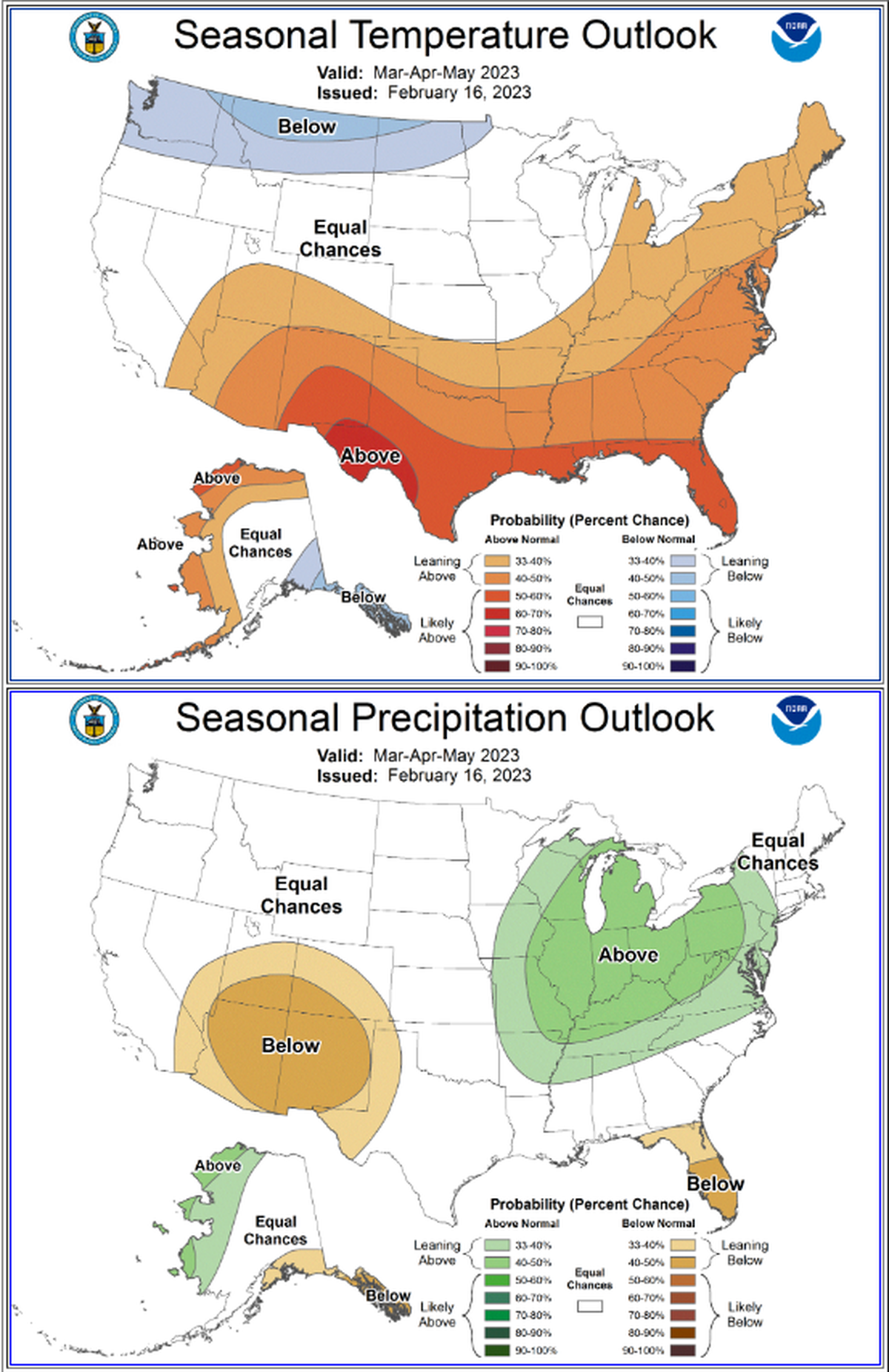
As for rainfall, there’s about a one-third chance of above, below or near normal rainfall.
.png "image (5).png")
There’s extreme year-to-year variability for spring precipitation in DFW, Murphy said. The spring of 2015 was the second wettest on record, with nearly 25 inches. Two years later, the spring of 2017 saw only 5.14 inches, about 20% of the former. However, the rolling 30 year average precipitation for spring remains steady, at 11.25 inches.