How long will Texas have to endure the heat? 100-degree days in the forecast for Fort Worth

It feels like Fort Worth is stepping into the dog days of summer.
Starting today through June 25, the National Weather Service forecast shows 100 degrees every day except for Saturday — when it will be a relatively cool 98.
All this heat has not exactly slapped North Texas by surprise.
An early heat wave
May’s warm weather broke a 26-year record for number of days over 90 degrees and tied another for average temperature. This year has already been off to a warm start, with the first 90-degree recorded on March 27.
Typically, North Texas doesn’t record a 90 degree day until April or May. This much heat, this early in the year, is reminiscent of two notoriously hot years — 1980 and 2011 — when by summertime, an oppressive heat wave broke records.
In total, 20 days in May were over 90 degrees, the most ever on record for North Texas, according to the National Weather Service. This year’s amount broke the previous May record set in 1996 of 19 days over 90 degrees.
Of those warm days, 15 of them were in a row from May 7 to 21. A string of high-70 degree days shifted things slightly after that, but the month finished out from May 27 to 31 over 90 degrees.
The greatest number of days over 90 degrees in May that round out the top five are:
- 19 days in 1996.
- 18 days in 1956.
- 17 days in 2018.
- 15 days in 2006.
Last month’s average temperature was 77.9 degrees, which is tied for the fifth warmest on record with 2012, according to the National Weather Service.
The top four warmest average May temperatures are:
- 79.7 degrees in 1996.
- 79 degrees in 2018.
- 78.4 degrees in 1998.
- 78 degrees in 2006.
The warmest temperature recorded in 2022 thus far, has been 97 degrees on May 15.
As early as Mother’s Day, North Texas was already gripped with the anxiety of facing a record-hot summer.
That much heat, this early in the year, is reminiscent of two notoriously hot years — 1980 and 2011 — when by summertime, an oppressive heat wave broke records. Some experts are warning we’ll see above-average temperatures, compounded by drought and wind.
Typically, temperatures heat up in North Texas as summer rages in June and July. Will summer 2022 be as bad as 1980 or 2011?
1980 heat wave
There were 69 days in 1980 where the temperature was at or above 100 degrees — 42 of those days consecutively.
Only 2011 had a total of more 100 degree days than 1980. But 1980 set the record for most consecutive days with triple digits, from June 23 to Aug. 3.
The first 100-degree day for that year was June 7. The highest temperature that summer was 113 on June 26 and 27.
June 1980 had a total of 13 days over 100 degrees, and August had 21 days, with the highest temperature getting to 105. September saw the last of the triple digits with four days of 100-degree highs.
July, however, set the record for the greatest number of days at 100 degrees as the entire 31-day month was over triple digits. Over 40 years later, the July record still stands as the greatest number of 100-degrees days in a month.
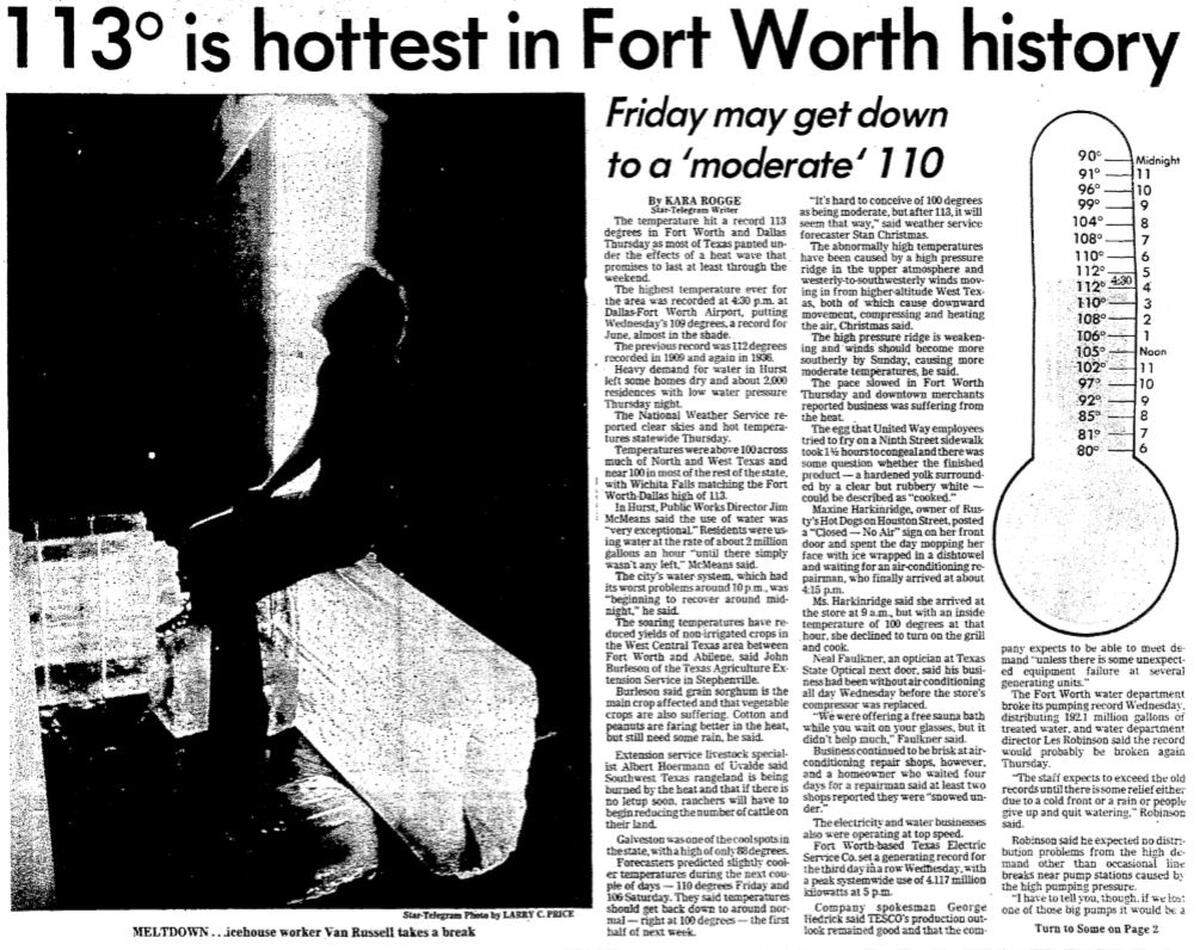
2011 heat wave
There were 71 days in 2011 at or above 100 degrees, a record that hasn’t come close to being topped since then.
Of those 71 days, 40 were consecutive from July 2 to Aug. 10, the second most since 1980. Another stretch in 2011 of 20 days from Aug. 15 to Sept. 3, is sixth on the highest consecutive list for North Texas.
The highest temperature was 110 on Aug. 2, and the lowest was 76 on July 2. The first 100-degree day of the year was June 13, and last was Sept. 29.
June had a total of seven days at 100 degrees. July 2011 had the second highest number of 100-degree days with 30, one shy of the record-setting 1980. August 2011 ranks third with 28 days of triple digits.

How do those years compare to 2022?
North Texas has seen multiple 90-degree days this year; April 5 clocked in at 95 degrees, and April 20 hit 91 degrees.
By comparison, 1980 didn’t see its first day above 90 until April 7, and 2011 had back-to-back days of 91 degrees on April 18 and 19.
May has had more 90-degree days than 1980 and 2011. The highest temp in May 2011 was 97.
Summer 2022 outlook
The Texas drought is the main culprit of the spring heat wave, according to the National Weather Service. More than half the state is under extreme drought conditions, with nearly one-fourth of Texas in exceptional drought..
With drought conditions earlier in the year, the beginning of summer heat occurs earlier than normal, meaning that all signs point to a hotter 2022.
The Climate Prediction Center projects a warmer than normal summer for Texas, particularly in central and western Texas, and especially in the Panhandle. New Mexico, Colorado, Utah and western Oklahoma are also likely to have scorchers.
Heat and windier-than-normal springs seem to be intertwined, with this spring’s winds resembling those of 2011, according to NWS.