The Texas drought is the worst in years. Are we on the brink of widespread disaster?
Texas is in the worst drought conditions since 2011, when 99% of the state was in drought. Eleven years ago, parched conditions caused over $7 billion in crop and livestock losses, sparked wildfires, pushed power grids to the limit and reduced reservoirs to dangerously low levels, according to the University of Texas at Austin.
As of July 21, 95% of Texas was in drought conditions, affecting an estimated 22.9 million Texans, according to the U.S. Drought Monitor. About 57% of the state is seeing extreme or exceptional drought.
Just six months ago, 67% of the state was in drought with 11% extreme or exceptional.
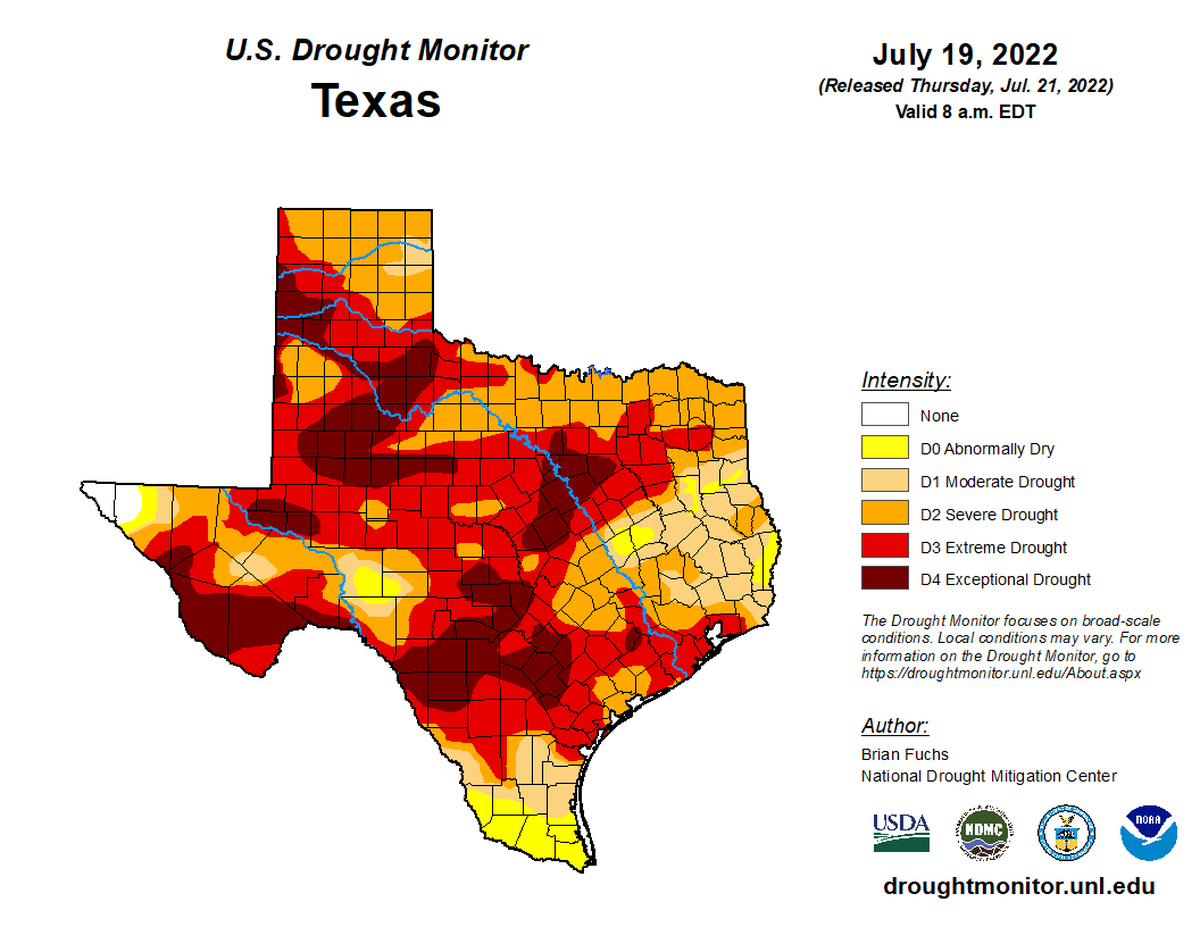
Rainfall in May and June, the wettest months of the year in Texas, was below-average, contributing to the drought conditions. La Niña conditions, causing the south to be dry, are expected to persist until at least August, meaning we may see drought conditions as bad as in 2011. With that, there are 215 county burn bans, 456 counties with disaster designations, and water restrictions in place throughout the state.
Why is Texas still in a drought?
The Panhandle, High Plains and southwestern Texas have been dry for years, experts say. Above-normal temperatures combined with below-normal precipitation and high winds have exacerbated drought conditions, according to the U.S. Drought Monitor.
June was warmer and drier than normal for much of the state, the fourth consecutive month with those conditions, according to the Texas Water Development Board. This year is the sixth driest to date, with January to June averaging less than eight inches of rainfall across the state, about 60% of the normal. That’s not as bad as in 2011, when we received less than six inches of rain in the first half of the year, only about 40% of normal.
.png "latestdmtx (1).png")
Rainfall was below normal for most of the state in May and June, expanding and intensifying the drought. The majority of the state received less than 50% of normal rainfall, according to the National Oceanic and Atmospheric Administration’s latest report.
What impacts has the drought had?
Gov. Greg Abbott this month renewed a disaster declaration, saying that exceptional drought conditions pose a threat of imminent disaster to public health, property and the economy. The proclamation said that significantly low rainfall and prolonged dry conditions are increasing the threat of fires.
Droughts are among the most costly weather-related events and the most far reaching, according to the National Weather Service.
One of the most dangerous consequences is elevated fire danger. Dry conditions have contributed to wildfires across the state these past months. Wildfire activity is expected to continue throughout the week, according to the Texas A&M Forest Service, as periodic critical fire weather occurs where very dry vegetation is present.
“We’re reaching the core of wildfire season and conditions look relatively dangerous over the upcoming week because of the dry weather and strong winds,” Texas state climatologist Nielsen-Gammon said. “If we managed to get several inches over the next month, that will at least provide some decent amounts of topsoil moisture to reduce the fire risk.”
Drought also causes water shortages, with streams, reservoirs and wells low. Water reservoirs in North Central Texas are operating at 86% capacity, according to the Texas Water Development Board, compared with 100% a year ago.
.png "recent-storage@2x (1).png")
Drought also damages crops and pastures and can cause widespread loss. Currently, farmers are having problems getting spring crops established. Livestock producers are having issues getting hay.
“Drought, it’s going to have a huge impact on crop production for a lot of our crops that can reduce yield, It can potentially delay harvesting, or just can add a lot of challenges,” said Vanessa Corriher-Olson, Texas A&M AgriLife Extension forage specialist. “For livestock producers, when we have drought conditions, that obviously decreases forage production, so that can increase their demand for hay or needing to feed their animals with supplementation.”
The National Integrated Drought Information System reports that 43% of the Southern Plains, which includes Texas, Kansas, New Mexico and Oklahoma, is in extreme to exceptional drought that’s likely to persist through September, raising concerns about the Texas agriculture and economy.
“There is never a good time for a drought, but the timing in this instance is particularly troubling. From the perspective of agricultural producers, many have experienced additional losses from extreme cold in 2021 as well as recent hail and dust storms,” said economist Ray Perryman in a news release. “In addition, everything needed to grow crops or livestock is more expensive than usual. From seed to fuel to hay to power for irrigation wells, farmers and ranchers have seen costs rise substantially. Although crop and other insurance can provide some relief, it only goes so far. Supply chain issues are further compounding the situation.”
Texas is an important source of beef, cotton, milk, poultry, corn, eggs, sorghum, vegetables, wheat, but yields can drop as the drought intensifies, causing prices to go up further.
How long do droughts usually last?
Some droughts last only a matter of weeks, exacerbated by extreme heat and/or wind, but more commonly persist for months or years.
A seven-year drought in the 1950s was the longest in Texas in modern history. The most recent and severe drought began in the fall of 2010 and lasted through winter 2014.
When will the drought end?
Over the next three months, drought conditions are expected to persist in most of Texas and worsen in a few areas, according to data from the Climate Prediction Center.
La Niña, a weather pattern that occurs in the Pacific Ocean, is anticipated to affect temperature and precipitation across the United States during the summer. The National Weather Service says there’s a 53% chance La Niña will last through August.
When the drought eases, it’ll happen a lot earlier in the northern part of the Dallas-Fort Worth metroplex than the southern part, Nielsen-Gammon said.
Nielsen-Gammon has projected that Texas will experience more 100-degree days, more extreme rainfall, more urban flooding, greater hurricane intensity and increased drought severity by 2036, a prospect that worries 77% of Texas voters.
What should you do in a drought?
Local officials may ban outdoor burning. In extreme fire conditions, officials may issue mandatory evacuation orders.
.png "DecBan (2).png")
The National Weather Service offers these tips for drought conditions.
Consider drought conditions when making travel plans:
- Check local drought conditions.
- Follow local guidance for outdoor recreation.
- Parks, trails and ski areas may modify their services during a drought.
- River may be closed to fishing and boating.
Reduce your household water usage:
- Identify and fix leaks.
- Select energy- and water-efficient appliances and plumbing fixtures.
- Take shorter showers.
- Turn off the water while brushing your teeth or shaving.
- Run the washer less frequently, only when you have a full load.
- Heed local water use restrictions.
Reduce your outdoor water usage:
- Consult with your local government or nursery to select drought-tolerant plants and trees.
- Only water a lawn if rainfall has not fallen in one to two weeks. Do so when the temperature is cooler in the early morning or late evening. Avoid watering on windy days.
Only water landscapes to maintain adequate soil moisture.
Use a sprinkler that makes larger water droplets. Turn sprinklers toward the lawn and not the pavement. Turn soaker hoses’ holes downward, facing the grass.
This story was originally published April 6, 2022 at 1:19 PM.