Federal court blocks Texas Republicans’ congressional voting map for 2026
The 2026 elections will proceed under the current congressional maps rather than newly drawn Texas congressional districts that sought to give Republicans more congressional power, a federal court ruled Tuesday.
The ruling follows Texas’ mid-decade congressional redistricting in August, when Republicans in the state Legislature approved a map that positions Texas to pick up five GOP seats in Congress. A days-long hearing was held in October in El Paso before a three judge panel, after plaintiffs requested the map not be used for the 2026 elections.
U.S. District Judge Jeffrey V. Brown delivered the Tuesday ruling on behalf of himself and Senior U.S. District Judge David C. Guaderrama, with U.S. Circuit Judge Jerry E. Smith dissenting.
“The public perception of this case is that it’s about politics,” Brown, a Trump appointee, said in the 160-page order. “To be sure, politics played a role in drawing the 2025 Map. But it was much more than just politics. Substantial evidence shows that Texas racially gerrymandered the 2025 Map.”
Texas’ mid-decade redistricting has created ripples nationally, including in California where voters recently approved mid-decade redistricting in The Golden State to counteract Texas’ new Republican seats.
The ruling was praised by Democrats. Mexican American Legislative Caucus Chair Rep. Ramón Romero, Jr., a Fort Worth Democrat, called it “a win for every Texan who believes in fair representation” in a statement.
“In a win for Texas voters, a federal court today blocked Texas Republicans’ attempt to racially gerrymander their congressional maps,” Democratic National Committee Chair Ken Martin said in a statement. “Texas Democrats and the DNC fought valiantly for fair representation, and now, with this decision, the court has ruled that Texas Republicans cannot implement this blatant gerrymander in the next election.”
But Gov. Greg Abbott, a Republican, said the ruling is “clearly erroneous,” and that Texas would swiftly appeal to the U.S. Supreme Court.
“The Legislature redrew our congressional maps to better reflect Texans’ conservative voting preferences — and for no other reason,” Abbott said in a statement. “Any claim that these maps are discriminatory is absurd and unsupported by the testimony offered during ten days of hearings.”
Texas Attorney General Ken Paxton, a Republican, said: “The radical left is once again trying to undermine the will of the people. The Big Beautiful Map was entirely legal and passed for partisan purposes to better represent the political affiliations of Texas.”
In North Texas, the changes passed in the 2025 map included pushing Congressional District 33 represented by U.S. Rep. Marc Veasey, a Fort Worth Democrat, fully into Dallas County. The district currently spans both Dallas and Tarrant counties.
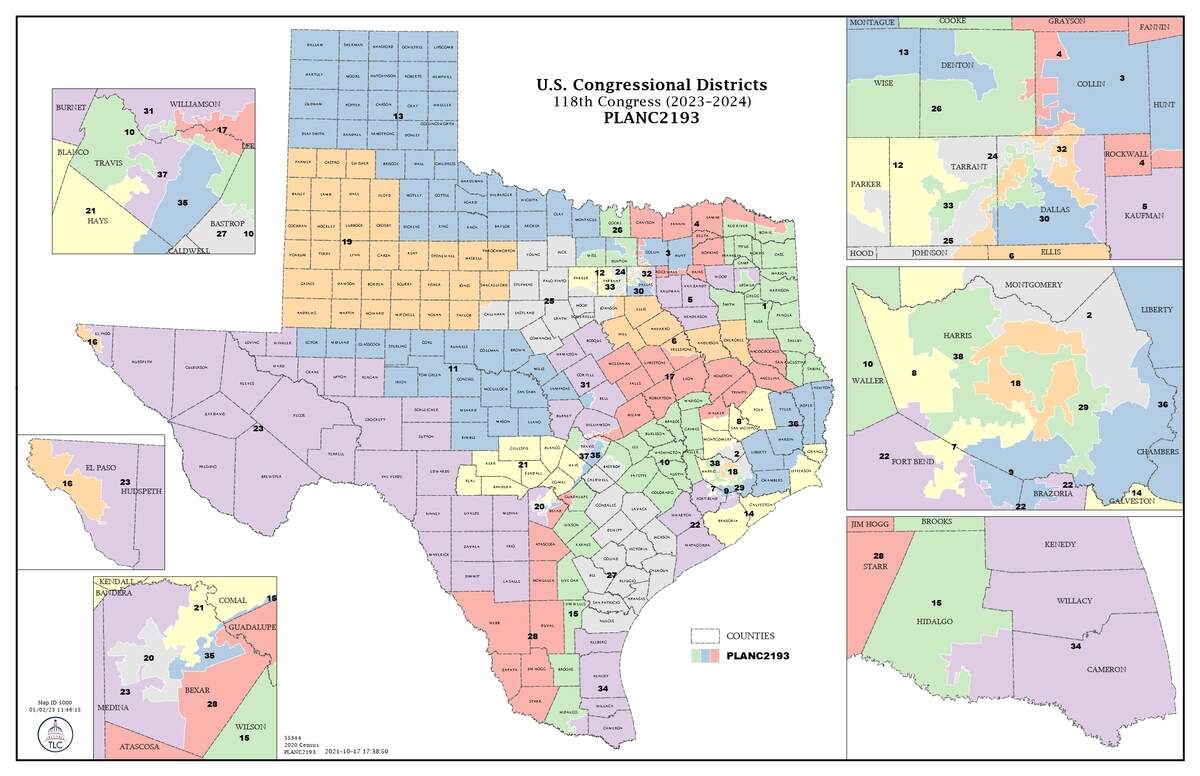
The move, coupled with other Dallas-Fort Worth area district boundary alterations, has led to speculation over possible shakeups in congressional representation in North Texas, were the new boundaries in effect for 2026 elections.
Veasey has previously said he’s running for Congress, but until Tuesday it had remained to be seen whether that bid was in Congressional District 33 or neighboring Congressional District 30, represented by U.S. Rep. Jasmine Crockett, a Dallas Democrat.
In a Tuesday interview, Veasey said he will seek reelection to his current district, Congressional District 33.
“The map staying intact is what is best and fair, I think, for Black and brown voters that live within District 33, which is what’s important to me,” Veasey said.
Veasey said the newly drawn Congressional District 33 has smaller Black and Latino populations, whereas the current boundaries better reflect the “Black and brown voters” who are driving the growth in the state.
He later added, “It’s important that this district remains in its current form because these are communities that have been forgotten, and I’ve spent a lot of time in these communities.”
Crockett said in late October that she’s still mulling her political options, which could include a run for the U.S. House or a U.S. Senate bid. Crockett lives in Congressional District 33 under the new boundaries, but U.S. House members do not have to live in the district they represent.
U.S. Rep. Julie Johnson, a Farmers Branch Democrat who represents Congressional District 32, announced she’d run for reelection to her current district, following the Tuesday ruling. Under the new map, the district was reconfigured and red.
The redraw came after President Donald Trump said he’d like Texas to gain five additional Republican House members.
Additionally, a July 7 letter from the U.S. Department of Justice to state leadership said three Houston area congressional districts and Veasey’s Fort Worth area district were racially-based “coalition districts” and unconstitutional. The letter said the state should “rectify these race-based considerations from these specific districts.”
Opponents of the mid-decade redistricting effort have said that the boundaries would disenfranchise Black and Hispanic voters and criticized the effort as a political power grab.
“Partisan gerrymandering has a limit and that limit is voting right,” Plaintiff Attorney Nina Perales said in court, according to the El Paso Times. “Intentionally diluting minority voting strength is unconstitutional.” During the October hearing, the state didn’t deny that the map was politically motivated but stressed that it was drawn “race blind” and legally.
The map’s drawer, Adam Kincaid with the National Republican Redistricting Trust, was hired by the Republican National Committee to craft the map. Kincaid testified that he and Republican leaders drew it using voter registration and turnout information, election results and geographical records from the U.S. Census Bureau, according to the El Paso Times.
“We are left with the bare facts that a Republican president wanted more Republican seats and a Republican Legislature passed a partisan (redistricting) bill,” State Attorney Ryan G. Kercher said during his closing remarks.
Kincaid was also behind proposed new boundaries for Tarrant County commissioner precincts.
In its ruling, the court cast doubt on the idea that Kincaid actually drew the map without using racial data.
The DOJ letter was flawed, drawing “the legally incorrect assertion that four congressional districts in Texas were ‘unconstitutional’ because they were ‘coalition districts’ — majority-non-White districts in which no single racial group constituted a 50% majority,” the order said.
The order goes on to say that Abbott “explicitly directed the Legislature to redistrict based on race.”
“The map ultimately passed by the Legislature and signed by the Governor — the 2025 Map — achieved all but one of the racial objectives that DOJ demanded,” the order reads. “The Legislature dismantled and left unrecognizable not only all of the districts DOJ identified in the letter, but also several other ‘coalition districts’ around the State.”
The order said plaintiffs’ evidence demonstrated that they’d likely be successful in their racial-gerrymandering challenges to Congressional Districts 9, 18, 26, 30, 32 and 35, but left a caveat for Congressional District 33 in North Texas.
“Although the DOJ Letter instructs Texas to eliminate CD 33’s status as a coalition district, CD 33 remains a coalition district under the 2025 Map,” the order reads. “At least for CD 33, neither the DOJ Letter nor racial considerations more generally were the primary factor motivating the Legislature’s reconfiguration of the district. Therefore, the Plaintiff Groups have not demonstrated a likelihood of success on the merits of their racial-gerrymandering challenge to CD 33.”
But that doesn’t undermine the plaintiff’s likely successful arguments overall, the order states, adding “it’s entirely possible for the Legislature to gerrymander one district without gerrymandering another.”
This story was originally published November 18, 2025 at 1:02 PM.