In Texas Senate race, Cruz and Allred trade charges of extreme positions on abortion
CORRECTION: U.S. Rep. Colin Allred and nearly all House Democrats voted against the Born-Alive Abortion Survivors Protection Act. An earlier version of this story misstated Allred’s stance.
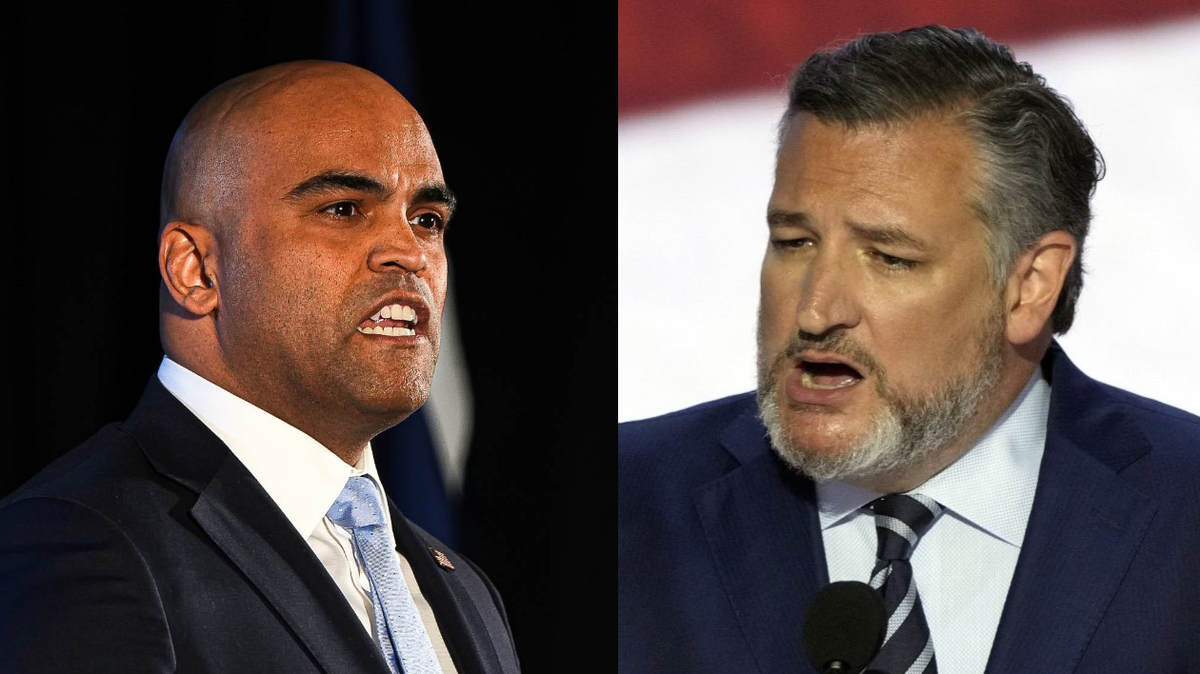
Who’s more extreme on abortion policy? Republican Ted Cruz and Democrat Colin Allred are pointing fingers as they run for U.S. Senate.
Allred, a congressman representing part of Dallas, has made abortion a center point of his statewide bid, launching a “Women for Allred” arm of his campaign at a Dallas event on Aug. 24. The event featured OB-GYNs and women who have been affected by Texas near-total abortion ban.
Cruz’s campaign has focused less on abortion, and Texas Democrats have taken notice, with the state party and Allred’s campaign saying he’s dodging questions on the issue. When Cruz has weighed in, Allred’s campaign has said the senator is lying to voters.
At Allred’s Dallas event, speakers warned about the consequences of abortion policies they said Cruz supports.
“Imagine in January 2025, when we restore a woman’s right to choose and we pass Roe v. Wade into law, and then we can tell the stories of what happened, but won’t have to have the experiences of them happening anymore,” Allred said to a crowd of 850 people.
But just 25 miles away the night before at an event in The Colony, Cruz told reporters it’s Allred who is extreme and not forthcoming.
“Well, listen, Colin Allred and the Democrats are making a lot of things up because they’re scared of their own radical record on abortion,” Cruz said, fresh off a campaign rally in The Colony that attracted 500 people.
Texas’ abortion law is among the strictest in the nation. It bans nearly all abortions without exceptions for rape and incest. There are exceptions for medical emergencies, but there’s been a push for clarity on what that means and when an abortion can be performed.
Abortion advocates have pushed for more clarity on Texas’ policy. Outside of the state, there’s been talk of a national abortion ban.
What do Cruz and Allred think?
Leave it up to the states, Cruz says
Cruz expressed opposition to a national abortion ban, advocating that abortion policy should be left to the individual states, speaking to reporters after his Aug. 23 event at LSA Burger Co. in The Colony
“What the Supreme Court said is, under our constitution, the way issues like that are typically decided is at the ballot box,” Cruz said. “The voters decide, and so where we are right now, is the laws governing abortion are made in each state, in the state Legislature. In Texas, down in Austin.”
One wouldn’t expect California or New York to have the same laws as Texas, he said.
“Listen, I’m pro-life,” Cruz said. “I want to see every life protected, but I also respect the Democratic process, and it will be the voters of Texas and the state Legislature that makes those determinations.”
Cruz said it’s false that Republicans want a national abortion ban.
“There’s not a Republican that I know of in the Senate who’s ever introduced a national ban,” Cruz said. “That’s a totally made up claim that he repeats every day.”
But Cruz introduced a federal bill in 2021 with South Carolina Sen. Lindsey Graham — the Pain-Capable Unborn Child Protection Act — that, if passed, would have made it a crime to perform an abortion 20 weeks or more after fertilization. The bill was co-sponsored by senators from across the country.
Cruz seemed to distinguish the legislation from a nationwide ban in an interview with WFAA-TV, a Star-Telegram content partner.
“What I have supported is restrictions on late term abortions, on exactly what Colin Allred supports: eight and ninth month, late term abortions, abortions after the unborn child can feel pain,” Cruz said.
The 2021 bill, which was co-sponsored by more than 40 Republican senators, included exceptions to save the life of the mother, and, in some cases, rape and incest.

Cruz did not say whether he personally supports Texas’ abortion law and adding exceptions for rape and incest to it, when pressed at the event in The Colony.
“I support that it should be the voters of Texas, and the elected state legislators and the governor that are going to make the decision as to what the rules in Texas should be,” Cruz said.
Soon after Roe v. Wade was overturned in 2022, Cruz expressed support for Texas’ abortion law. At the time, the state had a law that effectively banned abortion at around six weeks. Also on the books, but not yet in effect, was a “trigger law” criminalizing abortion after Roe v. Wade was overturned.
“In the state of Texas, the laws will now be decided by the state Legislature, and in the state of Texas we have significant limits restricting abortion, because the state of Texas is protecting the right to life,” Cruz said in a video interview published on June 24, 2022. “I agree with that. I think every life is an incredible and precious gift from God.”
Reinstate Roe v. Wade, Allred says
In an Aug. 28 interview with the Star-Telegram, Allred said he opposes a national abortion ban and believes the country should return to the standard under Roe v. Wade.
The landmark ruling in 1973 solidified the right to have an abortion before fetal viability — a fetus’ ability to survive outside the womb, which is typically when the gestational age is around 24 weeks.
Returning to that standard would mean exceptions for rape and incest, Allred said.
Cruz, speaking with reporters at his event in The Colony, said Allred supports “unlimited abortion up to and including the eighth and ninth months of pregnancy.”
“I’m the father of two boys. I’ve had two boys in Dallas in the last five years,” Allred said. “I find it offensive that Ted Cruz would knowingly misstate not only my position but what has been the standard in this country for the last 50 years.”
Under that standard, “outlandish claims like this certainly were not allowed,” Allred said.
He described a return to the days of Roe v. Wade as a return “to the center,” leaving room for states to have restrictions post viability, while also restoring the decision of whether to have an abortion to one between a woman and her doctor.
Allred said he also supports clarifying Texas’ law for medical professionals.
“I talked to a lot of OB-GYNs and even hospital administrators around the state, and they’ll tell you that the uncertainty in this law and the fact that it carries very real criminal penalties has led to paralysis,” Allred said.

Allred has in the past supported versions of the Women’s Health Protection Act and is a co-sponsor of the 2023 version.
The bill puts into law a right for health care providers to perform an abortion prior to viability. Generally, abortions could be performed post viability when a doctor finds it is “necessary to protect the life or health of the patient.”
The bill also puts into federal law protections for those who travel out of state for an abortion.
With some exceptions, the federal law would supersede inconsistent state laws.
“The Women’s Health Protection Act is intended to restore at the federal level the protections under Roe, and that’s what I support,” Allred said. “When I’m in the Senate, I look forward to having a chance to introduce what will ultimately become … the law that takes us back to that standard.”
Cruz also criticized Allred for opposing the Born-Alive Abortion Survivors Protection Act in the WFAA interview, calling the vote by Allred and Democrats “disturbing. “ The bill sets standards for the degree of care a doctor must provide if a child is born alive after an abortion and sets a criminal penalty if not followed.
The president of the American College of Obstetricians and Gynecologists at the time said the bill isn’t based in science or medicine and would limit doctor’s abilities to provide evidence-based care for their patients.
“It’s not right, it’s not Texan, it’s not American,” Allred said of Texas’ abortion policy.
This story was originally published August 30, 2024 at 4:11 PM.