Students, elected leaders slam Tarrant County’s ‘blatant attempt’ to silence votes
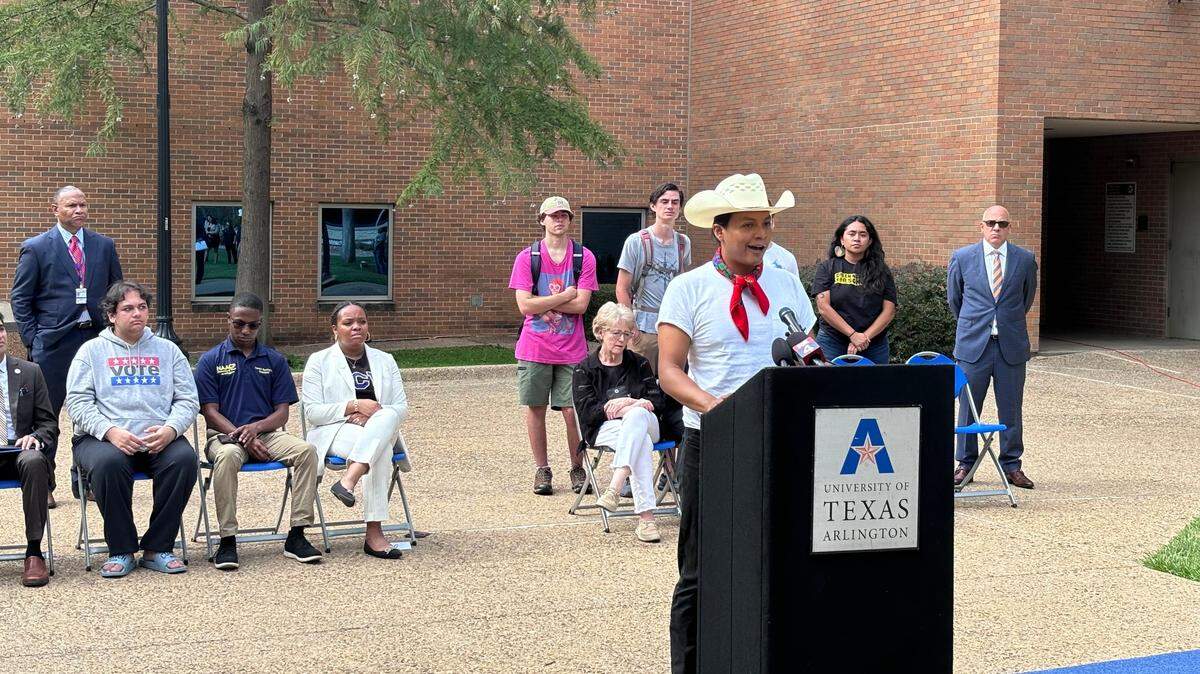
Tarrant County officials working to reduce the number of early voting sites on college campuses say the issue is about not favoring one group over another.
Student leaders and elected officials who met Wednesday at UT Arlington, one of the campuses on the chopping block, say the move is a clear attack on the voting rights of young people, voters of color and the LGBTQ community.
Just under 10,000 people voted on the UT Arlington campus during early voting in the 2020 general election.
The press conference was organized ahead of a special meeting of the Tarrant County Commissioners Court on Thursday. County Judge Tim O’Hare called the meeting to consider revised lists of early voting sites that include fewer college campuses than a proposed one that failed to pass Sept. 4, during the court’s regularly scheduled meeting.
The meeting is scheduled for 10 a.m. at the Tarrant County Administration Building, at 100 E. Weatherford St.
In his introductory remarks, Texas Rep. Chris Turner, a Democrat from Arlington whose district includes the UT Arlington campus, accused O’Hare and his fellow Republicans on the Commissioners Court of creating a “needless controversy” out of what used to be the routine approval of early voting locations.
“It’s turned into something that is simply hard to explain, unless you just make the assumption that some people in leadership in county government want to make it harder for people to vote,” he said.
Turner said “there is no good option” among the new lists and accused O’Hare of deliberately scheduling Thursday’s meeting on a day when he knew that his Democrat colleagues would be out of town.
O’Hare did not respond to a request for comment.
Simmons, whose office helped organize the press conference, said in a statement Wednesday that she had been hoping to attend Thursday’s meeting remotely in order to vote. However, she will be in the White House and will not be able to take her laptop in with her.
“For over five weeks, it has been public knowledge that I, along with Commissioner Brooks, would be in D.C. during this time,” she said.
“Together, we represent half of this county, which is a majority minority, meaning a disproportionate number of these minority citizens live within our two precincts,” she said. “This is clearly a targeted attempt to limit the minority members of the Commissioners Court’s ability to participate.”
What students had to say
Kayla Rabb, youth and college president of the Texas NAACP and a graduate student at TCU, called the county judge’s actions a “blatant attempt to suppress the votes” of students on the UT Arlington campus, as well as others that were removed from the lists up for a vote.
Tarrant County Election Administrator Clint Ludwig told O’Hare at last week’s session that he would ideally like to have 60 to 70 early voting sites. Despite that recommendation, the three lists up for a vote all have fewer than the 50 on the list that was not approved.
That list had early voting sites at UT Arlington, TCU, the UNT Health Science Center, the Southwest Baptist Theological Seminary and four Tarrant County College campuses.
The three lists up for voting on Thursday all include sites at TCU and UNTHSC. None has a site at the seminary, and only two have a site at UT Arlington. Each of the lists cut the number of TCC sites down to two. The TCC South campus was removed from all the lists, and the TCC Noertheast campus was removed from two of them.
Rabb and others who spoke on Wednesday noted that college early voting sites also serve faculty, staff and residents who live in the surrounding communities.
Rojo Meixueiro of the environmental justice group Sunrise Movement linked the recent attempts at voter suppression to the long history of racial discrimination in Tarrant County. He noted how non-white students still faced discrimination after the Civil Rights Movement desegregated the student body in the 1960s.
“The legacy of segregation and racial exclusion didn’t just vanish, in fact, is woven into the fabric of this institution in Tarrant County for decades,” he said. “Black, Latino and communities of color have faced systemic barriers from education to housing and now to access to voting.”
The voting rights of UT Arlington’s LGBTQ community will also be affected, said Blair Dedwyler, vice president of the university’s Queer Social Work Association.
Broad acceptance of the LGBTQ community in recent years has made its members a target for politicians like O’Hare, she said.
“Our voices are being amplified in the media recently, and now suddenly we don’t have access to vote on campus,” Dedwyler said in an interview after the event. “It’s horrible. It’s horrendous. I can’t I can’t believe that Judge O’Hare would try to silence the future of America.”
Mia Arnsworth, a senior biology major at UT Arlington, stopped by the press conference to listen to the speakers with friends. She has voted on campus before and said it was very convenient for her.
“A lot of my friends don’t even have transportation, and for them to take away the on site campus is very disappointing, because I feel like the youth is our future,” she said. “They should want to hear our voices, because we have a very important role in society.”
Public health graduate student Destiny Aladeyelu said she would likely not have been able to vote in previous elections had there not been a polling location on campus, as she did not have a car at the time.
The commissioners court’s actions are “definitely oppressing the students here and restricting their ability to vote,” she said.
Other elected officials and community leaders weigh in
Also in attendance was Texas Rep. Terry Meza, a Democrat UT Arlington alumna who represents part of Irving.
She has made it a point to vote at the UT Arlington polling location even after graduating to emphasize the importance of having voting sites on university campuses, she said.
Texas Rep. Salman Bhojani, a Democrat from Euless whose district includes parts of Arlington, including around the university, said he thinks voter suppression should be addressed at the state level, despite the partisan rhetoric surrounding the issue.
“I generally favor local control, that local municipalities and counties and school districts should be doing good work and representing communities closer to them, but this is something that should be addressed statewide,” he said in an interview after the conference.
Constable Robert McGinty, whose precinct includes UT Arlington, told the Star-Telegram that he stands in solidarity with the students and other elected officials who are “fighting for our democracy and the right for all of our constituents to have access to voting.”
O’Hare and county commissioners should not hinder students’ access to the voting booth, he said, but should work to ensure that access.
Katherine Godby of the Justice Network of Tarrant County also spoke at Wednesday’s press conference. Her organization is “deeply concerned about the assault on our democracy through the obvious voter suppression taking place,” she said.
Godby mentioned O’Hare’s statement to members of the True Texas Project that low voter turnout will help conservatives in municipal elections and the Tarrant County Criminal District Attorney’s attempt to reverse a court’s overturning of Crystal Mason’s illegal voting conviction.
UT Arlington said in a statement sent after the press release concluded that the university “has been fortunate enough that Tarrant County has designated it as a voting location for many years and the University appreciates opportunities to host voting on the UTA campus.”
Hosting a voting location “benefits our local community neighbors and UTA’s more than 41,000 students and nearly 5,000 employees, who live on or in close proximity to campus, attend classes on campus or work on campus - many of whom are residents of Tarrant County,” the statement read.
This story was originally published September 11, 2024 at 3:27 PM.