
Tarrant County pursues $140,000 grant to help offset ICE enforcement costs
The Tarrant County Commissioners Court approved a grant application Tuesday that will help offset costs related to federal immigration enforcement at the Sheriff’s Office.
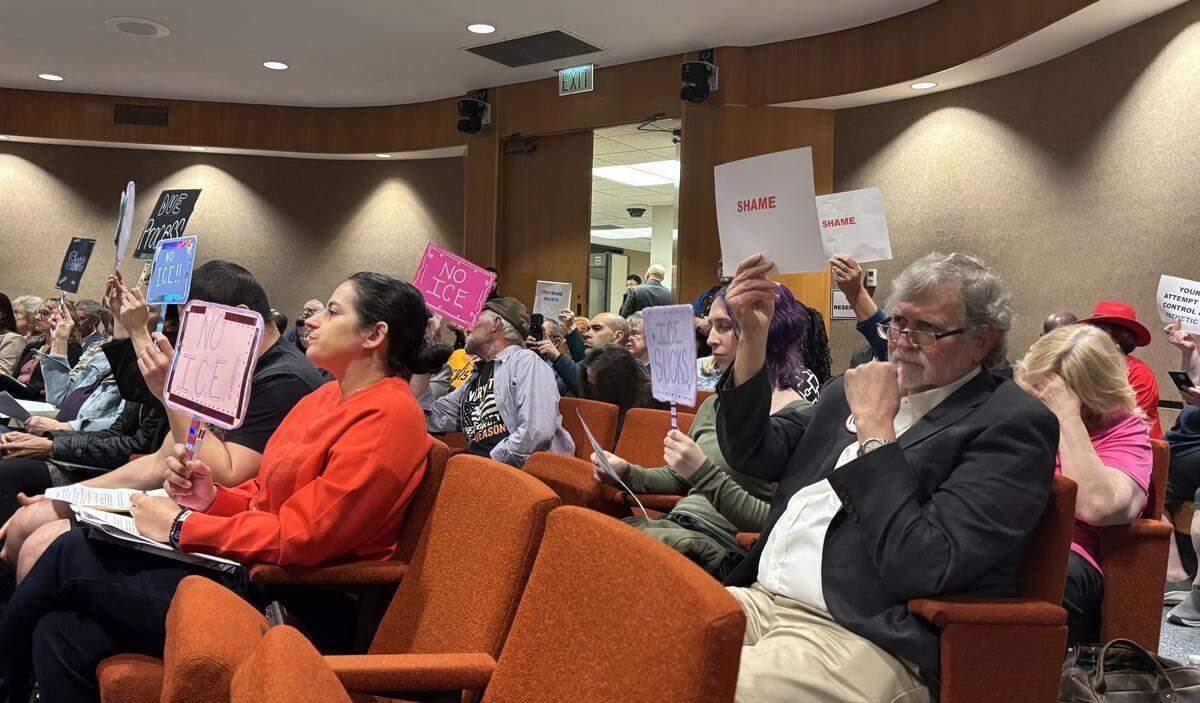
Roughly 20 people attended the commissioners meeting and spoke out against the initiative, saying they feared ramped-up ICE enforcement.
Last month, the Texas comptroller’s office announced new grants of up to $140,000 in state funding to sheriff’s offices that are involved in the federal 287(g) immigration enforcement program. The money reimburses the county for expenses such as training and equipment, said Jennifer Gabbert, chief deputy with the Tarrant County Sheriff’s Office.
The county has been part of the 287(g) program since 2017.
“Immigration has actually been inside the Tarrant County Jail for decades,” Gabbert said. “We used to have an immigration officer that actually sat inside the jail and worked with our team around 2017 or ‘18.”
State law requires every sheriff’s office that operates a jail to partner with ICE through the 287(g) program.
Commissioner courts are required to sign off on the new grant applications. Republican Commissioners Matt Krause, Manny Ramirez and County Judge Tim O’Hare voted in favor of the application. Democrats Roderick Miles and Alisa Simmons opposed it.
In January, Sheriff Bill Waybourn said the grant will not result in a visible increase in the presence of ICE agents in public. Tarrant County’s current model of the 287(g) program operates inside the jail, he said.
“What it will do is ensure that we have well-trained people, maybe even supervisional folks involved, that we can’t afford in our budget right now,” Waybourn said.
At least 150 of the 254 Texas sheriff’s offices are currently eligible to receive money through the program, according to the comptroller’s office. Fund disbursement for the program will begin in March.
Commissioners split on decision to apply for immigration grant
The county is going to be partnered with ICE through this program whether the grant is extended or not, Krause said.
“But by taking advantage of that and voting for this today, we actually get more state resources to help in the aid of that 287(g) program, which will help us be an effective partner with the federal, with the state and our local officials.”
The officers are targeting the individuals because “they’ve shown themselves to be violent criminals,” Krause claimed.
He said no matter which side of the aisle people are on, everyone wants to be safe, and this program is ensuring that.
“I know there’s been a lot of talk with ICE agents coming in from outside Minnesota and other places,” Krause said. “I think it should give us a degree of solace and confidence that this partnership is going to allow Tarrant County people who know the community, who know the area, to be the one doing the law enforcement in this area, not some outside people.”
The grant does not do anything to meaningfully address violent crime, Simmons said.
“This grant is not free money,” Simmons said. “They come with strings. They come with staffing requirements, training costs, legal exposure, long-term obligations that don’t disappear when the grant runs out. … We say yes to grant money today and start sending the bill to county taxpayers tomorrow.”
Simmons claimed the partnership with ICE is an effort to keep Black and Latino people out of Tarrant County.
Gabbert said there are 388 people from 25 different countries in the county jail being held because of their immigration status.
Miles agreed that the program disproportionately affects the community.
“Our responsibility is to ensure that Tarrant County remains a place for all residents, protected, respected and able to live without fear of unnecessary government intrusion,” Miles said. “SB8 offers state funding, but funding alone does not constitute sound policy.”
Ramirez said it’s not fair to vilify an entire workforce of federal law enforcement agents because of what has happened in other areas of the country.
“More than a decade ago, when I was serving the Fort Worth PD, in our gang unit, quite literally, we had HSI agents, ICE agents attached to our unit,” Ramirez said. “I couldn’t count the number of times that I saw their professionalism in action. I couldn’t count the number of times that they might have saved the lives of one of our Fort Worth police officers on operations.”
Tarrant County residents in attendance all opposed the grant
Of the roughly 20 people who came to the microphone at Tuesday’s meeting, all were opposed to the grant application. Two people were removed at O’Hare’s orders for outbursts criticizing the program.
Multiple speakers told Ramirez to talk about who ICE is now, not who the law enforcement agents used to be. They pointed to deaths in Minnesota in relation to the crackdown on immigration.
“I guess my question, though, is $140,000 is that all we’re getting to see the next Renee Good or Alex Pretti or Keith Porter … die in the streets of Tarrant County,” Tanner Trask said. “Now I don’t want Tarrant County, our residents, to be sold out at all for any price, but it feels like we could get more than $140,000.”
Trask said he’d rather not see the agreement with ICE at all.
Critics of the grant application included two candidates for County Commissioner seats, Gabe Rivas and Nydia Cardenas.
Rivas, who recently left his job at the county, said he knows the $140,000 the county is trying to get is just a “drop in the bucket” that is Tarrant County’s budget of $825 million.
“This fine print of the SB8 grant is a trap for us, the taxpayers,” Rivas said. “By accepting this grant, the court is signing away its fiscal authority. This prevents this court and in future courts, if you take this money, essentially handcuffing the county and the taxpayers from ever exercising oversight or trimming waste in the Sheriff’s Department.”
Cardenas said it is harmful for Tarrant County to be welcoming a stronger and more expanded relationship with ICE.
“To your own logic about villainizing all ICE agents because of a few ICE agents, this commissioners court continues to villainize all immigrants because of just a few immigrants who happen to be creating crime,” Cardenas said. “The statistics show that immigrants are less likely to commit crime than other Americans.”
As each speaker used their two minutes, audience members raised colorful, glittery signs that read “WWJD,” “ICE belongs to Satan” and “Shame.” Others raised fists or silently applauded in support of the speakers. Some meeting attendees had tape on their shirts that read “NO to 9b,” which is the agenda number associated with the grant application.
This story was originally published February 10, 2026 at 2:26 PM.