
Texas Senate upset shows growing power of working-class candidates, unions say
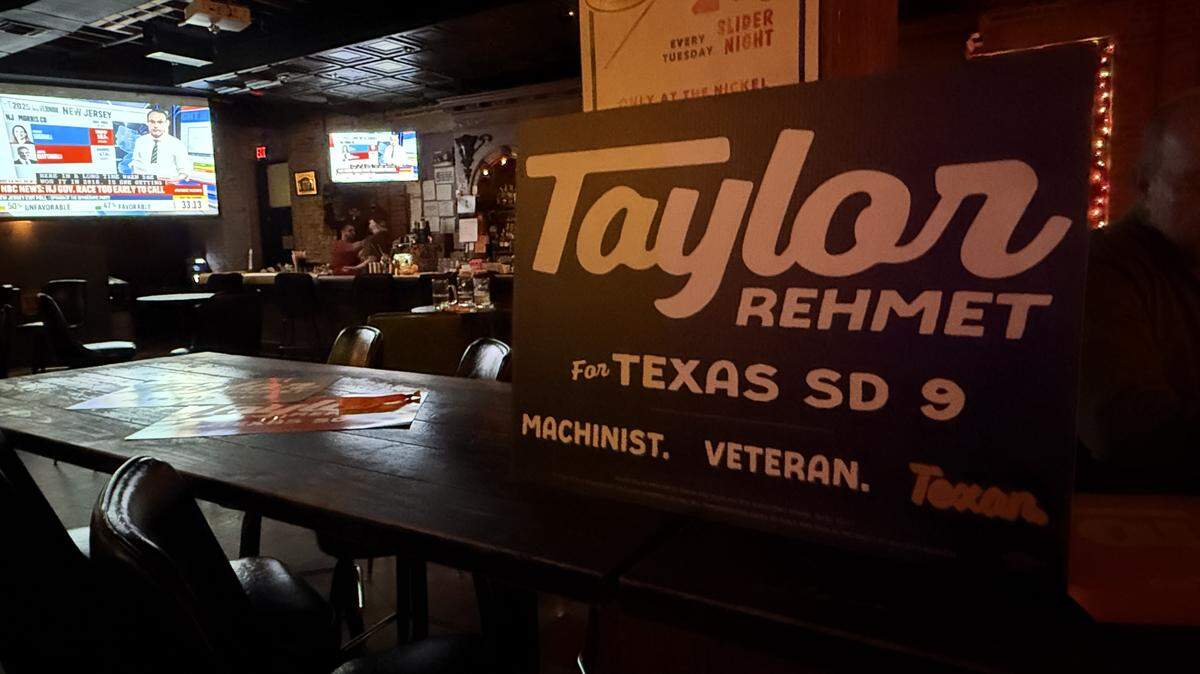
Democrat Taylor Rehmet said he believes putting working people at the core of his bid was key to flipping the state Senate seat.
On Jan. 31, Rehmet defeated Republican Leigh Wambsganss with 57.21% of the vote in a runoff to fill the District 9 seat held by Kelly Hancock, who resigned in June to become acting comptroller.
As an aircraft mechanic, Rehmet could authentically speak to the struggles working people face financially. More than a dozen union members are on the ballot this year, which could be the Democrats’ answer to affordability being one of the political hot topics.
Rehmet is the first union member to ever be elected to the Texas Senate, according to the Texas AFL-CIO, and his win is drawing national attention. He’ll also be the youngest member of the Senate at 33.
He will fill the seat until January 2027 when the winner in November takes over. Rehmet and Wambsganss are unopposed in their primaries, so they are assured a spot on the ballot in November.
The senator-elect said his win proved voters are hungry for leaders who understand “the dignity of work and the immense pressure families are under.
“What we’re seeing right now is a growing movement of labor-backed, people-first candidates who are winning because voters want results, not rhetoric,” Rehmet said in a written statement.
Democrats’ answer to the affordability issue
With affordability being such a buzz word in politics, Democrats need candidates who can authentically represent voters who are struggling, University of Houston Political Science Professor Brandon Rottinghaus said. Leaders of workers’ unions are on the ground with that demographic every day.
“I definitely see that as a big, big factor for Democrats,” Rottinghaus said. “They can’t change the percentage of people unionized, but they can definitely find people who can talk about these issues in an authentic and an intelligible way.”
Just because Rehmet won on Saturday doesn’t mean the Democrats have found their silver bullet, Rottinghaus said. It’s just a “proof of concept.”
Politicians are borrowing Rehmet’s pro-labor messaging
Looking toward the March 3 primary, Rottinghaus said this is the first time in a generation that laborers make up a significant part of the ballot from either party. Of the Texas AFL-CIO’s 2026 primary endorsements, 15 were union members running for a state office.
Because Rehmet won as a rank-and-file union member, more politicians are trying to borrow his message advocating for the working class, said Marcos Vélez, a Democratic and labor candidate for lieutenant governor.
“It’s really funny, all of a sudden, now everyone cares about working people’s issues,” said Vélez, who worked in refineries. “The reality for me is they’ve always been my issues. And I’m telling you, that’s why Taylor won, because they were his issues. He had that credibility.”
Rehmet is leader in the International Association of Machinists and Aerospace Workers union.
As leaders in unions, labor candidates have a proven track record of fighting for higher wages, lower health care costs for employees and expanding health care access, Vélez said.
“Then beyond that, we’re affected by those policies where your average politician is a millionaire or they’re incredibly wealthy compared to most middle class people,” Vélez said. “Labor candidates are normal working class, middle class people. I think people can tell that most politicians don’t have a whole lot of incentive to advance working people’s interests, because those aren’t their interests.”
Now is the time for labor candidates to be elected, Vélez said.
“We have relied on institutional candidates for the last 30 years, and we’re easily in the worst economic situation that any of us have seen in our lifetimes,” Vélez said. “And so if not now, then when? If not us, then who?”
A wave of labor candidates
Blue collar workers have typically been left behind politically, Texas AFL-CIO President Leonard Aguilar said.
“We are overlooked, I think especially with everything that is done for those companies, those corporations, those billionaires, all those extra perks that they get,” Aguilar said. “Working people need help also. Working people need the opportunity. One job should be enough to be able to sustain a family. And unfortunately, right now, it’s not.”
The working class’s top concern is affordability, Aguilar said. That means having a fair wage and a retirement to look forward to.
“We’re not asking for a lot,” Aguilar said. “It is just the dignity and respect that every worker in this state should have. Because without us, things don’t run, things don’t happen.”
Rehmet’s focus on workers’ needs has resonated with voters, Aguilar said, when early voting results on election night showed the Democrat in the lead.
“The working people of Texas across the board are just, we’re not talking about right versus left,” Aguilar said. “We’re talking about us versus them. This is workers versus those that have, the billionaires and such.”
The win for Rehmet is the kick-start to a much larger movement of union members coming from the shop floor or job site into spaces of power as elected officials, Aguilar said.
“Those people that have been in charge of the state of Texas have been in charge for a long time, for many decades, and people are tired,” Aguilar said on Saturday. “People are starting to take notice, and people are taking action. And today’s a good example of that.”
The history of unions in campaigns
Rottinghaus said the Democratic Party is looking to return to the basics, and labor candidates fit well into that goal.
“Democrats want to fuse their support of unions and vice versa, to show symbolically but also structurally, that they’re connected to the working class,” Rottinghaus said. “That’s something Democrats were very comfortable with generations ago, and the fact that they’ve gotten away from it in Texas has definitely led to some more poll complications.”
Labor candidates were more common in the 1990s, Rottinghaus said, because that’s when unionized workers were more prevalent.
As a right-to-work state, Texas’ percentage of union workers has always been lower than the national average of 9.9%. The high point was in 1993, when 7.5% of the workforce was in a union. Union members accounted for about 4.5% of Texas wage and salary workers in 2024, according to the U.S. Labor Bureau of Statistics.
Over the past couple decades, unions have stayed engaged with Democratic campaigns through endorsements and helping make yard signs or call voters. Now, they’re back on the ballots.