‘It smells out there.’ What will Tarrant County do about the Mansfield Subcourthouse?
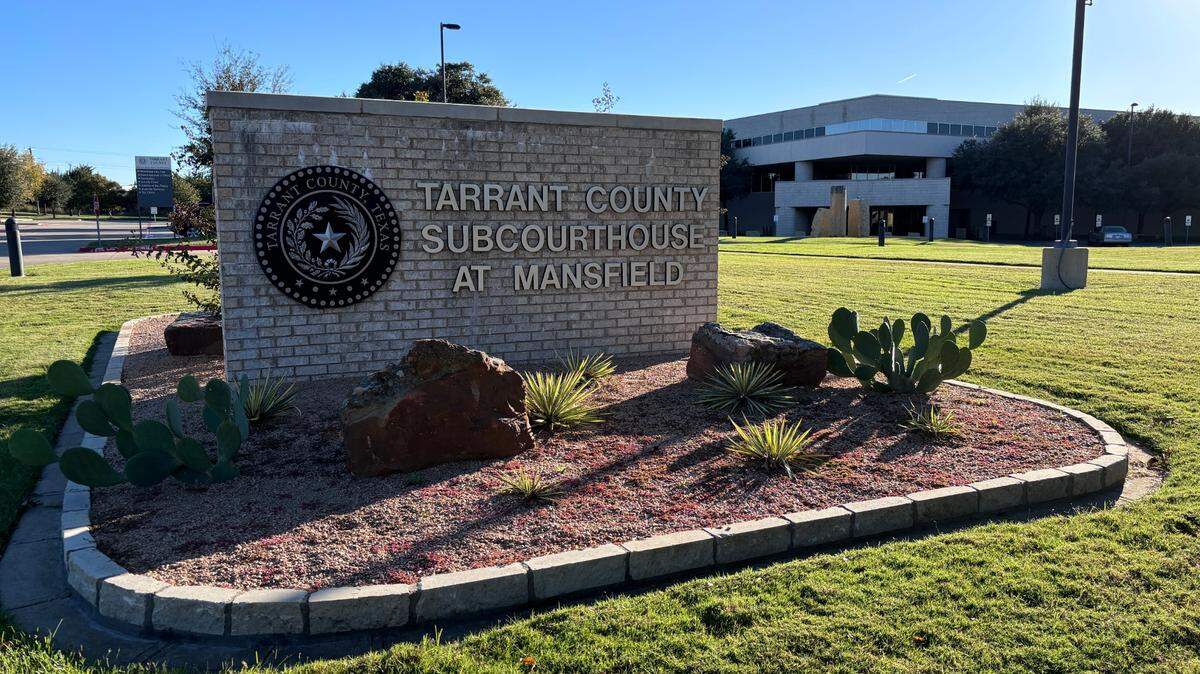
At 24 years old, the Mansfield Subcourthouse is only about halfway through its originally expected lifetime, but county employees who work there say drastic action is needed to address structural issues that turn it into a toxic workplace.
“It smells out there. It really smells out there,” County Clerk Mary Lousie Nicholson told members of the county Commissioners Court on Tuesday, Nov. 19. “And I don’t believe any of you would want that in your subcourthouses. That’s the only thing I’m advocating for. Whatever you guys decide, that’s your business, but please, please commit to fixing the smell. That’s all I’m asking.”
The county has saved the money needed to build a new subcourthouse, but commissioners then proceeded to vote along party lines to reject signing a letter of intent to buy 5.7 acres at the northeast corner of Heritage Parkway and Regency Parkway for the new building. The proposed site would have been part of development in the works for Mansfield’s new city hall and commercial space at The Reserve on Broad Street.
The foundation of the building at 1100 East Broad St. heaves and settles as much as an inch at a time, according to a presentation former County Administrator G.K. Maenius gave the county commissioners in September 2023.
This movement damages sewage lines, filling the building with noxious smells that employees in the county clerk’s office said have forced them to evacuate at times. It’s worse in the summer months, they said.
The Democrats on the court, Precinct 1 Commissioner Roy Charles Brooks and Precinct 2 Commissioner Alisa Simmons, advocated for buying the land and constructing a new subcourthouse, citing overcrowding issues and problems with renovating the building.
“The people of Tarrant County deserve better than this facility,” Brooks said. “It was not a good design when it was built, it was not a good construction program when it was built. And therein lies the problem. The problem was 20 years ago, and the decision to rush and build a subcourthouse on land that was not properly stabilized, to build a building on a foundation that was not properly designed to sit on the soil where it was to be built, and now the chickens have come home to roost.”
Simmons, in whose precinct the subcourthouse is located, said the first thing Maenius told her when they met after she took office in January 2023 was that she needed to build a new subcourthouse in Mansfield.
“Roads, bridges, airports and certainly subcourthouses should not be Republican or Democrat,” she said after her Republican colleagues expressed their intent to reject the land purchase and new building.
County Judge Tim O’Hare couched his opposition to the project in terms of space, comparing the square footage of subcourthouses in the county’s four precincts. A new subcourthouse in Mansfield would put almost 100,000 square feet of subcourthouse in Precinct 2, while the Republican-controlled Precincts 3 and 4, have around 58,000, he said.
Precinct 4 Commissioner Manny Ramirez said the county hadn’t properly vetted alternatives to building a new subcourthouse, saying that the prospect of signing a letter of intent to buy land for one “came out of nowhere.”
Maenius’ presentation from September 2023 included options other than building a new subcourthouse. An August 2021 report by the third-party structural engineering firm Frank W. Neal & Associates concluded with three proposed fixes for the building’s problems.
The firm did not recommend the first option: renovation. It would require demolishing and rebuilding a new floor, but the issues with broken plumbing make this option unfeasible, Maenius said.
Another viable option he presented was to expand the building to create more usable space. The Mansfield Subcourthouse is in the shape of a right triangle, and the two acute angles and the entryway’s atrium make for a significant amount of unusable space. The firm recommended the building be expanded into a square to add space.
This option would cost $15 million and still require the floor to be replaced, Maenius said. It would also require moving county workers to temporary office space during construction, which would cost around $2 million.
The third option he presented that day was the building of a new subcourthouse. Had the county approved a new building at that time, it would have cost $28.9 million. That number nearly doubled to just under $53 million in the event that the county waited five years to get started, due to projected construction cost hikes.
The county has saved just under $28 million for the project since 2016. With the sale of the old building, a new one could be built without accruing any debt on the part of the county, Maenius said.
One issue the opponents of a new subcourthouse had was the projected 10 to 20-year lifespan of a new building in Maenius’ presentation.
“Investing public funds into facilities that risk becoming obsolete within the next decade is not responsible governance,” Ramirez said in a written statement. “Instead, I support rehabilitating the current facility — less than 20 years old — and implementing efficiencies that reduce the need for physical space while creating more consolidated customer service centers.”
The current subcourthouse was occupied in the summer of 2000, according to Maenius’ presentation.
“I am fully open to exploring ways to enhance service efficiency and effectiveness for Southeastern Tarrant County residents,” Ramirez said. “This includes considering full or partial renovations of existing facilities. However, there seems to be a clear bias for constructing a new building within Mansfield’s new multi-billion-dollar development district. I believe that land would be better utilized to attract tax-paying corporate businesses rather than housing a government building.”
His statement also echoed a suggestion by O’Hare at the most recent commissioners court session: using technology to make government services more efficient, such as apps to streamline wait times.
“There are a multitude of ways to address overcrowding, using technology, using virtual waiting lines — there’s a number of ways to deal with this,” O’Hare said on Nov. 19. He also cited the proposed site’s location — “literally, as the crow flies, a mile from the Johnson County line” — as reason for his opposition to buying the land.
He and Precinct 3 Commissioner Gary Fickes did not respond to requests for comment. They and Ramirez did not respond to a question about what else they might want to do with the money saved for the project so far.
Simmons addressed the location, time and cost concerns at the Nov. 19 session.
“Today’s prices for that land will not be tomorrow’s prices, and so this is a good opportunity,” she said. “We would have a full-fledged subcourthouse to serve all those people along that 360 corridor that come from Arlington, the Tarrant County side of Grand Prairie and Mansfield. It’s not just for Mansfield.”