
How a simpler time helped shape Grapevine’s leader, the longest serving mayor in Texas
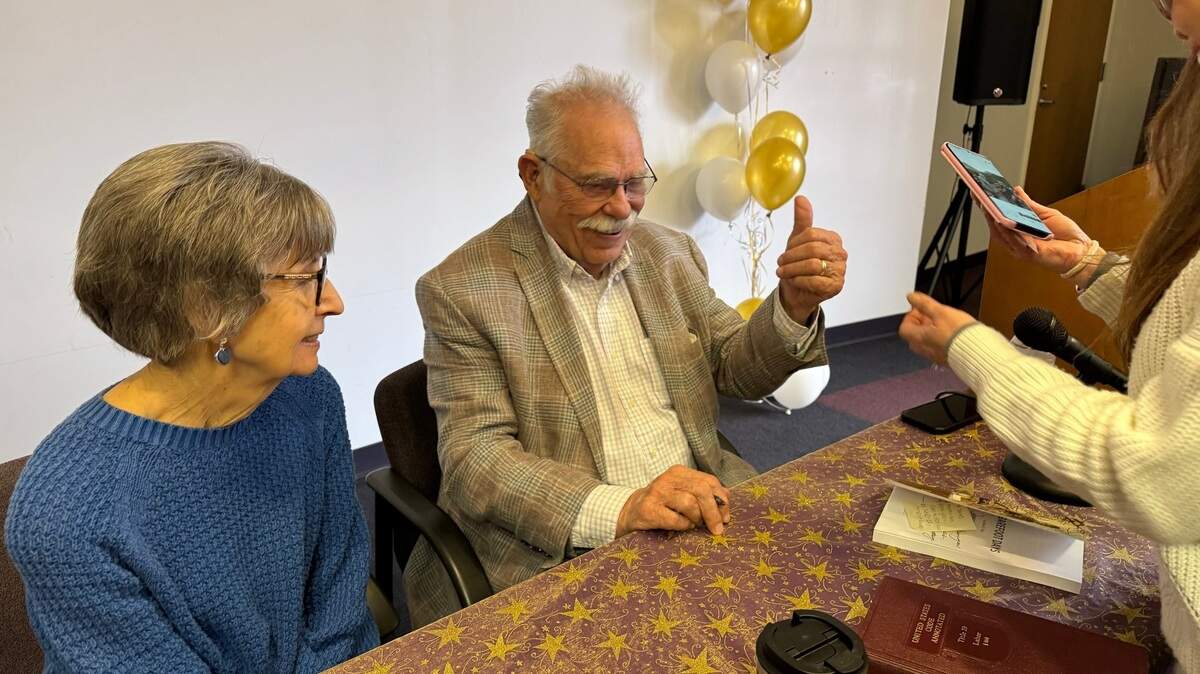
One doesn’t become the current longest serving mayor in Texas — and third longest in the United States — without compiling a lot of memories
For Grapevine’s William D. Tate, 81, some of his greatest memories were long before he took the office he has now held for nearly 48 years, and is running for re-election in May. He has put them together in a self-published book called “My Barefoot Days,” which was recently released and focuses largely on his days growing up in the city he has loved for so long.
“The book makes readers revisit their own childhood,” Tate said. “We used to jump over mud puddles to see who could not get wet. We made puppets and used a cardboard box to put on a show. We had to entertain ourselves.
“We had an imagination. We just figured it out. We didn’t have a blueprint.”
Tate’s book is a quick and smooth read at less than 250 pages. However, it is also one that deserves taking ample time to read, perhaps even going back over some parts that are sure to spark special recollections.
While the entire book is collectively a story, each chapter is its own story about a memorable part of his life. For example, one tells of the many picket fences and trails in what was once a small town long before becoming a major tourist hub of North Texas under the leadership of the very man relaying the history.
Another chapter describes in detail how, as children, Tate and his friends would make mud pies out of some sand his dad had hauled into their backyard. He recalled it as “one of the few activities that the boys and girls could do together, though I don’t remember my sister doing much cooking with mud.”
“I intended to write it that way, each chapter telling a story because that’s how life is,” Tate said. “Each of our memories is a chapter of its own.
“Folks have said it’s captivating, charming, but the most I get is that it takes them back to their childhood.”
Childhood memories
Those childhood memories, Tate said, have played a large role in the history he’s made as an adult.
“It made me a better politician, a better mayor, a better person,” he said. “If you are fortunate enough, as I was, to have such a wonderful youth it should naturally carry over into the rest of your life.
“That is when we learn to experience, to explore.”
Tate said it is a shame when some people forget those experiences from their younger days once they are grown up. Instead of starting over, he encourages continuing the journey from our youth and embracing what adulthood has to offer, using the lessons of our childhood to help us navigate.
“Ideas pop in my mind all the time, just like they did when I was a kid,” he said. “I hope they keep popping in there for as long as I’m alive. It’s still exciting.”
Tate’s tales go beyond such things as climbing his favorite tree — in which he is pictured on the book’s cover, ironically wearing shoes (but it was a photo he thought best captured the overall ambiance). And there are serious moments that make him appreciate all the more the life he came to lead — a life he might not have had were it not for one of the biggest decisions his father made as a young man.
In one chapter he tells of when his father was in law enforcement and captured a member of the Clyde Barrow Gang, of Bonnie and Clyde lore, which was followed by a rumored anticipated trip through town by the deadly duo. Though his dad never encountered Bonnie and Clyde themselves, on that Easter in 1934 morning they gunned down two highway patrolmen in what is now Southlake. The patrolmen were brought to Grapevine’s Lucas Funeral Home.
“The line of people to view their bodies extended all the way down Main Street,” Tate wrote. “Louise later told my dad that he was going to get killed if he didn’t throw that gun away, so he put his gun away. My dad later married Louise Bennett, who became my mother.”
Without that decision, Tate wonders if he might have even found his way into this world.
Evoking emotions
Tate said writing the book, naturally, became an emotional endeavor at times. In fact, there were several times he simply had to stop and take time and collect himself before moving on.
“It evoked some memories I hadn’t had in quite a while,” he said, reminiscing about his grandfather taking nitroglycerin pills for a heart condition, for example.
“It made me feel like I was having a heart attack,” he said, recalling some scary moments watching his grandfather’s battle to live. “My dad died at 58 with a heart attack.”
Tate said that while he didn’t want to write anything controversial, he wanted to be honest. He said he’s also grateful that he grew up in a family and in an area that differentiated themselves from much of what was going on elsewhere in society.
“I never understood the Black and white issue,” he said. “I was raised to respect people. It seemed to me that most folks around here were the same way, but I know there were problems in society and I have never understood why we can’t just accept and respect each other.”
Tate also reflected on being at his father’s store as a child, listening to the older men who would gather on a daily basis. He listened to their strifes and tales and came to a decision.
“It made me want to commit that by the time I was 40 I was not going to be one of those who wishes I had done something, and that I was going to be someone who had done something,” he said.
“I grew up here listening to the dreams of those people in my father’s store. Now, I’m trying to keep those dreams alive.”
A simpler time
While the book is designed to take readers back to a simpler time, it was also written to show the contrast of then and now, Tate said.
“We’d walk in our neighbors’ house if we were hungry and they’d feed us, or give us a cookie or something,” he said. “I wanted to show that contrast. Now, everybody locks their houses.”
One of Tate’s pet peeves is folks spending so much time looking at their cell phones. Of course, he has one, but you’ll never catch him so focused on it that he misses out on a conversation.
“That’s a big difference between then and now,” he said. “People don’t talk as much because they are glued to watching this little screen. It’s taken over so much of our lives.”
Then, he added: “I didn’t write it for money. I wrote to record for future generations a part of life that might have been the best.”
Along with the text of the book, over the final pages are many photos that take the reader through a visual stroll and depiction of the very words they just finished reading.
Tate’s love of Grapevine
Tate’s love of his hometown is evident in every turn of the page in his book. His grandfather was the city’s first night watchman, and his father served on the school board, city council, and as mayor. His parents were merchants on Main Street.
And since 1969, when he became its city attorney, he has also faithfully served his beloved Grapevine. In 1972 he joined the city council, later following in his dad’s footsteps and becoming its mayor.
Under his leadership, the DFW Airport was brought to the area. The city became a destination for folks wanting to get away from the stress of other places - and in many cases deciding to call home for that very same reason. The city has capitalized on its namesake, making Grapevine a place for enjoying some of the finest wine to be tasted, highlighted with the popular Grapefest. And no one does Christmas like they do in Grapevine.
“The way I judge whether I’m doing a good job is folks love living here,” Tate said. “I’m amazed at what we’ve achieved. People give me more credit than I deserve. We couldn’t have done what we’ve done without getting people involved.”
Tate wouldn’t trade his life for anything. Well, maybe one thing.
“I hope to see cancer cured,” he said, noting that he lost his mother, sister and a grandson at age 20 to the disease. “I know there’s been much progress, but I hope to see it completely eradicated while I’m still alive.”
Tate admitted that he once considered running for a higher office, before, as he jokingly said, “came to his senses.”
“I thought I wanted to be in the legislature, until I realized how it worked,” he said. “Then, I realized I had the best job in Texas as mayor of the greatest city.
“There comes a time when we have to leave the earth, and we should all want to be remembered as being the best we could have been.”
Which brings folks back to his memoirs and the days that he said helped him formulate a life from which he can proudly make that claim.
“It shows what you can do if you dream,” he said. “I wanted kids to see that even if you have humble beginnings, it shouldn’t keep you from accomplishing great things if you want them enough.”