How united is Tarrant County GOP heading into November? It depends on who you ask.
To Rick Barnes, the head of the Tarrant County GOP, one thing is certain: A Republican in office is better than any Democrat.
The local Republican Party’s fight to go red up and down the ballot this fall has meant focusing on small government, the border, inflation, abortion, transgender issues and gun rights, Barnes said.
But for the local commissioner candidates themselves, the focus has been on issues commissioners can control, like infrastructure, law enforcement funding, property taxes and public health.
The bottom line for the GOP is to bring in as many voters as possible for a red wave over Tarrant County come November. But in a party that’s sharply divided by ideologies and outspoken candidates, the question of unity depends on who you ask.
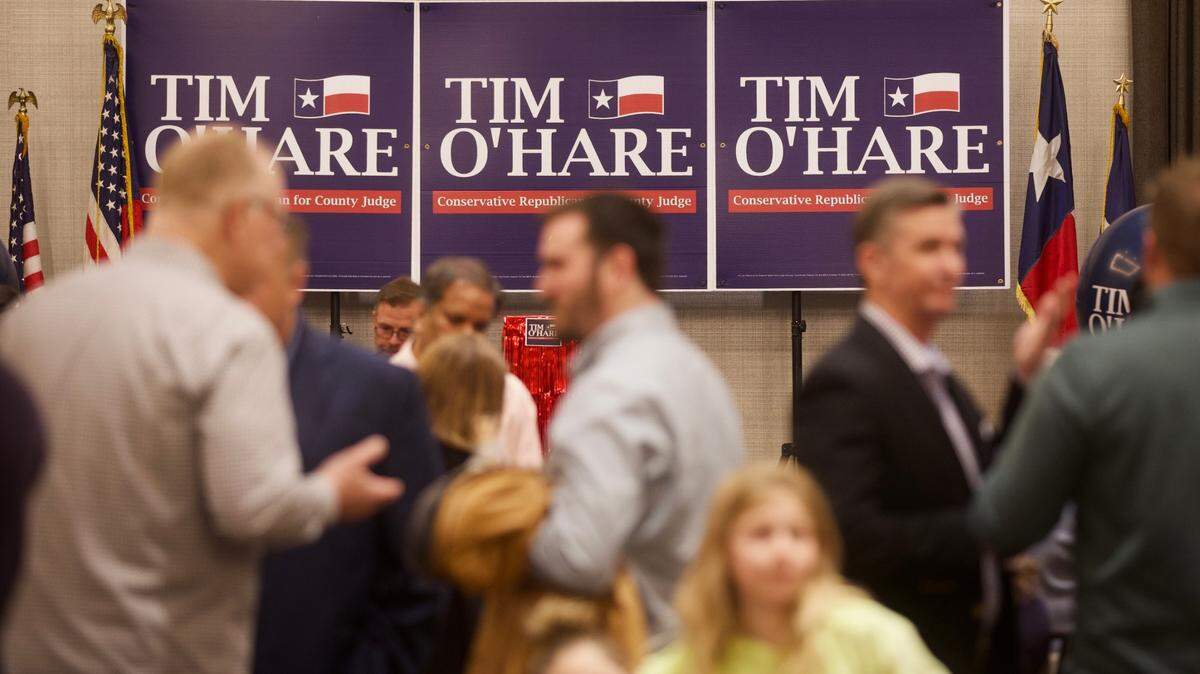
That divide was highlighted in the race for the Republican nomination for county judge, when Southlake attorney and former GOP chair Tim O’Hare went after former Fort Worth Mayor Betsy Price’s political record. O’Hare targeted Price’s handling of Black Lives Matter protests in 2020 and her support of President Biden’s infrastructure bill, in a primary cycle that saw conservatives across Texas go neck-to-neck to prove they were the most conservative choice.
O’Hare’s primary win led to backlash from prominent figures in the Tarrant County GOP including County Judge Glen Whitley, who criticized O’Hare’s campaign style against Price, and Fort Worth Mayor Mattie Parker, who told the Texas Tribune the party wasn’t one she identified with anymore.
Tarrant County is commonly referred to as the largest Republican county in the state, but it has proven it can flash to blue, such as in Beto O’Rourke’s 2018 race for Senate and Biden’s presidential election in 2020.
And while Republicans sit on opposite sides of the divide, Democrats are making inroads to try to get their candidates elected.
The red divide
Former President Trump remains at the center of GOP politics in Texas.
Mark Jones, political science professor at Rice University in Houston, said the party is split into three factions: Those who embrace Trump; those who don’t openly criticize Trump but minimize his importance in the party; and those who challenge the former president and his supporters.
“A lot of it is just where are you on Trump, where you are on Jan. 6,” Jones said. “Are you willing to openly criticize Trump’s behavior on Jan. 6? Essentially, do you support Trump’s narrative on Jan. 6 or do you stay quiet?”
Republicans also are divided by where they stand — and how outspoken they are — about LGBTQ issues, abortion, immigration and guns, Jones said.
Jones points to the Republican primary between O’Hare and Price.
“O’Hare tends to be very supportive of Trump and very conservative and very vocal for his support for conservative policies,” Jones said. “Price adopted a more moderate approach.”
Price supporters who spoke with the Star-Telegram after the March primary were largely undecided on who they would vote for come November. As politics become increasingly polarized, Jones thinks most Republicans will end up voting along party lines.
“While there may be a few Betsy Price supporters who will vote for Deborah Peoples,” the Democratic candidate for county judge, “more Betsy Price voters will vote Tim O’Hare than do anything else,” Jones said. “And I suspect there may even be more who leave the county judge race blank before voting for Deborah Peoples.”
To Allison Campolo, the local Democratic Party chair, it’s becoming more obvious the GOP’s platform doesn’t represent the majority of Americans’ beliefs. She points to the Republicans who have pushed back against anti-abortion laws and subsequent conversations about limiting contraception access.
“I think it’s become really clear that, you know, the Democratic platform is one which the majority of Americans support, even if you know, specific voters, even those in the Republican Party have different ideas on the stipulations they might want to see around, you know, various parts of the platform,” Campolo said.
The “extremism” on the other side, Campolo said, might push people toward voting for another party. Local and state campaigns have focused more on common ideals, like not banning healthcare outright and keeping communities safe. Democrats locally are working on “persuasion voters” to get them to choose blue in November, Campolo said.
Jones foresees more attention on the county judge races in Tarrant, Harris, Fort Bend and Bexar counties because of the view that Republicans will most likely reign victorious in statewide races.
Ricky Martinez of south Fort Worth knows he’s going to vote Republican no matter what, because that’s where his values ultimately sit. He said he initially voted for Betsy Price in the county judge primary but would’ve been fine with either Republican winning.
Heading into the general election, Martinez is making sure Tarrant County stays red. He’s afraid, he said, that Peoples might infringe on his Second Amendment rights.
While Martinez believes there’s still work to do to unite the GOP, he trusts the party will be fine.
“I’m hoping for a red wave,” he said, then laughed. “I don’t know if I sound like too — how can I say this — too much of a patriot or whatever, but I’m hoping it happens.”
Kathy Grissum doesn’t live in Tarrant County or vote in its elections, but her realty business is here and she believes what happens in the county affects her, too.
She generally feels as though the Republican Party is “pretty aligned” and that there needs to be more dialogue between the GOP and Democrats.
Grissum likens it back to real estate: When she’s working with clients, she asks them to make a list of wants and needs. She believes politicians should do the same.
GOP plan
Barnes said that the local GOP is reaching out to everybody but is finding that frustrated constituents are coming to them.
“They’re tired of government stepping on their rights,” Barnes said. “They’re tired of government coming up with policies that are causing the economic issues, but we’re also hearing, maybe for the first time that I can remember, we’re hearing people that are literally embarrassed about the decisions from the other side.”
Examples cited by Barnes include the issues of young children and gender, and transgender athletes.
Looking at the county races, Barnes believes GOP is the right choice all around.
“It is just slam dunk in reality of who the right candidate is who’s most qualified, who provides for the needs of the county and then who has the background and experience to provide the best environment,” Barnes said.
Barnes said he has spoken to some voters who initially supported Price and came around to O’Hare. The party isn’t seeing any challenge with getting Republican voters on the same page. The conversation after primaries, he said, has actually gotten easier.
“They know that while they wanted their other candidate in the primaries, they know that Tim’s still the best candidate in general, and they’ve circled their wagons around him,” Barnes said.
O’Hare’s focus heading into the elections is funding for the police and District Attorney’s Office, safe streets, and property taxes — issues where few voters from across the political spectrum disagree, he said.
He believes Tarrant could be a leader for the state with property taxes and that more could be done locally instead of waiting on the legislature.
O’Hare said his team is doing research and targeting as well as extensive presence on social media. He said he was feeling good about his current position in the race.
Where is support going next?
O’Hare beat Price for the Republican nomination with 56.95% of the vote.
In a race to prove he was the conservative choice, O’Hare ran a campaign that went after Price’s record as mayor that at one point prompted her to say her opponent was lying. Among the rumors she dispelled in a video released in February, she said she stood against Black Lives Matter extremists.
Following O’Hare’s win, Whitley took to Twitter to say he was disappointed a campaign riddled with attack ads would be successful in the county.
“I hope the race for my successor will shift from mudslinging to focus on serious issues and qualifications so that citizens better understand what’s at stake for the future of our county,” Whitley tweeted.
Whitley said he believed both sides are being run by those with more extreme views while 70% of the party itself is more in the middle. He thinks the GOP needs to find a way to bring more people out to vote during the primary elections, and he favors a primary system where every candidate runs in the same primary and the top two vote-getters move on to the general election.
States like Washington, California and Alaska have nonpartisan primary elections.
“In my opinion, it’s worked well, because it brings everybody into it and it means that your candidates, instead of running to the extremes that are going to come out and vote in the primary, are going to have to be a little bit more minded of serving everybody, and not just the extremists of that particular party,” Whitley said.
Those on the extreme ends of the party don’t represent what voters are truly focused on, Whitley said.
Asked who he would be supporting in the race, Whitley said he would most likely not be making a public endorsement.
“I’m still trying to figure out who I want to vote for,” he said.
Price told the Star-Telegram it was “hard to gauge” how unified the Republican Party was, but said she thought there were many who were “disenchanted” by this year’s primaries.
She anticipated more voters who didn’t show up for primaries would cast votes in the general election.
Price doesn’t necessarily view the party as united, citing factors like negative rhetoric and most members of the party being more concerned with where their money is going and what issues impact them.
“We’ll see how they vote in November,” she said.
Parker, in an interview with the Texas Tribune, said she supported Medicaid expansion even though she knew it was unpopular with the party. When asked by Tribune CEO Evan Smith if she still identified as a Republican, Parker said yes, but said the party confused her.
“We just eat our own,” Parker said.
She told Smith she couldn’t run in a Republican primary right now, something she was OK with, “because I just couldn’t look myself in the mirror and do it, because it’s gotten so partisan.”
One prominent figure among Tarrant County Republicans has already come out and swung his support toward Peoples. Steve Murrin, known widely as the “Mayor of the Stockyards,” referred to O’Hare as “one of the crazies.”
A representative for Parker said in an email the mayor had no comment on the race at this time, and Price told the Star-Telegram she would be staying out of it.
This story was originally published August 1, 2022 at 5:00 AM.