Texas will soon ban homeless camps in public places. What’s that mean for Fort Worth?
Fort Worth officials say they’ll focus on finding housing for people experiencing homelessness as Texas prepares for a new law that prohibits camping in public places.
Gov. Greg Abbott signed House Bill 1925, authored by Southlake Republican Rep. Giovani Capriglione, on June 16. The law goes into effect Sept. 1 and implements a statewide ban on camping in public places without consent, making it a class C misdemeanor punishable by a fine of up to $500.
Abbott has clashed with Austin leaders over the repeal of an ordinance that prohibited camping in public spaces. Austin voters have since approved a proposition reinstating a ban.
“It’s imperative that Fort Worth maintain the policies that we had in place already to prevent a public health crisis from happening here, where you had a widespread group of people camping on the streets,” Fort Worth Mayor Mattie Parker said. “But of course, the main thing is, do this humanely. I mean, we understand that folks who are homeless are in crisis themselves.”
Tara Perez, manager of Directions Homes in the city manager’s office, said the city will enforce the new law. Fort Worth and counties that don’t, risk losing state grant funds. The city’s law department is reviewing specific policies and procedures to ensure they’re in line with the bill, but Perez said she doesn’t anticipate significant changes.
“The plan is to continue that approach of services first,” Perez said, later adding that citations are the “last choice.”
The bill states that a city can’t adopt or enforce a policy that discourages enforcement of a public camping ban, but a city can encourage “diversion or a provision of services in lieu of citation or arrest.” That’s the approach that’s been taken by the Homeless Outreach Program and Enforcement (HOPE) team, Perez said. The unit, which was founded in 2019 and includes representatives from the police department, fire department, Tarrant County MHMR and DRC Solutions.
The Fort Worth Police Department staffs the unit with one sergeant, one corporal, and four police officers, Commander Amy Ladd and Lt. Chris Gorrie said in a joint statement. They described a strategy where, prior to issuing citations or making arrests, the unit tries to connect homeless people with housing and resources.
The unit will typically make three outreach attempts over the course of three to seven days before cleaning up a camp, Ladd and Gorrie said.
“The Police Department is optimistic that the HOPE Unit will be further expanded in the near future, not as a direct response to HB 1925, but instead in accordance with the unit’s original conception and due to its track record of success,” they said. “In sum, the HOPE Unit’s mission has been, and always will be, in line with the spirit and parameters HB 1925.”
City focused on housing options
Perez and Lauren King, executive director of the Tarrant County Homeless Coalition, said homelessness is down in the community compared to last year.
According to the organization’s 2021 State of the Homeless Report, Tarrant and Parker Counties saw unsheltered homelessness increase by 43% from 2019 to 2020 and decrease by 40% from January 2020 to January 2021. There was a 42% decrease overall in homelessness, the report states. Contributing factors may be the eviction moratorium related to COVID-19, as well as housing and rent assistance options, Perez said.
The number isn’t static, but as of June 30 there where 330 shelter beds empty and available in Tarrant County, most of which are in Fort Worth, King said. There are roughly 350 people sleeping outside in Fort Worth, she said.
“At this time, because homelessness is down, we do have an unusually large number of empty emergency shelter beds,” Perez said. “So we are really asking people to use those resources that are already available.”
King is confident the community has enough shelter beds. Historically the availability has been sufficient, she said.
But the number of people experiencing homelessness could increase in the future.
“I think one of the things we’re doing to prepare for that is really having the money focused on housing, because when we’re exiting people to housing at a faster rate, those emergency shelter beds turn over faster,” Perez said.
One city effort used CARES Act dollars to convert an extended stay hotel into Casa de Esperanza, apartments for people who are homeless and vulnerable to COVID-19. Perez said the city is also working to house people with its New Leaf Community Services project. Forty-eight units will be available for those who are homeless for a year or longer and have a disability, according to a city slideshow.
Perez said the city is also preparing to issue a request for proposals from developers to build an additional 150 units of housing. As mayor, Parker said her focus will be on setting up housing in neighborhoods across the city. Permanent housing allows people to heal and get back on their feet, she said.
“We do have people in this city that are camping in the shadows, and we need to do everything we can to get them out of the shadows, into shelter, into housing as quickly as possible,” Parker said.
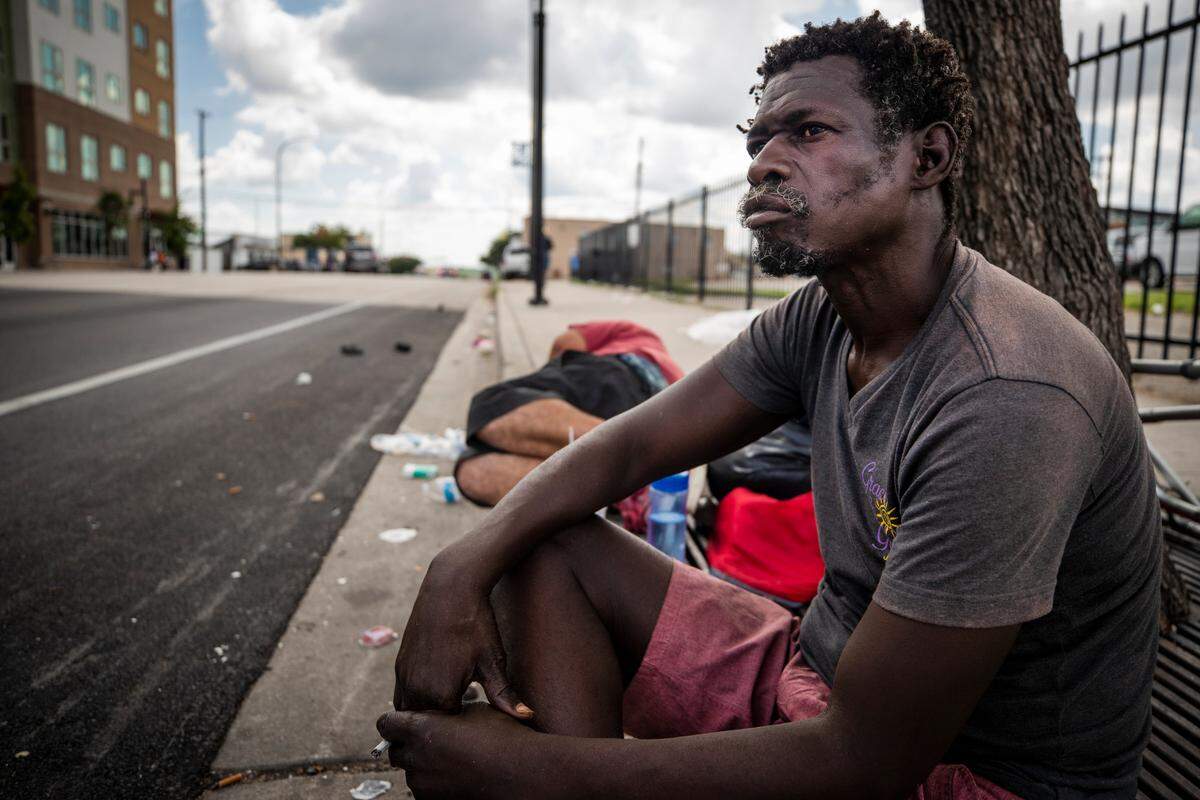
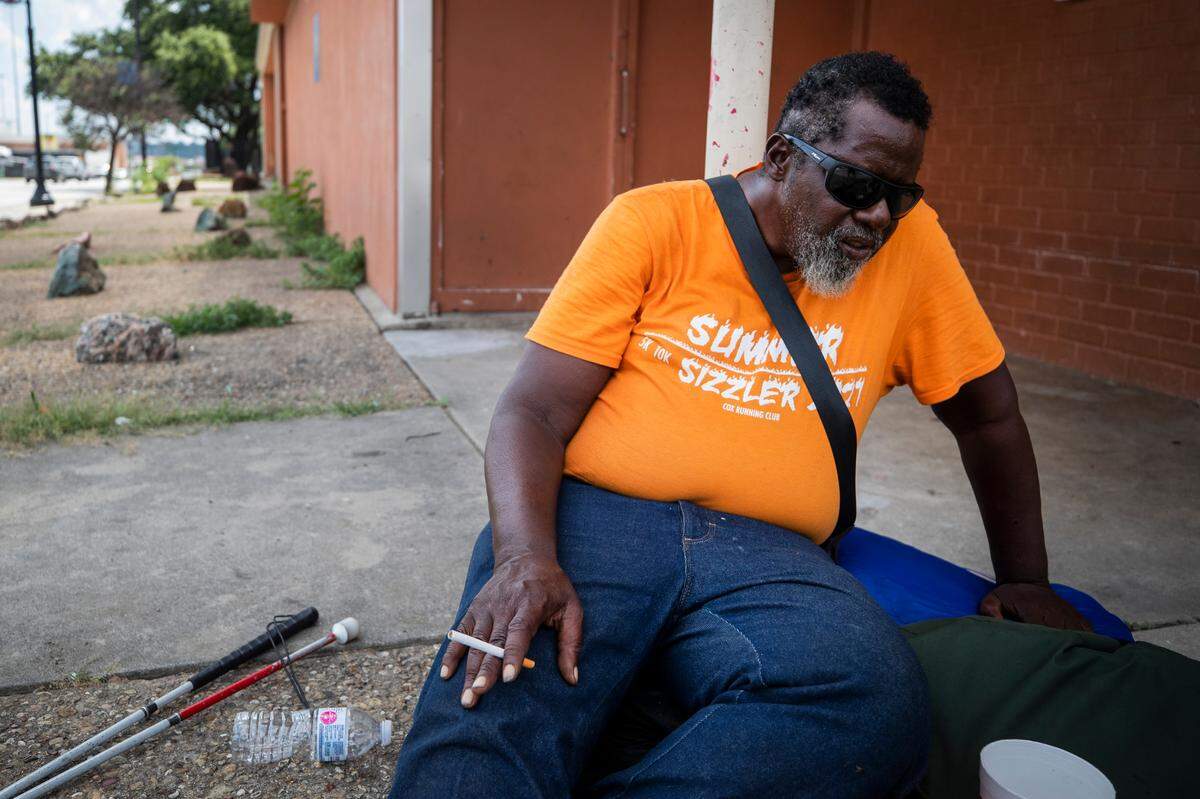
Frank Jeffery, 61, prefers not to stay in shelters because of the crowds and because he’s blind. He spoke while sitting outside a building with his possessions. With the law going into effect, he said, there should be more homes opened where the rent is cheaper but the quality level doesn’t go down.
Carlos Medina, 46, said he’s been staying at a local shelter off and on for about six months — sometimes there’s no room in the shelter (such as when it’s cold or raining) so he’ll find cover somewhere outside.
“I think what they’re trying to do is that they’re trying to push people into getting into a shelter or to get some kind of help,” he said of the new law.
But he questioned why they were passing the law before trying to first find more solutions. Medina recalled a mantra learned at a past job: “Don’t focus on the problem. Be the solution of the problem.”
“But people don’t think like that, and it’s sad, but that’s how life is,” he said.
Local vs. state control
The bill has been criticized by opponents as criminalizing homelessness and for taking control away from local officials, according to a bill analysis. Some supporters have said it’s needed to address the presence of campsites in areas where there could be a safety and health risk. Supporters have also said the bill could lead to cities and counties doing more to provide people with shelter and services.
“Our partners are all very much on the same page that housing is the solution, and so for us, that’s probably one of the biggest implications, that the state essentially took that local control away and is forcing our community to respond in a certain way,” King said.
Parker said she doesn’t see the bill as posing an issue for local control in Fort Worth. She pointed out that the legislation was largely a reaction to the situation in Austin, which she called “abhorrent.”
“The way Fort Worth government operates, the way we serve our citizens, should be autonomous from what happens in the state of Texas,” Parker said. “But at the same time, I do respect the authority our state government had ... to really push a different rhetoric and narrative forward because ultimately those policies have had a negative impact on the state of Texas, and they (state leaders) thought they needed to take action.”
Perez previously told the Star-Telegram there could be legal risks for the city associated with the bill. In a Boise case, the 9th U.S. Circuit Court of Appeals ruled that law enforcement couldn’t issue citations to homeless individuals camping in public places if a shelter bed isn’t available.
“I’m not concerned for us here because we do have space in our shelters. If we were at capacity, it’d be a different discussion,” Parker said, continuing that lawyers would be in the room to make sure court rulings weren’t being violated.
The City Attorney’s Office in a prepared statement said the area of law is rapidly changing.
“If and when additional changes are made, whether through legislative or court action, the City will continue its efforts to be compliant with the law and will persevere in its approach of addressing public camping and homelessness primarily through access to services and housing,” the statement reads.
City designated camping site unlikely in Fort Worth
There are exceptions in the bill for recreational camping and for camping on property designated by local governments for homeless individuals. Cities that want to create a camping site must get approval from the state and submit a plan that includes information such as access to healthcare and transportation.
Some Fort Worth residents experiencing homelessness have said they’d like to have the option of an authorized camping area, but a city authorized space isn’t expected in Fort Worth. Parker said such a site is a “hard no.”
“Where would you put it, right?” Parker said. “Not in my neighborhood. You’re going to hear that across the entire city, and I don’t think it solves any problem.”
The Tarrant County Homeless Coalition also opposes a designated area for those sleeping on the streets. In addition to finding a location, such an area would require services such as sanitation, security and health care, King said. Setting up such a site is more expensive and complicated than it sounds, she said.
“I think on the surface it sounds really easy, like, ‘Oh, yeah people want to camp,’ ” King said. “Our outreach team would tell you over and over again that 98 out of 100 people, if you told them they had a place to live, they would take that, they would not want to live outside. Even for people that say, ‘I don’t want to be housed’ there’s generally something behind that.”
This story was originally published July 7, 2021 at 4:45 AM.