Texas Supreme Court: Voters don’t qualify for mail-in ballots due to lack of COVID immunity
The Texas Supreme Court ruled Wednesday afternoon that a lack of immunity to the novel coronavirus does not make a voter eligible for a mail-in ballot under Texas law.
Attorney General Ken Paxton had asked the state’s highest civil court to weigh in on the issue to prevent local election officials in some of Texas’ largest counties from processing mail-in ballots for voters who cite the disability category and normally would not qualify.
While the court agreed with Paxton that a lack of immunity to the virus alone would not qualify a voter for a mail-in ballot, they declined to order local election officials to investigate mail-in ballot applications they have received and said there is no evidence election officials have processed faulty ones.
“We agree with the State that a voter’s lack of immunity to COVID-19, without more, is not a ‘disability’ as defined by the Election Code. But the State acknowledges that election officials have no responsibility to question or investigate a ballot application that is valid on its face,” the opinion written by Chief Justice Nathan Hecht read.
The court took no side in the debate over expanding access to mail-in ballots, which has recently ping-ponged back and forth in the courts. The Texas Democratic Party, voters and civil rights groups have launched a slew of legal challenges in state and federal courts seeking to loosen the state’s vote-by-mail restrictions amid the pandemic. Groups challenging the state have raised concerns over voters risking their health by visiting polling places while the virus spreads.
In order to qualify to vote by mail under Texas law, voters must submit an application and be 65 or older, disabled, out of the county on Election Day and during in-person early voting or confined in jail.
The ruling is a win for Paxton, who has argued that while a person ill with COVID-19 would qualify for a mail-in ballot, a fear of contracting the virus by going to the polls would not meet the state’s eligibility requirements.
“I applaud the Texas Supreme Court for ruling that certain election officials’ definition of ‘disability’ does not trump that of the Legislature, which has determined that widespread mail-in balloting carries unacceptable risks of corruption and fraud,” Paxton said in a statement Wednesday.
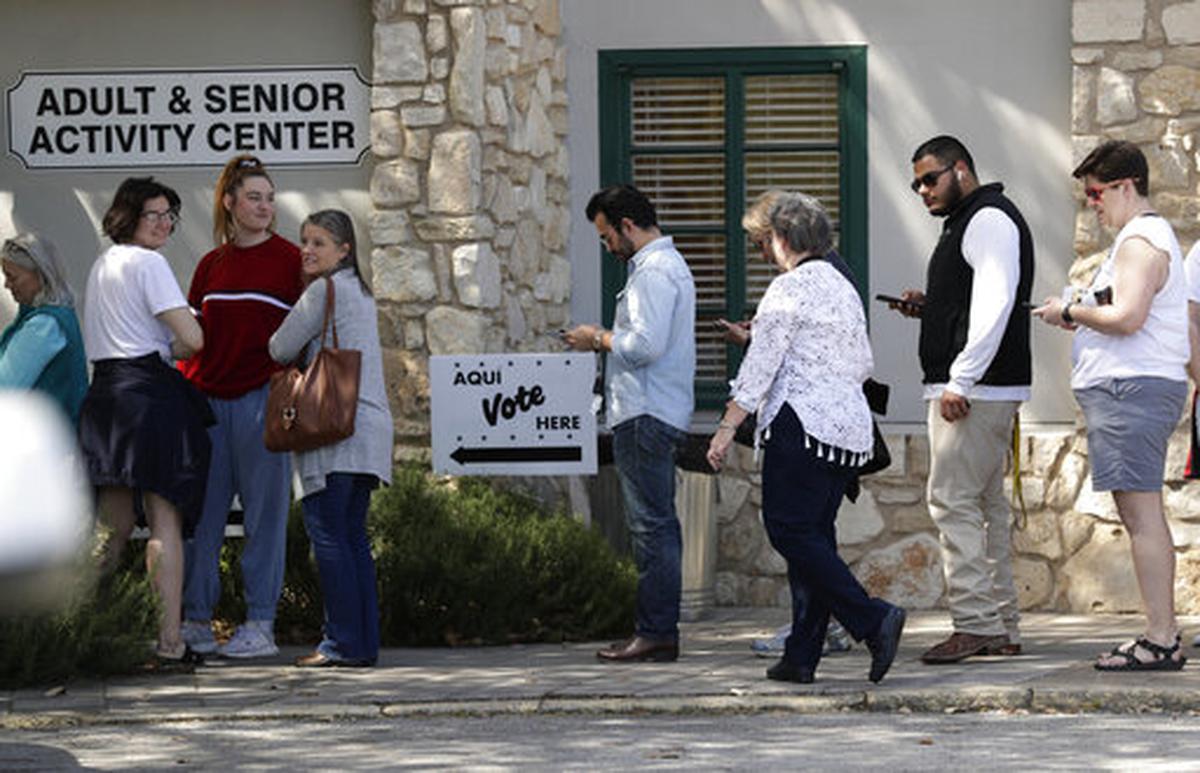
Texas Democratic Party Chair GIlberto Hinojosa said in a statement that Wednesday’s ruling forces voters to risk their health standing in line at the polls or risk prosecution for requesting a mail-in ballot.
“Leave it to the all-Republican Texas Supreme Court to put out 45 pages of opinion and give no guidance to voters about who can vote by mail during a pandemic — even after one of the Supreme Court justices under the age of 65 contracted coronavirus last week,” Hinojosa said, referring to Justice Debra Lehrmann recently tesing positive. “This is reflective of Texas Republican leadership that long ago failed to serve Texans’ needs and interests.”
Paxton has warned local officials that they could be subject to criminal sanctions if they advise voters who normally aren’t eligible to apply for mail-in ballots.
However, on the state’s form to apply for a mail-in ballot, voters are only required to check a box marking which reason they are applying under — and are not required to provide evidence to justify they meet that designation.
In a hearing before the Texas Supreme Court last week over Zoom, attorneys for the state asked the court to order local election officials to reject any mail-in ballot applications that had the “disability” box checked and any extraneous info citing COVID-19-related reasons.
But the court ruled that local election officials are not required under state law to investigate the reason why the disability box may be marked, and that ultimately, “the decision to apply to vote by mail based on a disability is the voter’s, subject to a correct understanding of the statutory definition of ‘disability.’”
What is a disability, under election law?
Texas Election Code defines a disability as “a sickness or physical condition that prevents the voter from appearing at the polling place on election day without a likelihood of needing personal assistance or of injuring the voter’s health.”
While Justices Jeffrey Boyd and Jane Bland determined that a lack of immunity to the novel coronavirus would qualify as a “physical condition,” a mail-in ballot would not be warranted because, in general, contracing COVID-19 is “highly improbable” for the population overall, the order read.
“We agree, of course, that a voter can take into consideration aspects of his health and his health history that are physical conditions in deciding whether, under the circumstances, to apply to vote by mail because of disability,” the order read. “We disagree that lack of immunity, by itself, is one of them.”
Earlier this month, The Texas Supreme Court sided with Paxton and granted an emergency stay on the 14th Court of Appeals 2-1 decision that upheld a lower court’s ruling. In April, state district Judge Tim Sulak issued a temporary injunction allowing Texans who lack immunity to the novel coronavirus to cite the disability category under state law in order to request a mail-in ballot.
A separate federal lawsuit is also pending in the courts. Last week, U.S. District Judge Fred Biery sided with the Texas Democratic Party and granted a preliminary injunction that allows Texans who seek “to vote by mail in order to avoid transmission of COVID-19” to apply for a mail-in ballot.
But Biery’s ruling was put on pause after a panel of judges from the U.S. 5th Circuit Court of Appeals in New Orleans sided with Paxton and granted an administrative stay of Biery’s ruling. The stay is temporary while the 5th Circuit weighs whether the ruling should be blocked as the state’s appeal is considered.
Gov. Greg Abbott has previously said he expects both cases to head to the U.S. Supreme Court, and when asked about Wednesday’s ruling in an interview with KTBC in Austin, he pointed to measures he’s taken like extending the early-voting period by a week for the July 14 elections. Early voting begins in a little over a month on June 29.
“In anticipation of a ruling like that, I made sure that early voting was going to be extended so that people would have extra time to vote early in ways in which they would reduce their contact with others, and hence, reduce the possibility of contracting or spreading COVID-19 during the voting process,” Abbott said.
This story was originally published May 27, 2020 at 5:59 PM.