Endangered species now thriving in India region after decades of armed conflict
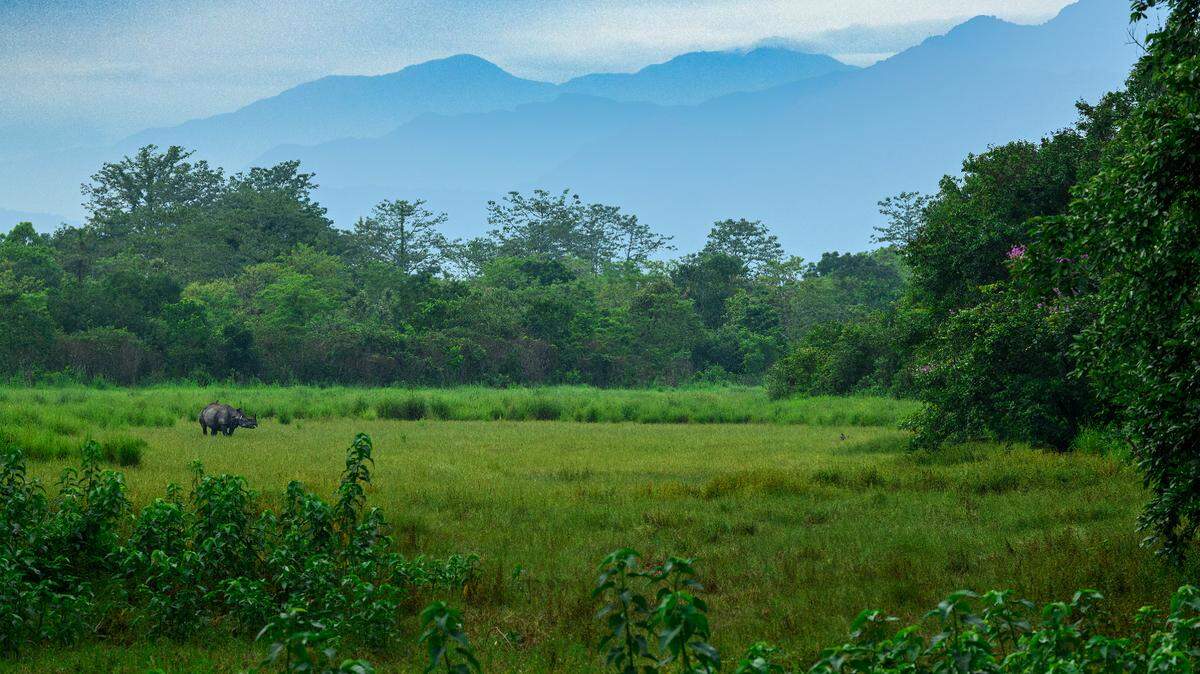
India’s Manas National Park sits at the intersection of two of the world’s most important and biodiverse ecosystems.
The Indo-Burma and Himalaya hotspots are home to many rare and endangered species found nowhere else in the world.
The park itself, home to dozens of globally threatened mammals and bird species, is also situated in a region severely impacted by decades of armed conflict and civil unrest, according to a study published June 11 in the journal Nature.
Between the late 1980s and early 2000s, the park was subjected to poaching and habitat destruction, and park personnel were targeted by “armed rebels,” all of which led to steep declines in wildlife populations, researchers said.
The greater one-horned rhino became locally extinct, eastern swamp deer were nearly driven to extinction in the region, and male elephants, or “tuskers,” were almost exterminated as a result of poaching, according to the study.
Other species, like spotted deer and wild boar, important prey for globally endangered carnivores within the park, were depleted as they were targeted for “bushmeat,” researchers said.
Two decades later, researchers now have a clearer picture of how wildlife has rebounded in the region.
Post-conflict recovery
Throughout 2022 and 2023, researchers used camera traps and field surveys called line transect distance sampling to assess “post-conflict recovery” of endangered prey and predator groups which they compared to a 2015 baseline survey of the region.
The results show Manas is now estimated to have one of the highest elephant densities in the world. Researchers also recorded high densities of wild buffalo and tiger populations, according to the study.
“Rhinoceros and swamp deer populations grew significantly,” researchers said, while populations of leopards, gaur, sambar and barking deer remained stable, indicating habitat recovery and “functionality.”
However, populations of wild pig and hog deer declined dramatically during this period, researchers said. This is likely the result of “illegal bushmeat hunting,” according to the study.
Researchers attribute the rebound of many species to the “restoration of law and order,” the advancement of monitoring tools and data collection and the implementation of forest staff.
Manas National Park is “designated as a UNESCO World Heritage Site, and also holds the status of Biosphere Reserve, Elephant Reserve, Tiger Reserve, and an Important Bird Area,” according to the study.
The park encompasses “several protected areas” in southern Bhutan and northeastern India, according to the study.
The research team included Vaibhav Chandra Mathur, Jayanta Kumar Bora, Jyotishman Deka, Deb Ranjan Laha, Keshab Gogoi, Qamar Qureshi and Ujjwal Kumar.
This story was originally published June 17, 2025 at 2:24 PM with the headline "Endangered species now thriving in India region after decades of armed conflict."