Mass graves — filled with medieval soldiers — unearthed in Hungary. See the discovery
The day was Aug. 29, 1526.
Thousands of Hungarian troops marched to the border of Mohács where they met an army led by Sülejmán the Magnificent, sultan of the Ottoman Empire.
An hour and a half later, 14,000 men were dead, Hungary’s king was killed and the medieval country fell apart.
The extent of the dark day in Hungary’s history wasn’t fully understood until archaeologist László Papp discovered a mass grave not far from the battleground in 1960, according to the Danube-Dráva National Park Directorate.
Now, a total of five mass graves are being unearthed and studied for the first time.
“The goal is to ensure that the heroic soldiers receive their final honors in a dignified manner half a millennium after the battle, and to present one of the most important, fate-turning historical events of Hungarian history to visitors in a new, interactive exhibition,” Gábor Bertók, director of the Janus Pannonius Museum, which is working on the project, told Hungary Today.
Researchers have started on two of the five graves, the first of which revealed more than 300 skeletons, mostly from young men, Bertók told the outlet.
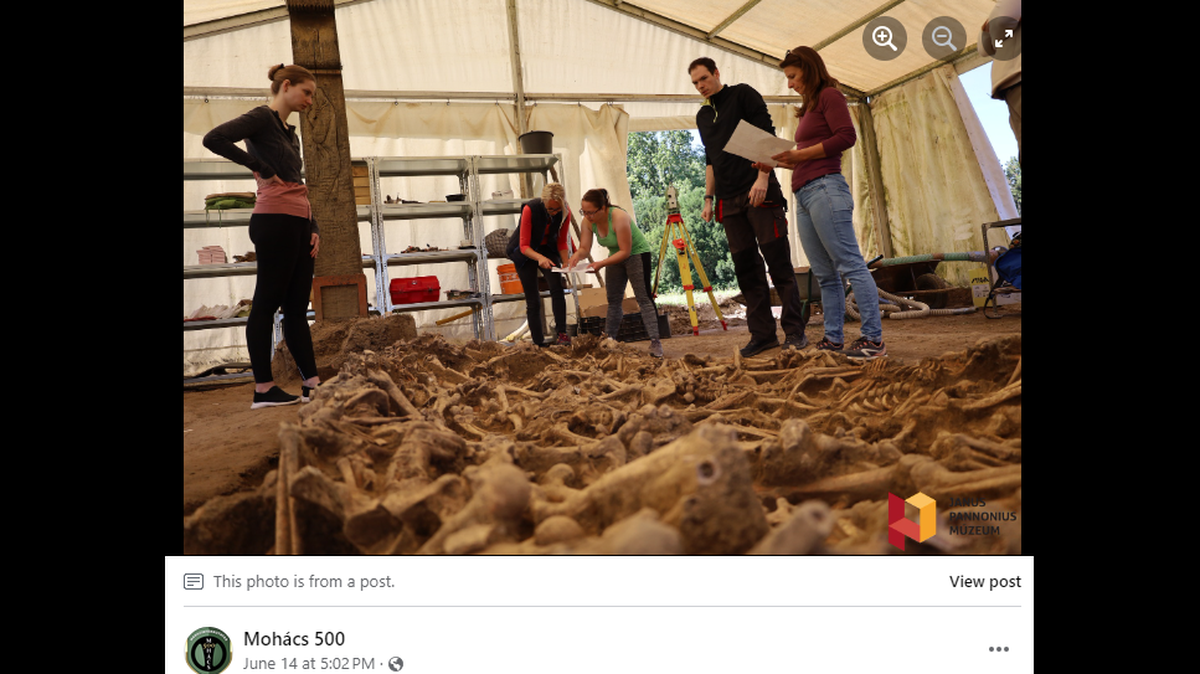
Excavations on the second grave, No. 4, began earlier this month, according to a June 18 Facebook post from the Janus Pannonius Museum.
The site has been covered since 1976, according to a June 14 Facebook post from the Mohács National Memorial, but after a few days of demolition, the grave was exposed again for the first time in 48 years.
In just a few weeks, teams have made significant progress, the museum said.
“Twelve skeletons have so far been excavated and 63 numbered, but it is estimated that more than 150 skeletons will be recovered in total,” Réka Neményi, head of the Janus Pannonius Museum’s archaeology department, told Hungary Today.
György Pálfi, head of the anthropology department at the University of Szeged, told the news outlet the bodies had been thrown haphazardly into the ground. Pálfi also noted that of the first bodies exhumed from the grave, 10 of them had cuts and injuries that are associated with executions and not injuries they would have gotten during battle.
In grave three, which was already studied, there were also bodies of a few older men, women and children, Pálfi told Hungary Today, suggesting members of the Ottoman army may have taken prisoners and executed them with the soldiers during the Battle of Mohács.
Multiple scientific studies have been published so far explaining the findings inside the graves, and research will continue as archaeologists piece the skeletons together, one at a time, officials said.
Mohács is in southern Hungary, near the border with modern-day Croatia and Serbia.
This story was originally published July 1, 2024 at 8:00 AM with the headline "Mass graves — filled with medieval soldiers — unearthed in Hungary. See the discovery."