
Snowflakes on Mars are cube shaped and geysers erupt as ice thaws in spring, NASA says
Winter on Earth can be brutal, but NASA has discovered the season is two years long on Mars, with minus 190-degree Fahrenheit lows and cube-shaped snowflakes.
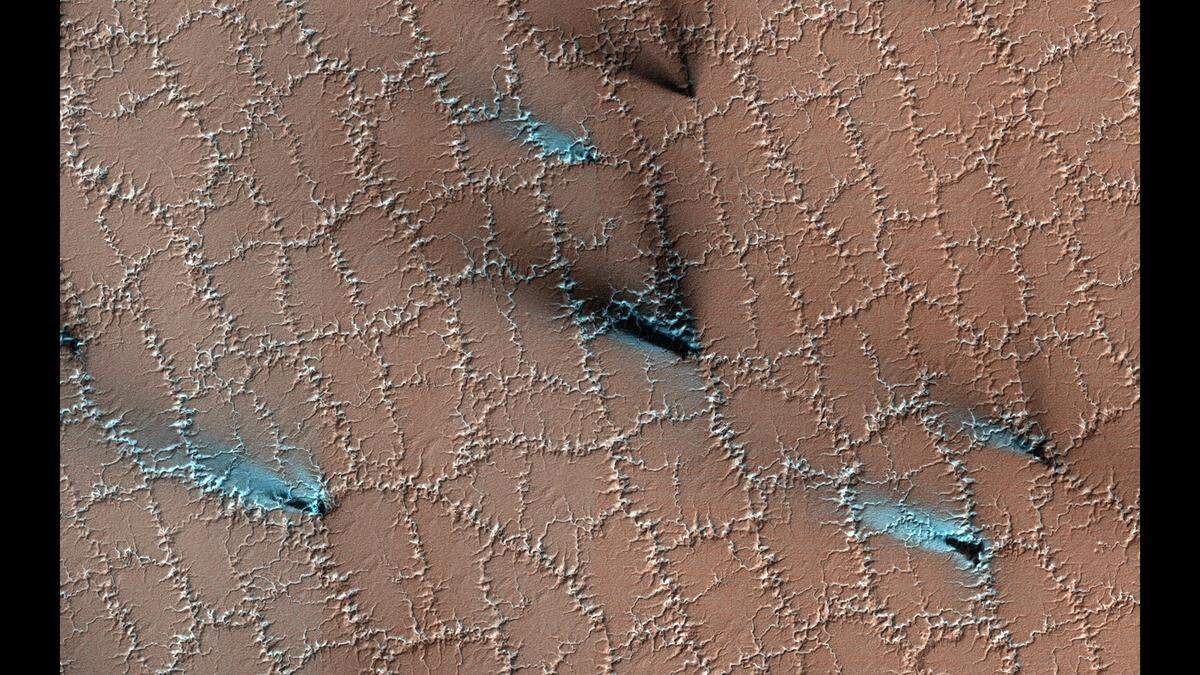
Crazier still: When spring finally comes, thawing ice explodes in geysers, according to a report released Dec. 22.
“When winter comes to Mars, the surface is transformed into a truly otherworldly holiday scene,” NASA scientists say.
“Snow comes in two varieties: water ice and carbon dioxide, or dry ice. Because Martian air is so thin and the temperatures so cold, water-ice snow sublimates, or becomes a gas, before it even touches the ground. Dry-ice snow actually does reach the ground.”
Instead of the six-sided flakes like Earth, Mars gets cubes falling from the sky. This is due to the way ice crystals form when carbon dioxide freezes, NASA says.
These flakes are “smaller than the width of a human hair,” which means even the biggest of snow drifts are seldom more than a few feet tall.
“Perhaps the most fabulous discovery comes at the end of winter, when all the ice that built up begins to ‘thaw’,” NASA says.
“As it does so, this ice takes on bizarre and beautiful shapes that have reminded scientists of spiders, dalmatian spots, fried eggs and Swiss cheese.”
This thawing also causes geysers. These jets are created when sunlight penetrates the “translucent ice,” heating the gas underneath, NASA says. The gas eventually bursts out, creating “fans of dust” that drift on the Martian winds.
It was in 2015 that NASA’s Mars Reconnaissance Orbiter found evidence “liquid water flows intermittently on present-day Mars,” according to a news release. Scientists believe much of the water on Mars evaporated between 2 billion to 2.5 billion years ago “as the planet’s atmosphere thinned over time.”
This story was originally published December 26, 2022 at 9:11 AM with the headline "Snowflakes on Mars are cube shaped and geysers erupt as ice thaws in spring, NASA says."