Man’s body ID’d 25 years after being found by woman walking dog, CO cops say
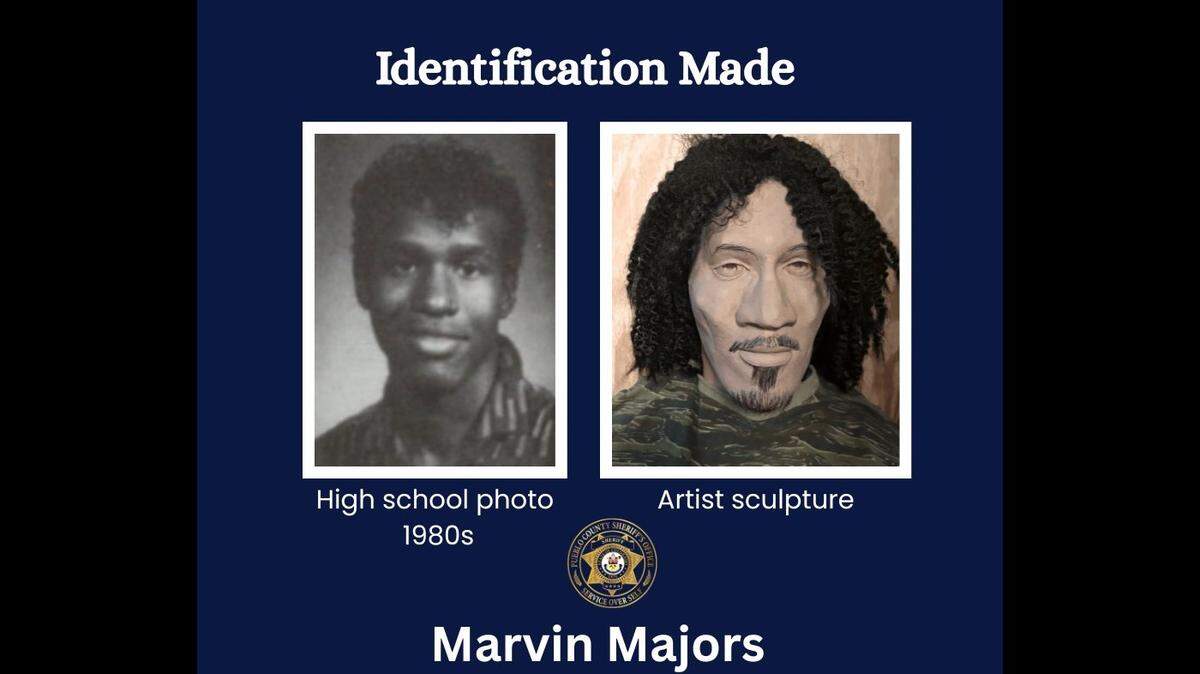
Nearly 25 years after a woman walking her dog found a man’s body in a field, the remains were identified, Colorado deputies said.
With help from DNA testing, the man was identified as Marvin Majors, who was 34 at the time of his death, the Pueblo County Sheriff’s Office said in a June 26 news release.
“Through modern science and teamwork, our detectives were able to get the breakthrough they needed to identify this person,” Sheriff David J. Lucero said in the release.
Body found in field
As a woman was walking her dog in November 2000, she stumbled upon a man’s body “in a field just north of the Pueblo city limits,” deputies said.
“The body, which was mostly skeletal remains, did not have any identification,” deputies said.
Though the Pueblo County Coroner’s Office could not determine the man’s cause of death from an autopsy, “foul play was not suspected,” deputies said.
An anthropologist assessed the remains and determined the man, who “had thick black hair that was in dreadlocks,” was 35 to 50 years old and stood between 6 foot, 1 inch to 6 foot 3 inches tall, according to deputies.
Despite deputies’ monthslong efforts to identify the man, his name remained a mystery.
‘Leads and tips dwindled’
A year after his body was found, a University of Colorado sculptor used the man’s skull to make a facial reconstruction in the form of a clay bust
Photos of the bust were provided to the media and public, as well as shared across missing persons websites.
However, deputies said “only a few leads came in.”
One tip pointed deputies to a rancher who said the man was “someone who had been camping on his property in August 2000” and “told him he was traveling from New Mexico to Denver,” according to deputies.
The remains were found near the rancher’s property, deputies said.
Soon, though, “leads and tips dwindled,” deputies said.
Investigators revisit case
Then, in June 2021, investigators revisited the case and learned the FBI had created a DNA profile for the man, deputies said.
His profile had been updated to a “combined national DNA database,” according to deputies.
After getting a new DNA sample from evidence taken from the campsite in 2000, deputies said with help from the Colorado Bureau of Investigation they submitted it “to a genetic genealogy database in 2023.”
Genetic genealogy uses DNA testing coupled with “traditional genealogical methods” to create “family history profiles,” according to the Library of Congress. With genealogical DNA testing, researchers can determine if and how people are biologically related.
In November, a DNA match was found with a distant relative of Majors, deputies said.
A possible sibling then gave detectives a DNA sample, which was compared to that of the unknown man, confirming his identity as Majors, deputies said.
“This was somebody’s family member, and our team went above and beyond to identify him and to bring some closure to his family,” Lucero said.
Majors was from Oklahoma and “grew up in Los Angeles,” family told deputies.
He “lived a transient lifestyle,” his family told deputies.
Majors’ family had not heard from him since the late 1990s “and wondered what had happened to him,” deputies said.
Pueblo is about a 110-mile drive south from Denver.
This story was originally published June 27, 2025 at 1:48 PM with the headline "Man’s body ID’d 25 years after being found by woman walking dog, CO cops say."