
White shark’s trek deep into mid-Atlantic proves to be computer glitch, experts say
One great white shark’s impressive trek into the mid-Atlantic has proved to be a false alarm, according to the shark researchers at OCEARCH.
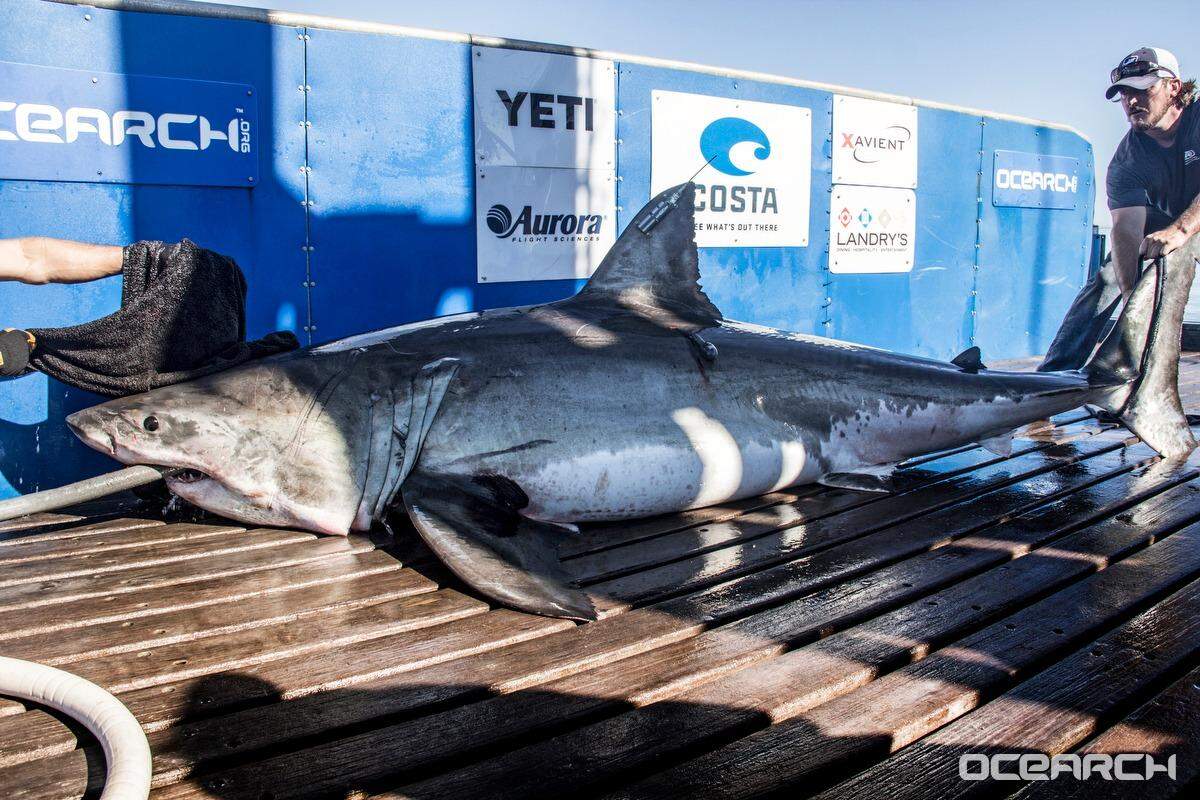
The shark, named Miss Costa, was believed to be about “300 nautical miles from the Mid-Atlantic Ridge,” the nonprofit reported in a March 31 Facebook post.
However, that came into question when a second satellite “ping” echoed from 1,280 nautical miles in the other direction.
“On March 31 Miss Costa came to the surface and her tag transmitted a ping, but due to an error in the algorithm during the reinitialization process, the tracker had Miss Costa at the wrong location,” OCEARCH reports.
“Over the weekend Miss Costa spent time at the surface again, allowing her tag time to reinitialize and transmit a new and more accurate location. Miss Costa is currently about 70 nautical miles off Cape Hatteras, off the continental shelf.”
The data discrepancy was a first for the agency, and a disappointment to biologists who suspected Miss Costa may have mated off the Outer Banks and was moving into the mid-Atlantic as part of a post-mating ritual.
“Movement far into the North Atlantic is consistent with our hypothesis that mature male and female white sharks gather off the Carolinas and nearby areas during late winter and early spring to mate,” OCEARCH reported.
“Once mating has occurred, our hypothesis is that the pregnant female sharks then make offshore runs towards the Mid-Atlantic Ridge while their young are gestating. We’ve seen three other of our large, mature females make these offshore runs during this time frame.”
One possible explanation for why females flee the cost is a desire to escape large, aggressive males that are prone to bite during mating, experts say.
“Mating is a rough process for white sharks and once a female has gone through this and is pregnant, she likely wants to avoid being harassed by other males,” OCEARCH says.
OCEARCH has an expedition scheduled April 17 through May 4 off North Carolina to explore the link between the Outer Banks and shark mating. Hormone data collected from mature white sharks may “confirm if this region is a white shark mating site,” officials said.
Miss Costa’s satellite tracker was attached in 2016, and should have run out of battery a year ago, experts say.
She weighed just over 1,000 pounds and was 12 feet, 5 inches when tagged, data shows. It’s estimated she could “be between 14 and 15 feet long today,” OCEARCH says.
This story was originally published April 3, 2023 at 7:34 AM with the headline "White shark’s trek deep into mid-Atlantic proves to be computer glitch, experts say."